Where Saskatchewan’s Mule Deer Live
Many hunters dream of chasing big game across wide-open spaces, but finding those elusive mule deer in Saskatchewan can sometimes feel like trying to find a needle in a haystack. This guide is here to unravel the mysteries of mule deer habitat in the province, offering a deep dive into where these magnificent animals live, how they use the landscape, and the best ways to locate them for your next hunting adventure.
Understanding Saskatchewan's Mule Deer Habitat Preferences
Saskatchewan might be famous for its whitetails, but for those who know where to look, it offers incredible opportunities for mule deer. These fascinating creatures have very distinct preferences when it comes to where they make their homes, often gravitating to landscapes that offer a unique blend of cover, forage, and water. It's not just about vast expanses; it's about the subtle nuances of the terrain that provide them with everything they need to thrive.
The Allure of the Prairie Coulees
When you think of mule deer in Saskatchewan, the first image that often comes to mind for experienced hunters is the intricate network of prairie coulees. These natural depressions, often carved by ancient glacial meltwaters or erosion, are true havens in what might otherwise appear as endless flatland. They're much more than just ditches; they're vital arteries of life for mule deer. These coulees provide immediate, crucial shelter from the elements, whether it's the biting cold winds of winter or the scorching sun of a summer day. The deep cuts in the landscape offer thermal cover that allows deer to conserve energy and stay comfortable.
Beyond mere shelter, coulees are ecological hotspots. They typically retain more moisture than the surrounding prairie, which means lusher vegetation. You'll often find a mix of taller grasses, brush, and even small trees like willow or saskatoon berry bushes clinging to the slopes and bottoms. This dense vegetation provides not only excellent hiding cover but also a diverse and abundant food source. Mule deer are browsers as much as grazers, so this variety is incredibly important to their diet. They'll browse on woody shrubs, forbs, and succulent plants that flourish in these protected microclimates. Water sources, whether seasonal puddles or more permanent springs, are also frequently found within or near coulee systems, making them truly self-sufficient ecosystems for a resident deer population. When you're Hunting Mule Deer in Prairie Coulees, understanding these features is paramount.
Blending into the Grasslands and Rolling Hills
While coulees are critical, mule deer aren't exclusively confined to them. They are creatures of the open prairie, readily utilizing the expansive grasslands and gently rolling hills that characterize much of southern Saskatchewan. These areas serve as crucial foraging grounds, especially during periods when visibility and security aren't as pressing. Mule deer will often feed on the higher ground, particularly at dawn and dusk, taking advantage of the nutritious prairie grasses and forbs that carpet these landscapes. They’re constantly on the move, grazing selectively on various plants throughout the day.
The rolling topography provides subtle undulations that mule deer use to their advantage for both feeding and travel. They'll crest a rise, scan the horizon, and then dip into a shallow depression for cover as they move between feeding areas and bedding sites. This natural camouflage allows them to virtually disappear in seemingly open country. These higher, drier areas are also crucial for spotting danger, and mule deer's keen eyesight, combined with their tendency to "pronk" or stiff-legged jump when alarmed, are perfectly adapted to these surroundings. Hunters often find themselves Glassing a Saskatchewan Coulee for Mule Deer from a distance, patiently waiting for deer to move out into these feeding grounds.
Seeking Refuge in the Cypress Hills
Now, if you're picturing Saskatchewan as entirely flat, the Cypress Hills Interprovincial Park region is here to prove you wrong. This unique geographical anomaly in the southwest corner of the province stands as an elevated plateau, untouched by the last glaciation, boasting a completely different habitat structure than the surrounding prairie. Here, you'll find true forests – lodgepole pine, white spruce, and aspen stands – a dramatic departure from the short-grass prairie. This coniferous and mixedwood forest offers mule deer an entirely different kind of refuge.
In the Cypress Hills, mule deer utilize the dense timber for bedding and security cover, especially during the harsh winter months. The deep snow can be challenging, but the forest provides thermal protection and can offer browse from coniferous trees or sheltered deciduous shrubs. The numerous springs and small creeks that originate in the hills provide consistent water sources, a valuable commodity in an otherwise arid region. The open meadows and clearings interspersed within the forest serve as prime feeding areas, much like the grasslands, but with the added security of nearby timber. This diverse terrain allows for varied hunting tactics, from still-hunting the timber edges to glassing the open pockets. The presence of true forest cover makes for a stark contrast to hunting in the wide-open prairie.
Key Regions and Wildlife Management Zones for Mule Deer
Saskatchewan is a big province, and while mule deer can be found in various pockets, some areas consistently stand out as prime hunting grounds. Understanding these regions and the specific Wildlife Management Zones (WMZs) within them is crucial for planning a successful hunt. The population dynamics and habitat quality vary significantly across the province, so focusing your efforts where these animals truly thrive makes all the difference.
Southwest Saskatchewan: The Mule Deer Stronghold
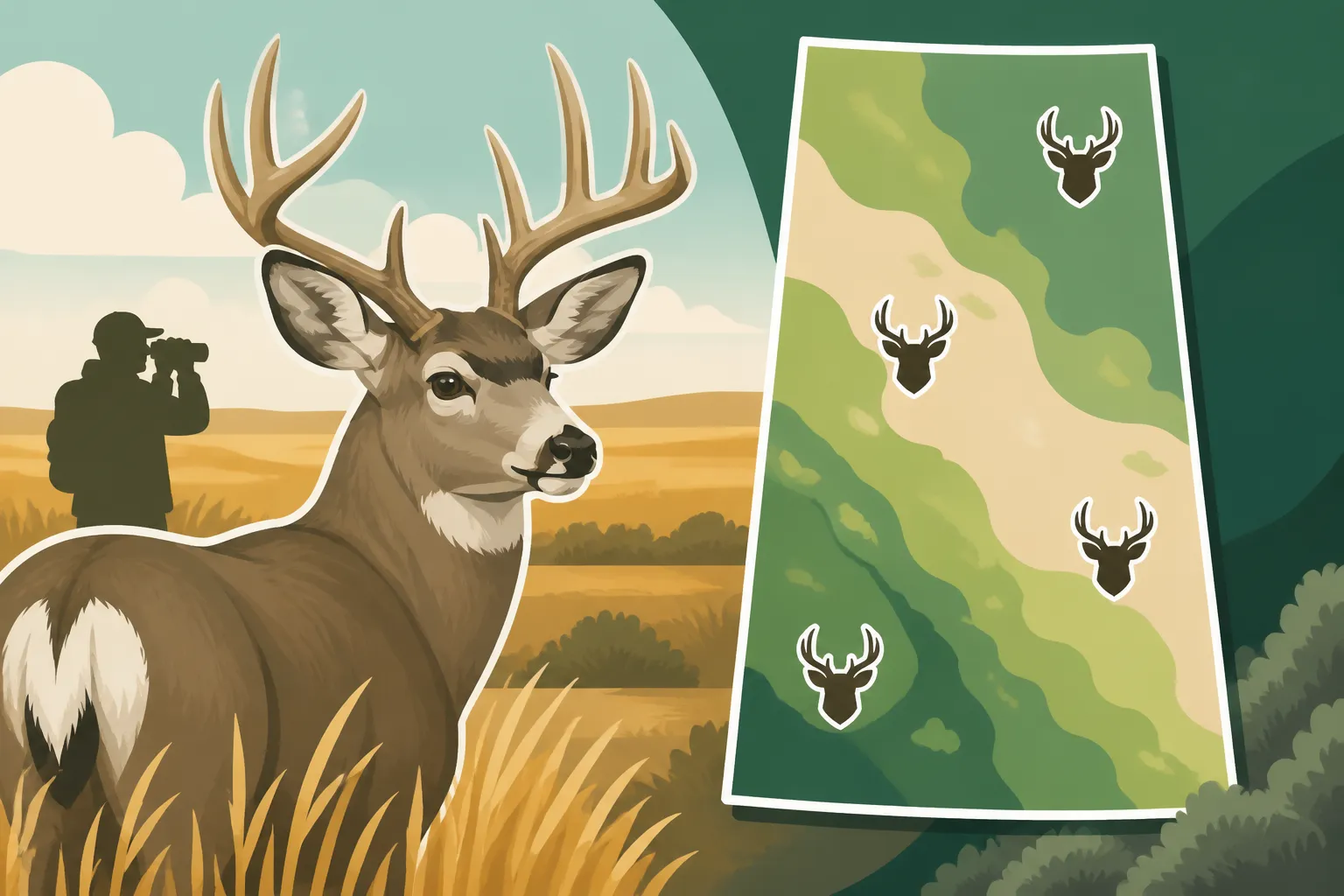
Without a doubt, southwest Saskatchewan is the undisputed heartland for mule deer in the province. This region, characterized by its arid climate, rolling prairie, and extensive coulee systems, provides the ideal environment for these animals. WMZs like 1, 2, 3, 4, 7, 8, and 9 are consistently among the top contenders for healthy mule deer populations and impressive trophy potential. These zones benefit from large tracts of unbroken native grassland, extensive coulee networks, and less intensive agricultural pressure in some areas compared to the more fertile central parts of the province. This is where you'll find some of the most consistent mule deer numbers and where the potential for a truly memorable hunt is highest.
The proximity to Grasslands National Park, while not huntable itself, plays a vital role in providing a large sanctuary that helps sustain populations in adjacent areas. The landscape here is often rugged and challenging to navigate, requiring physical exertion and good glassing skills, but it's precisely this remoteness and cover that allows mule deer to reach maturity. Hunters often describe this area as truly wild, offering an experience reminiscent of what North America might have looked like a century ago. It’s also important to note that many landowners in this region are accustomed to hunters and often understand the value of a well-managed deer population. These are the areas often highlighted by hunting intelligence platforms like GoHunt for their strong mule deer data.
The Great Sand Hills and Missouri Coteau
Beyond the immediate southwest, two other distinct geographical features hold significant mule deer populations: the Great Sand Hills and the Missouri Coteau. The Great Sand Hills, a vast area of active sand dunes, native grasslands, and interspersed wetlands, offers a truly unique habitat. While challenging to access and navigate due to its soft sandy terrain, it provides incredible cover and food sources for mule deer. The dunes themselves, stabilized by grasses and shrubs, offer excellent bedding areas, and the varied vegetation within this ecosystem supports a healthy population. It's an area that truly rewards those willing to put in the effort to explore its remote corners.
The Missouri Coteau, a band of rugged, hilly terrain stretching across south-central Saskatchewan, is another important region. Formed by glacial activity, this area features a complex mosaic of rolling hills, deep coulees, and wetlands. The broken topography and diverse vegetation offer excellent mule deer habitat, providing ample cover and varied forage. While not as concentrated as the far southwest, the Coteau holds healthy pockets of mule deer, often coexisting with whitetails. These areas require thorough scouting and often benefit from a different approach than the wider, more open prairie. Understanding these unique topographies is key to Hunting Saskatchewan's Southern Prairie effectively.
Expanding Range and Lesser-Known Pockets
While the southwest remains the prime territory, there's anecdotal evidence and some research suggesting that mule deer populations might be expanding their range, or at least showing up more frequently, in areas further north and east. This could be due to a combination of factors, including population dynamics, habitat changes, and even climate shifts. These "fringe" areas might not hold the densities found in the traditional strongholds, but they can offer exciting opportunities for diligent hunters willing to explore.
For instance, certain zones within the Aspen Parkland transition zone, where the prairie meets the boreal forest, might occasionally see mule deer. These deer often utilize the bluffs and river valleys that cut through this landscape, adapting to a slightly different vegetative composition. While rare, a savvy hunter might even encounter one in a northern forest fringe area, though these are typically transient animals. The key in these lesser-known pockets is extensive scouting, often utilizing trail cameras and a deep understanding of local micro-habitats. Hunters looking into these areas might consult information on Why Mule Deer Numbers Rise and Fall to better understand the variables at play.
Seasonal Movements and Habitat Shifts
Mule deer aren't static residents; their use of the landscape is dynamic, shifting significantly throughout the year in response to food availability, weather patterns, and breeding cycles. Understanding these seasonal movements is crucial for any hunter hoping to intercept these intelligent animals. What works in September might not work in November, and ignoring these natural rhythms can lead to a frustrating experience.
Summer Grazing and Fawning Grounds
As the snow melts and the Saskatchewan prairie bursts into vibrant green, mule deer scatter across the landscape. During the summer months, their primary focus is on foraging and, for does, fawning. Pregnant does will seek out secluded areas with ample cover to give birth to their fawns, typically in late May or early June. These fawning grounds are often characterized by dense stands of grass or brush within coulees or secluded bluffs, offering protection from predators and the elements. These areas provide the fawns with a safe place to hide while the does feed nearby.
Throughout the summer, both bucks and does will spread out across the grasslands and agricultural fields (where available), taking advantage of the abundant and nutritious forage. They're often seen in smaller groups or as solitary animals, particularly the mature bucks who are busy building their antler mass. Water sources become critical during the hot summer, so deer will often be found within a reasonable distance of sloughs, dugouts, or springs. They might not be as concentrated as during other seasons, making them harder to pattern, but understanding that their primary drive is feeding and security for young is key.
Fall Patterns and Pre-Rut Staging Areas
As the long days of summer shorten and the first crisp hints of autumn arrive, mule deer patterns begin to shift. Their metabolism ramps up as they prepare for the colder months and the rigors of the rut. In early fall, leading up to the hunting season, you'll often see larger bachelor groups of bucks forming. They'll spend a lot of time in feeding areas, often on the edges of agricultural fields or rich native grasslands, trying to put on as much fat as possible.
As the pre-rut approaches in October and early November, bucks become more active, sparring and establishing dominance. They start to move more widely, checking scrapes and looking for does. During this time, areas that provide good visibility combined with quick access to cover become prime real estate. Think about the edges of extensive coulee systems, brushy draws, or bluffs that overlook prime feeding grounds. These are the "staging areas" where bucks will frequent, scent-checking for does and challenging rivals. Knowing that the rut is just around the corner, bucks become more visible and less cautious, making this an exciting time to be afield. Hunters hoping to be successful might want to read more about Hunting the November Rut.
Wintering in the Deep Snow
Saskatchewan winters are legendary for their harshness, and mule deer have evolved specific strategies to survive. As temperatures plummet and snow accumulates, mule deer will concentrate in areas that offer critical thermal cover and accessible food. Deep, unbroken coulee systems with dense brush, shelterbelts, and isolated patches of timber become their life rafts. These areas provide protection from the relentless prairie winds and can trap heat, creating microclimates that are several degrees warmer than the exposed prairie.
Food sources shift in winter, with deer relying more heavily on woody browse, dried forbs, and any available agricultural residuals like standing corn or pea stubble. Movement is conserved to the absolute minimum necessary for survival. You'll often find deer "yarded up" in traditional wintering areas, where they'll create a network of trails through the snow. Identifying these winter range areas is crucial, but ethical hunters must remember that deer are highly vulnerable during this time, and minimizing disturbance is paramount. It’s also wise to prepare for Hunting Saskatchewan Winter Weather Safely to endure the conditions you might face while pursuing game in the deep cold.
Scouting and Locating Mule Deer in Saskatchewan
Successfully hunting mule deer in Saskatchewan isn't just about finding the right WMZ; it's about meticulous scouting and understanding how to read the landscape. These animals are masters of their environment, and it takes a keen eye and strategic approach to locate them, especially in the vastness of the prairie.
Utilizing Topographical Maps and Satellite Imagery
In today's hunting world, digital tools have revolutionized scouting. Before you even step foot in the field, you should be spending significant time studying topographical maps and satellite imagery. Platforms like GoHunt, onX Hunt, or even Google Earth allow you to virtually explore vast stretches of country from the comfort of your home. You're looking for key features that mule deer rely on: deep coulees, river breaks, isolated bluffs, and shelterbelts. These are the arteries of mule deer movement and security. Identify pinch points where coulees narrow or converge, or areas where different types of cover meet.
Focus on changes in elevation and vegetation. Darker green areas on satellite imagery often indicate denser cover, while lighter shades might be open prairie or agricultural fields. Look for areas that offer a combination of these elements: good feeding areas adjacent to thick cover. Also, pay attention to water sources – sloughs, dugouts, or stock ponds – as deer will always need access to water. Marking potential bedding areas, travel corridors, and feeding zones on your digital map will give you a significant head start. Don't underestimate the power of Scouting With Satellite Imagery in Saskatchewan to narrow down promising areas.
Reading Sign on the Ground
Once you've done your digital homework, it's time to hit the dirt and look for actual sign. Mule deer sign is distinct from whitetail sign, though they can sometimes overlap. Mule deer tracks are generally larger and more rounded than whitetail tracks. Their stride is also typically longer. Look for their distinct "bounding" or "pronking" gait in snow or mud, where all four hooves often land in a cluster. Scat (droppings) will also be generally larger than whitetail droppings, often in distinct piles.
Beyond tracks and scat, keep an eye out for rubs and scrapes. Mule deer rubs are typically higher on smaller diameter trees or shrubs compared to whitetails, reflecting their preference for browsing and their tendency to stand taller. While they do make scrapes, they are generally not as elaborate or consistently used as those made by whitetails. Look for fresh beds on ridge tops overlooking coulees or in dense brush within coulee bottoms – areas that offer both security and a vantage point. The fresher the sign, the closer you are to a resident deer. Learning to distinguish between the two species is also important, so researching Telling a Whitetail From a Mule Deer can be very helpful.
Glassing Techniques for Open Country
Mule deer hunting in Saskatchewan is often a game of patience and optics. Because they frequent open country, effective glassing is paramount. A good pair of binoculars (10×42 or 12×50) and a spotting scope (20-60x) mounted on a sturdy tripod are essential tools. Find a high vantage point that offers a panoramic view of the landscape – a hilltop, a bluff edge, or even the roof of your truck (where legal and safe). Settle in, get comfortable, and grid search the landscape methodically.
Don't just scan; pick apart the details. Look for subtle movements, horizontal lines that break up the vertical vegetation, or patches of color that seem out of place. Mule deer are incredibly camouflaged, so you're often looking for pieces of a deer – an ear, a patch of hide, or the tell-tale glint of an antler. The best times for glassing are early morning and late evening when deer are most active. Overcast days or periods just after a rain can also be productive, as deer often move more freely during these times. Patience is the greatest virtue here; many a mule deer has been spotted after an hour or more of diligent glassing. When you find one, the real work of Stalking Mule Deer in Open Prairie begins.
Conservation and Management of Saskatchewan's Mule Deer
The majestic mule deer is a cherished game animal in Saskatchewan, and its continued presence and health are important to hunters and wildlife enthusiasts alike. However, like all wildlife populations, mule deer face a range of challenges, and ongoing conservation and management efforts are critical to ensuring their future. Understanding these dynamics offers a broader perspective on hunting them ethically and responsibly.
Population Trends and Challenges
Saskatchewan's mule deer populations, while generally healthy in their core range, are not immune to fluctuations. Several factors contribute to the rise and fall of their numbers. Harsh winters with deep snow and prolonged cold snaps can lead to significant winter kill, especially among fawns and older animals. Conversely, mild winters allow more deer to survive, leading to population increases. Drought conditions can impact forage quality and water availability, stressing deer and potentially reducing reproductive success. Disease, particularly Chronic Wasting Disease (CWD), is another serious concern. CWD has been detected in mule deer in Saskatchewan, and while its long-term impact on overall populations is still being studied, it is a persistent challenge that requires ongoing monitoring and management, which is why Saskatchewan's CWD Testing Rules are so important.
Habitat loss and fragmentation, primarily due to agricultural expansion and human development, also pose threats to mule deer. While they can adapt to some changes, large-scale alteration of native grasslands and coulee systems reduces the quality and quantity of suitable habitat. Predation, from coyotes and occasionally wolves, can also impact fawn survival, though this is typically less of a limiting factor than environmental conditions. Wildlife management agencies continuously monitor mule deer populations through aerial surveys, hunter harvest data, and disease surveillance to inform management decisions and set appropriate hunting quotas.
The Role of Habitat Preservation
At the core of mule deer conservation is the preservation and enhancement of their natural habitat. Native grasslands, with their complex ecosystems of grasses, forbs, and shrubs, are invaluable. These areas provide food, cover, and fawning grounds that are irreplaceable. Efforts to maintain and restore native prairie are crucial for the long-term health of mule deer. This includes responsible grazing practices on rangelands that mimic natural disturbances, and preventing the conversion of native prairie to agricultural land.
Coulee systems, as we've discussed, are ecological lifelines. Protecting these riparian areas from excessive disturbance, preventing overgrazing of their banks, and maintaining the diverse vegetation within them is paramount. Shelterbelts and strategically planted tree rows can also provide important winter cover in more agricultural landscapes, acting as vital corridors and sanctuaries for deer. Organizations like the Saskatchewan Wildlife Federation play a significant role in advocating for habitat preservation and engaging landowners in conservation efforts. Hunters also contribute through their licence fees, which directly fund wildlife management and habitat initiatives. Ensuring that mule deer have ample, high-quality places to live is the best way to ensure strong populations for future generations to appreciate and hunt.
Comparing Key Mule Deer Regions
To give you a clearer picture of where to focus your efforts, here’s a quick comparison of the primary mule deer regions in Saskatchewan.
| Feature | Southwest Saskatchewan (e.g., WMZ 1-9) | Great Sand Hills | Missouri Coteau | Cypress Hills |
|---|---|---|---|---|
| Terrain | Rolling prairie, extensive coulees | Sand dunes, native grass, wetlands | Hilly, broken, mixed vegetation | Forested plateau, open meadows |
| Primary Cover | Coulees, deep draws, native grass | Dunes, thick brush | Hills, coulees, some bush | Coniferous/mixed forest |
| Forage | Native grasses, forbs, browse | Varied grasses, shrubs | Mixed prairie/parkland forage | Forest browse, meadow grasses |
| Water Sources | Dugouts, sloughs, springs | Wetlands, springs | Sloughs, creeks | Springs, creeks |
| Access | Often private land, some Crown | Challenging, sandy roads | Mixed private/Crown | Mixed, parkland areas |
| Mule Deer Density | High | Moderate to High | Moderate | Moderate |
| Hunting Style | Spot-and-stalk, glassing | Walk-in, spot-and-stalk | Spot-and-stalk, still-hunting | Spot-and-stalk, still-hunting |
Disclaimer
The information provided in this guide is for general informational purposes only and is subject to change. Hunting regulations, season dates, and zone boundaries can vary yearly. Always consult the official Saskatchewan Hunters' and Trappers' Guide published by the Ministry of Environment before planning any hunting trip. It is the hunter's responsibility to know and follow all applicable laws and regulations.