Glassing a Saskatchewan Coulee for Mule Deer
Finding mule deer in Saskatchewan's vast, often subtle coulee country can feel like searching for a needle in a haystack. The sheer scale of the landscape, coupled with the mule deer's uncanny ability to blend into their surroundings, frustrates countless hunters year after year. This guide is designed to equip you with the knowledge and tactics needed to effectively glass these challenging terrains, revealing hidden deer and boosting your success.
Understanding Saskatchewan Coulees and Mule Deer Behavior
Saskatchewan's landscape, particularly in the southern and western regions, is often characterized by expansive prairies, but it's the hidden coulees that truly define mule deer habitat here. These geological features are natural sanctuaries, offering everything a mule deer needs to thrive and evade detection.
The Anatomy of a Saskatchewan Coulee
Imagine a deep, winding crease in the prairie, carved over millennia by water and wind. That's a coulee. They vary dramatically in size and depth, from shallow depressions that barely conceal a full-grown whitetail to immense, canyon-like systems that stretch for miles. What makes them so critical for mule deer is their complex structure. You'll find steep, grass-covered slopes, often dotted with brush like willow, chokecherry, or even small aspens. The bottoms might hold seasonal water, thicker stands of brush, or even small pockets of timber. Many coulees also feature benches or shelves along their sides – flat, terraced areas that provide excellent bedding sites with commanding views. These features are why places like the Qu'Appelle Valley Slopes are renowned for holding significant game.
Mule deer rely on coulees for several vital reasons. Firstly, they offer unparalleled thermal cover, providing shelter from blistering summer sun and biting winter winds. Secondly, the diverse vegetation within and along the edges of coulees provides a year-round food source, from various grasses and forbs in spring and summer to woody browse in fall and winter. Lastly, and perhaps most importantly for hunters, coulees serve as natural travel corridors and security zones. A mule deer can disappear into a coulee in a blink, navigating its twists and turns to avoid perceived threats. Understanding this topography is the first step in unlocking their secrets.
Mule Deer Movement Patterns in Coulee Country
Mule deer are creatures of habit, but their habits are deeply influenced by the terrain and time of day. In coulee country, their movement patterns revolve around safety, food, and water. During daylight hours, especially after sunrise and well before sunset, mule deer will often be seen moving between bedding areas and feeding grounds. These bedding areas are almost always chosen for their vantage point and security – a bench on a coulee side where they can see danger approaching from multiple directions, or a thick stand of brush that offers concealment. You'll often find mule deer beds high on a coulee wall, or tucked into a small draw leading off the main coulee.
Their feeding activity tends to peak in the low light hours of dawn and dusk, when they'll emerge from the security of the coulee to graze on the adjacent prairie, or browse more openly within the coulee bottom itself. Watering sources, whether a dugout, a spring, or a seasonal puddle, are also key points of movement. They might use the coulee system as a highway to reach these sources, often making multiple stops along the way. During the rut, these patterns can become more erratic as bucks actively search for does, often covering significant ground and making themselves more visible. Knowing where Saskatchewan's mule deer live and how they use these features is paramount, as discussed in detail in our guide to Hunting Mule Deer in Prairie Coulees.
The Art and Science of Glassing for Mule Deer
Glassing is more than just looking through a pair of binoculars; it's a patient, systematic process of dissecting the landscape to find what’s hidden. It requires the right tools and a disciplined approach.
Essential Optics and Gear for Effective Glassing
To truly excel at glassing for mule deer in Saskatchewan's vast coulee country, you need to invest in quality optics and know how to use them. Your primary tool will be a good pair of binoculars. For general scanning, 10x or 12x magnification is usually ideal, offering a wide field of view while still providing enough power to resolve details. For picking apart distant coulee walls or identifying antlers at extreme range, a pair of 15x binoculars, often referred to as "big eyes," mounted on a tripod, becomes indispensable. These higher-power binoculars gather more light, making them excellent in low-light conditions and for minimizing eye strain over long periods.
Beyond binoculars, a spotting scope is a game-changer. With magnifications typically ranging from 20x to 60x, a spotting scope allows you to scrutinize distant animals, judge their size and age, and confirm antler characteristics without disturbing them. An angled eyepiece is often preferred for comfort during long sessions, especially when glassing uphill or from a seated position. A sturdy tripod is non-negotiable for both 15x binoculars and spotting scopes. It eliminates shake, reduces fatigue, and allows for minute adjustments, letting you pick apart every rock, bush, and shadow. Brands like Maven, Vortex, and Swarovski are well-regarded for their optical clarity and durability. When researching gear, resources like GoHunt often provide comprehensive reviews and comparisons that can help you make an informed decision about the best optics for your specific needs and budget. Remember, the clearer the image and the more stable your platform, the more effective your glassing will be.
Here's a quick comparison of common glassing optics:
| Optic Type | Typical Magnification | Primary Use | Pros | Cons |
|---|---|---|---|---|
| 10x Binoculars | 10x | General scanning, close to mid-range observation | Wide field of view, handheld, good light gathering | Limited detail at extreme range, can cause eye strain over time |
| 12x Binoculars | 12x | Enhanced detail, mid-range observation | Good balance of power and field of view, handheld | Can be slightly heavier, more prone to shake than 10x |
| 15x Binoculars | 15x | Long-range scanning, detail work, low light | Excellent detail, superb light gathering | Requires tripod, heavier, narrower field of view |
| Spotting Scope | 20-60x | Extreme long-range observation, antler judging | Max detail, confirms antlers, reduces disturbance | Requires tripod, bulky, narrow field of view, usually monocular |
Strategic Glassing Techniques
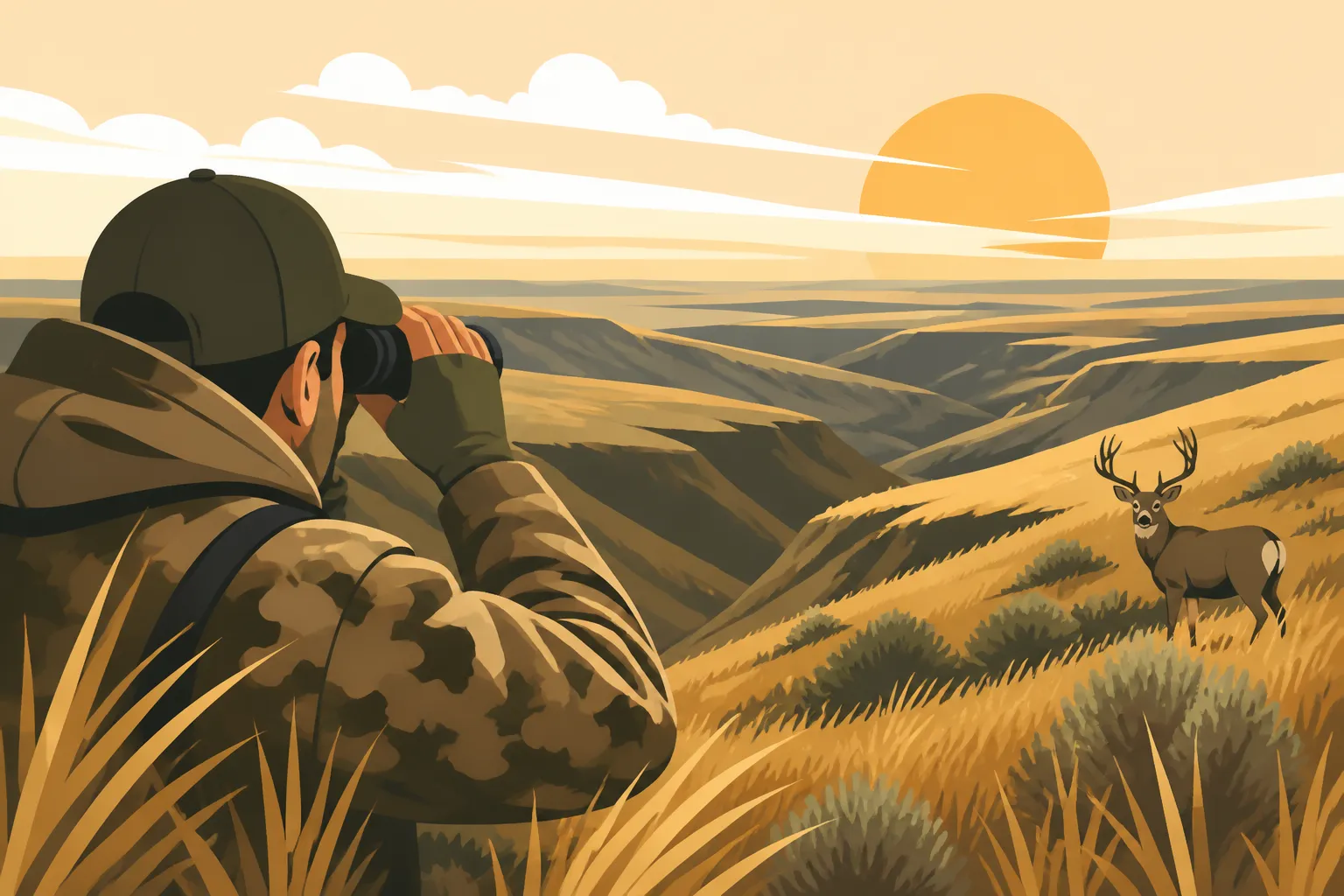
Effective glassing is a methodical process. Start by selecting a vantage point that offers a wide, unobstructed view of the coulee system you intend to scan. Elevated positions are best, allowing you to look into the coulees rather than just across them. Consider the sun's position – you want it at your back or to the side, never directly in your eyes, as glare makes it impossible to see details. Wind direction is also crucial; deer will often bed on lee slopes, sheltered from the wind.
Once settled, begin a systematic grid search. Don't just randomly scan. Start at one end of the coulee, or a distinct section, and slowly work your way across, scanning in small, overlapping sections. Move your binoculars or spotting scope centimeter by centimeter, scrutinizing every shadow, every cluster of brush, every rock. Many hunters make the mistake of looking for a deer. Instead, train your eyes to look for parts of a deer: the horizontal line of a back or belly in a vertical landscape, the distinct shape of an ear, the contrasting color of an antler against dry grass, or the tell-tale white of a muzzle. Even a flicker of movement, a patch of different texture, or an unnatural shape can give away an animal. Sometimes, it's just a subtle shift in color that catches your eye. This is where patience is truly golden. You might spend an hour or more picking apart a single coulee slope, only to have a deer materialize out of thin air. This systematic approach and relentless focus will vastly increase your odds of success.
Timing, Conditions, and Advanced Tips for Coulee Hunting
Glassing is most effective when conditions are in your favor and you understand how mule deer react to different environmental factors. Knowing when and how to glass can turn a frustrating day into a rewarding hunt.
Optimal Times and Weather for Glassing
The best times to glass for mule deer in Saskatchewan coulees generally align with their most active periods: early morning, shortly after sunrise, and late afternoon into early evening. During these low-light hours, deer are typically moving between bedding and feeding areas, making them more visible. The soft, diffused light of dawn and dusk also helps minimize harsh shadows that can obscure animals, and the cooler temperatures often encourage more movement. Midday, when the sun is high and temperatures are warm, mule deer are usually bedded down in heavy cover, making them extremely difficult to spot. However, don't dismiss midday entirely; sometimes a quick stretch or repositioning can briefly expose a bedded deer.
Weather conditions play a massive role. Overcast days, for instance, can offer fantastic glassing opportunities. The uniform light reduces shadows and glares, allowing you to see details more clearly for longer periods. Perhaps the most advantageous condition for glassing mule deer in coulees is after a fresh snowfall. The white blanket provides an incredible contrast against the deer's natural brown and grey coat, making them stand out dramatically. A light dusting of snow can turn previously invisible deer into clear targets. Additionally, cold temperatures often increase the need for deer to feed, prompting more daylight movement. Conversely, strong winds can make glassing challenging due to eye strain and reduced deer activity, as they hunker down for shelter. Our guide to Hunting Mule Deer After a Snowfall delves deeper into these specific advantages.
Interpreting Sign and Planning Your Stalk
Once you’ve spotted a mule deer, the hunt isn’t over; in fact, the real strategic work begins. Don't immediately jump up and start stalking. Take your time to observe the animal. Is it alone, or are there other deer with it? What is its exact location relative to landmarks? Is it feeding, bedding, or moving? Which direction is it heading, or likely to head? Pay close attention to the wind direction, as this will dictate your approach. Mule deer have incredible noses, and if they catch your scent, your stalk is over.
This is where integrating technology like mapping applications comes into play. Tools like those from GoHunt or onX Hunt allow you to mark the deer's location, assess the terrain between you and the animal, and plan a precise route that uses cover, avoids open areas, and keeps the wind in your favor. Look for draws, ridges, or heavy brush that can conceal your movement. It’s also crucial to identify potential escape routes for the deer. If it's bedded, try to visualize where it will run if spooked. Sometimes, it’s best to wait for the deer to move into a more favorable position or closer to accessible terrain before initiating your stalk. Understanding how to approach these animals after a successful glassing session is a critical part of Spot-and-Stalk Mule Deer in Saskatchewan. Patience, meticulous planning, and a deep respect for the animal’s senses are key to turning a spotted deer into a harvested one.
Disclaimer
Hunting is an activity that carries inherent risks. Always prioritize safety, adhere to all local and federal hunting regulations, and ensure you have proper training and licensing before heading into the field. The information provided in this guide is for informational purposes only and should not be taken as legal advice or a substitute for official hunting regulations.