Quad and Side-by-Side Rules on Crown Land
Navigating Saskatchewan's vast and often remote hunting grounds can be a challenge, especially when you're trying to get deep into the bush or retrieve a hard-won animal. Many hunters rely heavily on their quads or side-by-sides to access these areas, but the rules around where and how you can use these vehicles on Crown land can feel like a tangled thicket. It’s easy to get confused about what’s allowed, what’s restricted, and what could land you in hot water. This guide aims to clear up that confusion, offering a realistic look at the regulations and practical advice for responsibly using your off-road vehicle while hunting in Saskatchewan.
Understanding Crown Land Access in Saskatchewan
Saskatchewan boasts an incredible amount of Crown land, particularly as you move north into the Aspen Parkland and then deeper into the Boreal Forest. For many of us, this public land represents the purest form of hunting freedom—vast, untamed areas where you can truly escape and pursue game without the complexities of private land access. But that freedom, while real, comes with a responsibility to understand the rules that govern its use, especially when it comes to mechanical access.
Defining Crown Land and Its Importance for Hunters
Crown land in Saskatchewan refers to lands owned by the provincial government, held in trust for all citizens. It includes provincial forests, some wilderness areas, specific land parcels managed by various ministries, and even some undeveloped areas within more agricultural zones. Unlike private land where you need explicit permission from the landowner, Crown land is generally accessible to the public for recreational activities like hunting, provided you adhere to provincial and municipal regulations.
For hunters, Crown land is often the holy grail. It provides opportunities to hunt away from crowded areas, to explore diverse ecosystems, and to chase game that might be less pressured. These areas are crucial for wildlife populations, offering critical habitat, breeding grounds, and migration corridors. The sheer scale of Saskatchewan's Crown land, particularly in the central and northern parts of the province, means endless possibilities for those willing to put in the effort. If you're looking for an adventure beyond the usual farm fields, learning to navigate Saskatchewan's Crown land access is essential. You can find detailed information on Public Hunting Land in Saskatchewan through various provincial resources.
The Role of Quads and Side-by-Sides in Hunting Remote Areas
Let's be honest, trying to hunt deep in the boreal forest or even some of the more rugged sections of the Aspen Parkland without an off-road vehicle is a daunting task. These machines aren't just for joyriding; they're indispensable tools for many hunters. They allow us to cover significant distances efficiently, reach areas far from main roads that would otherwise be inaccessible, and, crucially, assist in game retrieval. Imagine downing a big moose or an elusive whitetail miles from the nearest trail – a quad or side-by-side transforms a multi-day packing ordeal into a manageable recovery.
This isn't just about convenience; it's often about practicality and safety. Hauling heavy gear, setting up remote camps, or retrieving a large animal can be incredibly difficult, if not impossible, on foot, especially when facing challenging terrain or early winter snows. Without these vehicles, many productive hunting areas would remain largely untouched by hunters, effectively limiting opportunity. However, with this utility comes the need for diligence in understanding where and how these powerful machines can be used responsibly, ensuring that access remains open for future generations.
Navigating the Regulations for Off-Road Vehicles on Crown Land
It can feel like a bureaucratic maze sometimes, trying to figure out exactly where your quad is welcome and where it's not. Saskatchewan's regulations for off-road vehicles (ORVs), which include quads (ATVs) and side-by-sides (UTVs), are designed to balance public access with environmental protection and public safety. While general rules apply across the board, specific nuances come into play when you're operating on Crown land, particularly when hunting.
General Rules and the Off-Road Vehicle Act
The primary legislation governing ORVs in Saskatchewan is The Off-Road Vehicles Act. This act outlines the basic requirements for operating these machines. Generally speaking, if you’re operating an ORV on public roads, highways, or even certain designated trails that might intersect with public infrastructure, you’ll need to ensure your vehicle is registered and insured. The operator must also possess a valid driver's license, and wearing an approved helmet is mandatory for anyone operating or riding an ORV. These are non-negotiable safety and legal requirements that apply across the province.
However, the specific rules change when you venture onto Crown land that isn't typically considered a "public road" in the traditional sense. Here, the emphasis shifts more towards responsible land stewardship and minimizing environmental impact. While the general safety requirements (like helmet use) are still good practice and often enforced, the focus on registration and insurance for off-road use on Crown land where no public road is involved can be different. It’s critical to remember that while Crown land might feel like a free-for-all, it is still regulated. For a broader understanding of how vehicles are generally governed, you can refer to Vehicle Rules on Saskatchewan Crown Land.
Specific Restrictions and Prohibited Areas
This is where many hunters hit a snag. While Crown land is generally accessible, it’s far from a blanket "drive anywhere" policy. Specific areas are often designated as restricted or completely prohibited for ORV use to protect sensitive habitats, minimize disturbance to wildlife, or preserve wilderness values.
For instance, most Provincial Parks in Saskatchewan strictly prohibit ORV use off of designated trails, and often prohibit them entirely within park boundaries unless specifically marked. Similarly, Wildlife Management Areas (WMAs) and Fish and Wildlife Development Fund (FWDF) lands often come with their own set of specific rules. Many FWDF parcels, for example, are managed with the intent of protecting habitat, and as such, may be designated as "foot access only" or limit vehicular traffic to specific access points or trails. It’s absolutely crucial to check the specific regulations for the Wildlife Management Zone you plan to hunt in, as rules can vary significantly from one zone to another. Tools like GoHunt or other digital mapping applications are incredibly helpful for visualizing these restricted areas and understanding the underlying land designations.
Beyond designated protected areas, there are also general environmental considerations. Driving through wetlands, riparian zones (areas along rivers and streams), or other fragile ecosystems can cause significant damage and is generally prohibited. The goal is to prevent erosion, minimize habitat destruction, and reduce noise pollution that can disturb game animals and other users. Knowing these restrictions before you head out is paramount to avoiding fines and ensuring the longevity of these valuable hunting grounds.
The Importance of Designated Trails and Responsible Use
The golden rule for ORV use on Saskatchewan Crown land, especially when hunting, is to stick to designated trails or existing cutlines whenever possible. These trails are typically established routes that minimize impact and are generally understood to be acceptable for vehicular traffic. Venturing off-trail, creating new paths, or driving through sensitive areas not only risks environmental damage but can also lead to fines and loss of hunting privileges.
These restrictions aren’t arbitrary; they’re put in place for very good reasons. Uncontrolled ORV use can cause significant erosion, disrupt wildlife patterns, spread invasive species, and degrade the overall wilderness experience for everyone. By adhering to designated trails, you’re not just following the law; you’re actively contributing to the conservation of Saskatchewan's natural resources and ensuring that future generations can enjoy the same hunting opportunities. It’s an ethical obligation that comes with the privilege of access. When you're making your way into the dense cover, remember that staying on established paths is key to responsible Hunting Saskatchewan's Forest Fringe.
When it comes to game retrieval, there's a common misconception that all rules go out the window once you've harvested an animal. While Saskatchewan regulations often allow for the direct and careful retrieval of big game from off-trail locations when no other practical means exists, this is not an open invitation to joyride. You are expected to choose the most direct route, minimize disturbance, and cause no damage to the land. This is a privilege, not a right, and it should be exercised with extreme care and respect for the environment. Often, getting a deer out might mean using an ATV on a Frozen Slough Crossing but only if it's the most practical and least damaging route.
Practical Tips for Planning Your Hunt with an ORV
Preparation is everything when hunting Saskatchewan's wild landscapes. Relying on an ORV means adding another layer of planning to your trip, ensuring you not only comply with the rules but also have a safe and successful experience.
Mapping Tools and Pre-Hunt Scouting
Before you even load your quad onto the trailer, your most valuable tool will be a reliable mapping application. Apps like GoHunt or onX Hunt, coupled with the provincial government’s own online mapping resources, are absolutely invaluable. These tools allow you to overlay different layers, showing you Crown land boundaries, provincial forests, FWDF parcels, and often even existing trails or cutlines.
Spending time scouting with these tools from home can save you immense frustration and potential legal trouble in the field. You can identify potential access points, see where designated trails lead, and, critically, identify any "foot access only" areas or other specific ORV restrictions before you arrive. This virtual scouting is a game-changer, especially when planning a hunt in the vast expanse of Hunting Saskatchewan's Boreal North. Always cross-reference with the most current Saskatchewan hunting guide, as regulations can change. For more advanced planning, consider integrating Scouting With Satellite Imagery in Saskatchewan into your routine.
Getting Permission and Understanding Lease Lands
Even on Crown land, there can be complexities, particularly concerning grazing leases or other forms of occupied Crown land. While the land itself is Crown property, the surface rights might be leased to an individual for agricultural purposes. In such cases, while you might have general public access for hunting, you may still need to contact the leaseholder for permission to drive an ORV across their leased portion, especially if it involves crossing cultivated fields or areas with active livestock.
The best practice is always to err on the side of caution. If you're unsure, try to contact the local Ministry of Environment office or the leaseholder (if identifiable) to clarify access rules. Ignoring these nuances can lead to strained relations with landowners, which ultimately hurts all hunters. Always respect private property signs and know the boundaries. For a deeper dive into these situations, check out our guide on Hunting Occupied Crown Land in Saskatchewan or understanding how to approach Hunting a Grazing Lease Quarter.
Equipment and Safety Considerations
Beyond the legal requirements of helmets and proper operation, ensuring your ORV is properly equipped and you're prepared for potential challenges is paramount. Saskatchewan's terrain, especially in the remote northern regions, can be unforgiving.
Consider these essentials:
- Winch and recovery gear: Even experienced operators get stuck. A winch, tow straps, and a small shovel can be lifesavers.
- Navigation: GPS devices (and paper maps as backup) are crucial, as cell service can be non-existent in many hunting areas.
- First aid and emergency kit: Accidents happen. Be prepared for injuries, and carry survival essentials like fire starters, extra warm clothing, and high-energy food, particularly if you're venturing far from roads.
- Communication: Satellite phones or two-way satellite messengers are highly recommended for remote areas where cell phones are useless.
- Tools and spare parts: Basic tools for minor repairs, tire repair kits, and extra fuel can prevent a long walk out.
Remember, conditions can change rapidly in Saskatchewan. What was a dry trail in the morning can become a muddy bog by afternoon, or a light snowfall can quickly become a blizzard. Always be prepared for the unexpected, and never push your luck. You'll find more useful advice in our article on building a Winter Truck Kit for a Saskatchewan Hunt and knowing What to Do If You Get Stuck in the Bush.
Minimizing Impact and Ethical Hunting
Using an ORV for hunting is a privilege, and it’s up to all of us to ensure that privilege isn't abused. Minimizing your environmental footprint and adhering to ethical hunting practices are fundamental.
- Stay on trails: This cannot be stressed enough. Avoid creating new trails or driving through sensitive vegetation.
- Control speed and noise: Reduce your speed, especially around known wildlife areas, and avoid unnecessary noise that can disturb animals and other hunters.
- Pack it in, pack it out: This applies to all hunting, but it’s especially important when using ORVs. Don't leave trash or any signs of your presence.
- Respect others: You’re not the only one using Crown land. Be considerate of other hunters, hikers, and recreational users.
- Vehicle maintenance: Ensure your ORV is in good working order to prevent spills or breakdowns that could lead to environmental contamination.
By operating your quad or side-by-side responsibly and ethically, you help maintain positive relationships with wildlife managers, landowners, and other outdoor enthusiasts. This ensures that these vital access methods remain available for hunters for years to come. Remember to plan for all eventualities, including Hunting Saskatchewan Winter Weather Safely.
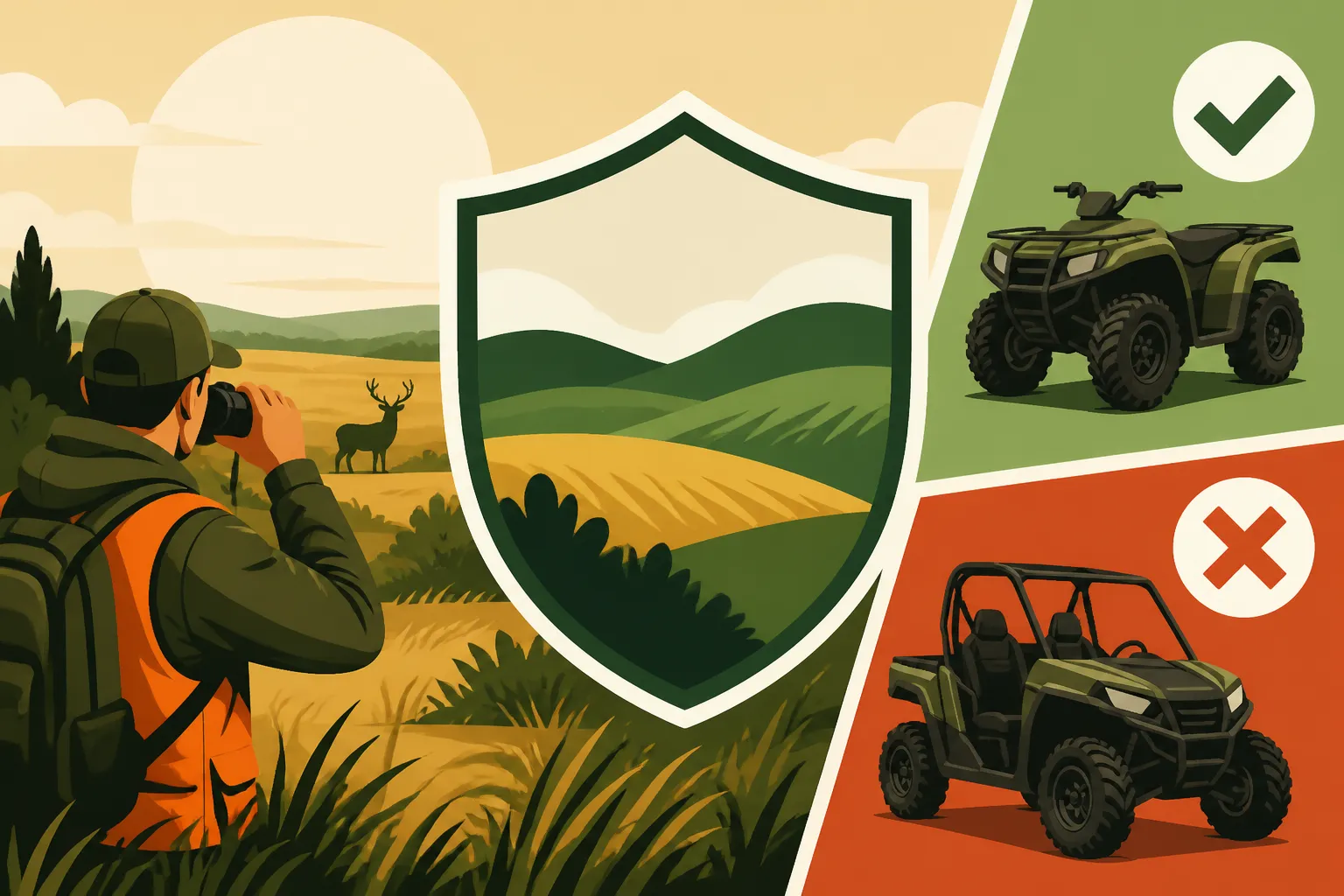
| Aspect | Do's | Don'ts |
|---|---|---|
| Pre-Trip Planning | Consult digital maps (e.g., GoHunt), provincial guides. | Assume all Crown land is open to ORVs. |
| On Crown Land | Stick to designated trails, existing cutlines, or established routes. | Drive through wetlands, riparian zones, or create new trails. |
| Drive directly and carefully for game retrieval (if permitted). | Joyride off-trail or cause excessive environmental damage. | |
| Safety | Always wear an approved helmet. Carry a first-aid kit and recovery gear. | Operate under the influence. Overload your ORV. Go alone without a plan. |
| Environmental | Pack out all trash. Minimize noise and disturbance to wildlife. | Leave garbage or vehicle fluids. Disturb sensitive habitat or wildlife. |
| Land Access | Verify rules for WMZs, FWDF lands, and any lease areas. | Trespass on private land or ignore "foot access only" signs. |
| Legal | Ensure your ORV is registered and insured if on public roads/trails. | Operate without a valid driver's license (where required). Ignore speed limits. |
Disclaimer
The information provided in this guide is for general informational purposes only and is not a substitute for official government regulations. Hunting laws and regulations in Saskatchewan can change. Always consult the most current Saskatchewan Hunters' and Trappers' Guide and provincial legislation before embarking on any hunting trip or using an off-road vehicle on Crown land. It is your responsibility to understand and comply with all applicable laws.