Glassing Saskatchewan Prairie for Pronghorn
The Saskatchewan prairie, with its endless horizons and subtle undulations, is a truly awe-inspiring place, but it can also be incredibly daunting for hunters trying to locate the lightning-fast ghost of the plains: the pronghorn. Their unique camouflage and incredible speed make spotting them a genuine challenge in such vastness. This guide aims to pull back the curtain on effective glassing strategies, helping you transform that overwhelming landscape into manageable sections, spot more pronghorn, and ultimately increase your chances of a successful hunt.
Understanding Pronghorn Behavior on the Saskatchewan Prairie
To successfully glass for pronghorn, you first need to understand how these incredible animals move and live across the expansive Saskatchewan prairie. They aren't like deer, hiding in thick bush; their survival strategy is built on open country and unparalleled speed.
Daily Movement Patterns
Pronghorn are creatures of habit, often following predictable daily routines dictated by feeding, watering, and bedding. Early morning and late evening are prime times to find them actively grazing, often on forbs, grasses, and even some shrubs. As the sun climbs higher and temperatures warm, especially during the peak of summer and early fall seasons, they tend to bed down. These bedding areas are typically on slight rises or in shallow depressions that offer a commanding view of their surroundings, allowing them to spot danger from a distance. You'll rarely find them tucked away in heavy cover; their natural defence is open visibility and the ability to outrun any threat. Understanding this rhythm is crucial, as you’ll be looking for active animals at dawn and dusk, and subtle, bedded forms during midday.
Habitat Preferences and Cover
While pronghorn thrive in open grasslands, they aren't completely devoid of using "cover"—it just looks different from what a whitetail hunter might imagine. On the Saskatchewan prairie, cover for a pronghorn can be anything from a shallow coulee, a subtle fold in the land, a patch of taller grass, or even the sparse brush found along a dry creek bed. They will often utilize these minor topographical features to break up their outline, especially when bedded. A slight rise allows them to scan the landscape, while a shallow dip can provide a brief respite from the wind or sun. Learning to recognize these subtle "hiding spots" is key. Areas near Hunting a Prairie Coulee Bottom or on the edges of native grass pastures are prime locations to focus your glassing efforts. Keep in mind that while they love open fields, they also need access to water, so keeping an eye on dugouts or small potholes can be productive, especially during dry periods, as detailed in How Drought Moves Saskatchewan Game.
How Pronghorn Respond to Pressure
Pronghorn are notoriously wary. Their incredible eyesight, often compared to that of an 8x binocular, means they detect movement and irregularities long before you ever will with the naked eye. Any perceived threat will often result in them bolting, usually at speeds that leave most other animals in the dust. They are less tolerant of human presence than, say, a whitetail that might sneak off into the bush. Pronghorn will often run for miles before feeling secure again. This means minimizing your profile, staying concealed, and initiating your glassing from a significant distance are paramount. If you spook a herd, don't expect them to stop a few hundred yards away; they'll likely vanish over the horizon, often requiring a new scouting effort entirely. This sensitivity to pressure is why effective long-range glassing is not just an advantage, but a necessity, especially if you're planning on Stalking Pronghorn Across Open Ground.
Essential Glassing Equipment for Pronghorn
Successfully locating pronghorn in the vastness of Saskatchewan prairie depends heavily on the quality and appropriate use of your optics. Skimping here is like trying to find a needle in a haystack blindfolded.
Binoculars and Spotting Scopes
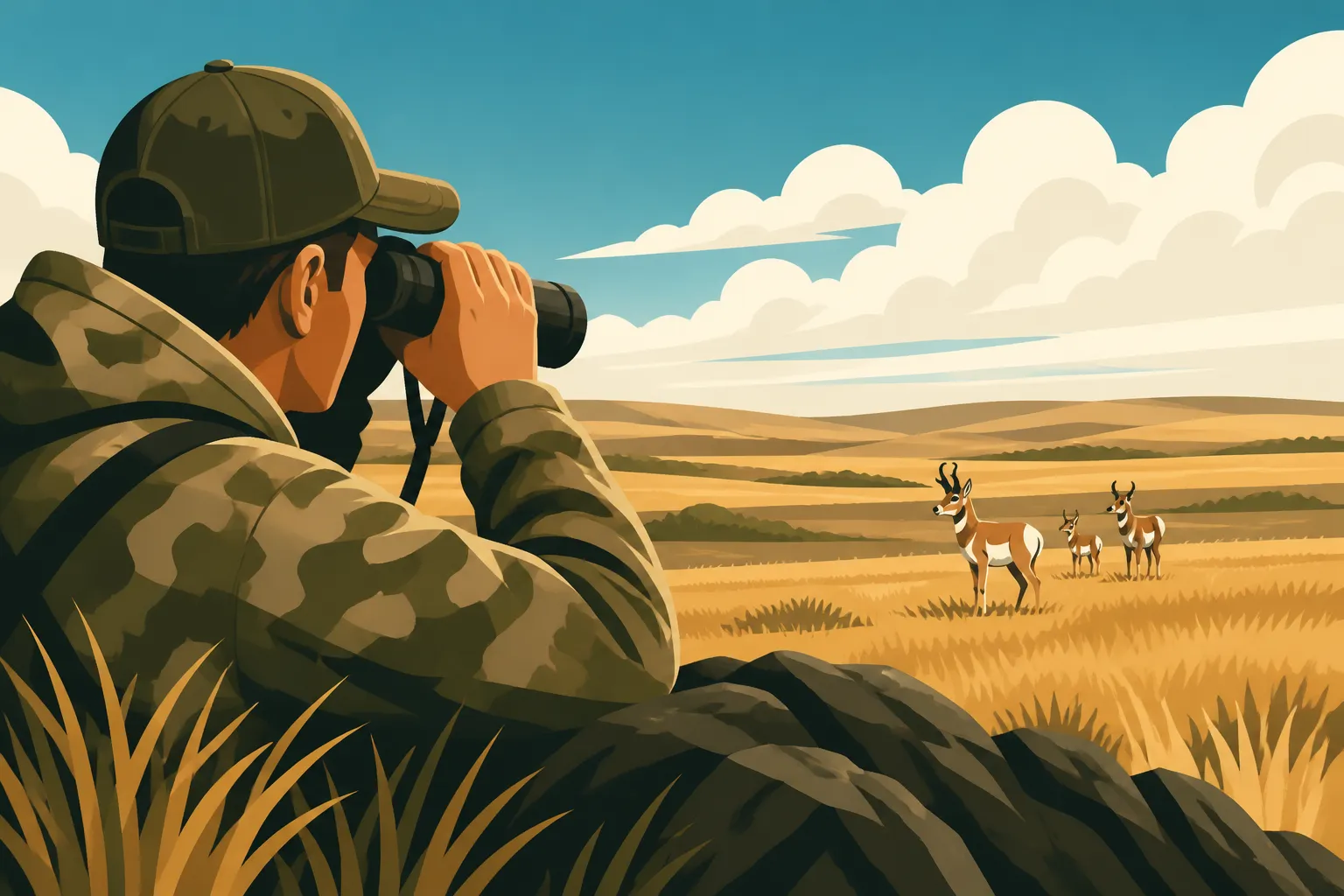
For serious pronghorn hunting, a good pair of binoculars is your primary tool. Magnifications of 10x or 12x are excellent for wide-field scanning, allowing you to cover vast amounts of ground efficiently. Brands like Zeiss, Swarovski, and Vortex are popular choices among serious hunters for their clarity, light transmission, and robust construction. However, don't overlook quality options from companies like Maven or Athlon that offer fantastic performance without breaking the bank. For longer distances, or to truly judge the details of a buck, a high-quality spotting scope is indispensable. An angled scope, typically in the 65mm to 85mm objective range with variable magnification from 20-60x or 20-70x, will allow you to comfortably scrutinize animals for extended periods. Consider models with ED (extra-low dispersion) glass for superior clarity and reduced chromatic aberration, which is crucial for distinguishing horn size and shape at a mile or more. This combo allows you to scan with binoculars and then zoom in with the scope.
Tripods and Other Stability Aids
Holding binoculars steady for more than a few minutes can lead to arm fatigue and shaky images, making it easy to miss subtle details. A sturdy tripod is absolutely non-negotiable for serious glassing, especially with a spotting scope, but also for 10x or 12x binoculars. Look for a tripod that is lightweight enough to carry but robust enough to remain stable in Saskatchewan's often windy conditions. Carbon fiber models are excellent for weight savings. Pair it with a good fluid head or a pan-and-tilt head that allows smooth, controlled movements. Quick-release plates are a blessing for swapping between binos and your spotting scope. Beyond the tripod, a beanbag rest or even a simple shooting stick can offer momentary stability when you need to quickly scan a new area or verify a sighting without deploying the full tripod setup. Comfort is key when you're spending hours behind glass, so adjustable height and a comfortable seating arrangement (even a small stool or ground pad) can make a huge difference in your ability to concentrate.
Rangefinders and Wind Meters
Once you've spotted a pronghorn, especially a potential shooter, knowing the exact distance is paramount. Laser rangefinders capable of reading out to 1,000 yards or more are essential for prairie hunting. Given the vastness, shots can often be long, and precise distance measurements eliminate guesswork. Many modern rangefinders also offer angle compensation, which is useful if you're shooting from an elevated position into a coulee, though less critical on the mostly flat prairie. Some high-end models even integrate ballistics calculations. While not directly a glassing tool, a wind meter (anemometer) can be incredibly helpful for understanding local conditions before a stalk or shot, informing your decision-making. The open prairie is notorious for swirling and unpredictable winds, which can make judging distances and bullet drop exceptionally challenging. Having this data allows you to make more informed choices, even before you start your approach.
| Equipment Type | Ideal Magnification/Objective | Key Features for Pronghorn | Notes |
|---|---|---|---|
| Binoculars | 10×42, 12×50 | ED Glass, Wide Field of View | Primary tool for scanning broad areas |
| Spotting Scope | 20-60x65mm, 20-70x85mm | Angled Eyepiece, ED/HD Glass | Essential for precise animal ID & judging |
| Tripod | N/A | Carbon Fiber, Fluid Head | Critical for stability and comfort |
| Rangefinder | 1000+ yard range | Angle Compensation (optional) | Crucial for distance calculation |
| Wind Meter | N/A | Small, Durable, Accurate | Helps with shot placement in windy conditions |
Strategic Glassing Techniques for Open Country
The endless horizon of the Saskatchewan prairie can feel overwhelming when you're trying to find a small, tan animal. Without a systematic approach, you'll just be aimlessly scanning and missing crucial details.
Breaking Down the Landscape
The first step to effective glassing is to stop looking at the entire landscape as one giant, undifferentiated mass. Instead, mentally or physically divide the area in front of you into smaller, manageable sectors. Imagine a grid laid over the terrain. Start with the closest sector and work your way outwards. Focus on areas of interest: subtle changes in elevation, the edges of distant fields, small patches of brush, or even areas where the ground cover changes. Pronghorn will often stand out against a contrasting background, so pay attention to the boundaries between different textures or colors in the landscape. Consider how Hunting a Saskatchewan Quarter Section or even a Hunting a Field of Standing Corn might look, and how you would break down its edges and interior. Always remember that the small details, the things that break up the natural lines of the prairie, are where animals often reveal themselves.
Grid Searching and Panning
Once you've broken the landscape into sectors, employ a methodical grid search pattern. Start at one edge of your chosen sector and slowly pan your binoculars or spotting scope across, moving in small, overlapping increments. Think of it like reading a book: move left to right, then drop down slightly, and move right to left. This ensures every inch of the terrain is covered. Avoid rapid, jerky movements; this causes eye fatigue and makes it incredibly easy to miss a bedded animal or one that's barely visible. When using a spotting scope, it's particularly important to use the lowest magnification initially to get a wider field of view, then zoom in on any suspicious spots. Be patient. Many hunters miss animals because they simply don't spend enough time looking at one area. Sometimes, a subtle flicker of an ear or the distinct shape of a leg will only become apparent after you've stared at a spot for several minutes.
Utilizing Elevation and Light Conditions
Choosing the right vantage point is paramount for glassing. Always try to gain as much elevation as possible, whether it's parking your truck on a high spot, climbing a small hill, or using an observation point like an old farm building. The higher you are, the more ground you can see, and the better your chances of spotting animals against the horizon or tucked into depressions. Be mindful of the sun's position. Early morning and late evening are often the best times, not only because pronghorn are more active, but also because the low angle of the sun creates longer shadows and better contrast, making animals "pop" from the background. Try to position yourself with the sun at your back, or at least to the side, to avoid looking directly into glare. This is particularly important on the flat, reflective prairie. Consider how the light might change throughout the day and be prepared to adjust your position accordingly.
Interpreting What You See: Identifying and Judging Pronghorn
Spotting a brown blob in the distance is one thing; confirming it's a pronghorn and then judging its sex and trophy potential is another entirely. This takes practice and a keen eye.
Distinguishing Bucks from Does
At long distances, distinguishing between a buck and a doe can be surprisingly tricky, especially if the buck isn't mature or is holding his head low. The most obvious difference is the presence of the black horn sheath and the characteristic "prong" on the buck's horn. Does typically have much smaller, often barely visible, horn nubs, or no horns at all. Beyond the horns, look for a larger, more muscular body profile in bucks, especially in the neck and shoulder region. Bucks also have a more prominent black patch below their ears and often a darker face. Does tend to have a more slender, graceful appearance. Pay attention to how they interact if there are multiple animals. Bucks will often display more assertive behavior, especially during the rut, which usually occurs in September and early October. Understanding What a Pronghorn Buck Weighs can also help in mentally estimating their size relative to does.
Judging Trophy Potential at a Distance
Judging pronghorn horns at a mile or more is one of the most challenging aspects of prairie hunting. You're looking for height, mass, and shape. A truly mature buck will have horns that stand tall above his ears, often appearing to extend well past the tips of his ears. Look for good mass throughout the horn, not just at the base. The prong itself should be well-defined and forward-pointing. Avoid bucks with short, fat horns or those that appear spindly. It's often helpful to compare the horn height to the length of the ear; a good buck will have horns significantly taller than his ears. Another trick is to look at the overall "blackness" of the horn, indicating good growth and mature structure. Patience is key here; you might need to watch an animal for a long time, waiting for it to turn its head or stand up from bedding, to get a clear view from multiple angles before making a judgment.
Reading Body Language and Alertness
Pronghorn body language can tell you a lot about their current state and whether you've been spotted. An alert pronghorn will typically have its head up, ears swiveled, and be intensely staring in one direction. Their white rump patch might be flared, which is a clear sign of alarm, signaling danger to the rest of the herd. If you see this, chances are you've been made, and your approach will be much harder. A relaxed pronghorn will be grazing calmly, perhaps occasionally lifting its head to chew its cud or scan briefly. When they are feeding, their tails will often wag gently. If they start walking off slowly, looking back frequently, they are probably aware of something but not yet spooked. Learning to read these subtle cues helps you decide whether to attempt a stalk, pull back, or simply continue glassing from afar. Remember, even a small shift in their behaviour can indicate they've picked up on something unusual.
Advanced Tips for Spotting Elusive Prairie Antelope
Even with the best equipment and techniques, pronghorn hunting on the prairie demands an extra level of commitment and smart usage of all available tools.
Patience and Persistence
This might sound like a cliché, but it's absolutely fundamental for glassing pronghorn. You're searching for an animal that can disappear into subtle folds of land, or simply stand perfectly still, blending seamlessly into its surroundings. Many hunters give up on a spot too soon, assuming there's nothing there, only for a pronghorn to materialize minutes after they've moved on. Dedicate significant time to each glassing session, sometimes hours, meticulously covering every square foot. Think of yourself as an archaeologist, slowly sifting through the dirt for artifacts. Take breaks to rest your eyes, but then get back to work. Sometimes, all it takes is a subtle shift in light, or an animal standing up from a bed, to reveal what was previously hidden. The reward for this patience is often finding those big bucks that have learned to use the terrain to their advantage.
Using Technology to Your Advantage
In today's hunting world, technology can be a game-changer for finding elusive game like pronghorn. GPS units with detailed land ownership maps, like those offered through platforms such as GoHunt, are indispensable for navigating vast tracts of prairie. These tools allow you to identify public land, private land boundaries (crucial for Saskatchewan Landowner Permission Law), and even topographical features that might hold animals, all from your phone or tablet. Applications like GoHunt provide satellite imagery that helps you scout potential glassing spots and identify water sources or natural travel corridors long before you even set foot on the ground. You can mark waypoints for promising areas or note where you've previously seen animals. This kind of advanced digital scouting, often done in conjunction with Scouting With Satellite Imagery in Saskatchewan, saves immense time and effort, letting you focus your in-field efforts on the most productive areas. Leveraging these tools means you're not just hunting, you're smart hunting.
Learning from Every Observation
Every time you hit the prairie, whether you fill a tag or not, is an opportunity to learn. Pay attention to where you see pronghorn, when you see them, and what they are doing. Did you find them on a north-facing slope in the morning? Were they in a coulee bottom during the heat of the day? How did they react to your presence? Make mental notes, or better yet, log your observations in a journal or on your mapping app. Over time, these observations will help you build a comprehensive understanding of pronghorn behaviour in your specific hunting areas. Understanding their reliance on certain types of terrain, especially where Why Fences Are Hard on Pronghorn is a concern, can inform future scouting. This accumulated knowledge will refine your glassing techniques and make you a more effective hunter in the long run. The prairie is a vast classroom, and every outing is a lesson waiting to be absorbed.
Disclaimer
Hunting is an inherently dangerous activity. Always prioritize safety, adhere to all Saskatchewan hunting regulations, and ensure you have proper training and licensing. This guide provides general information and should not replace official government resources or professional instruction. Respect private property, practice ethical hunting, and be aware of weather conditions and wildlife safety protocols at all times.