Cougars and Where They Have Turned Up
The rustle of leaves, a sudden chill in the air, and then, a fleeting glimpse of a long, powerful body disappearing into the tree line. For many years, the idea of a cougar in Saskatchewan felt like a tall tale, something reserved for the mountains out west or the deep, unpenetrated northern forests. But times are changing, and more and more, hunters and landowners are reporting sightings of these elusive big cats in places they were never thought to roam. This guide delves into the fascinating and often misunderstood presence of cougars in Saskatchewan, exploring their history, biology, and importantly, where they are turning up, offering insights into this apex predator's quiet return to our landscapes.
The Elusive Return: Historical Context of Cougars in Saskatchewan
For generations, the cougar was considered an animal of legend, a ghost of the past in Saskatchewan. Our grandparents might have shared stories, but concrete evidence was scarce. This perception deeply shaped how people viewed the prairie and parkland ecosystems – as places where top predators were mostly confined to wolves and bears in the far north.
The Myth of the Prairie Cougar
Back in the day, if you talked about seeing a cougar on the open prairie, you'd likely get a skeptical look, maybe even a chuckle. The common belief was that cougars, or mountain lions as they're often called, belonged firmly in mountainous terrain or dense, expansive forests, not the vast, relatively open plains of Saskatchewan. This misconception stemmed from their historical range contraction, which saw them pushed out of many areas due to human settlement, habitat alteration, and aggressive eradication efforts in the late 19th and early 20th centuries. For decades, the province's wildlife management focused primarily on other species, with cougars rarely being a part of the conversation outside of incidental, unconfirmed reports.
This persistent myth meant that even when legitimate sightings occurred, they were often dismissed as misidentifications – a large coyote, a lynx, or even a domestic dog viewed in poor light. The sheer lack of widespread understanding about cougar biology and their adaptability further cemented this belief. People simply didn't expect to see one, and that expectation, or lack thereof, influenced how they interpreted what they saw in the wild.
Early Records and Apparent Disappearance
Historically, cougars did roam across parts of what is now Saskatchewan. Fossil records and early settler accounts confirm their presence, particularly in areas offering more rugged topography or dense cover, such as the Cypress Hills or along major river valleys. These big cats were an integral part of the natural predator-prey dynamics, preying on deer, elk, and other smaller game. However, with European settlement came a dramatic shift in the landscape and a concerted effort to remove large predators. Cougars, like wolves, were seen as threats to livestock and human safety, leading to bounty systems and unregulated hunting that effectively extirpated them from most of their historical range in the province by the mid-20th century.
For many years, the only "cougars" officially recognized were those occasionally passing through from adjacent provinces, particularly Alberta and Manitoba, where populations managed to persist. These were considered transient individuals, not indicative of a resident population within Saskatchewan itself. The concept of a self-sustaining cougar population in our province was practically unthinkable until relatively recently, setting the stage for the current re-evaluation of their status.
Understanding Cougar Biology and Behavior in a Saskatchewan Context
Before we dive into where these magnificent animals are showing up, it helps to understand a bit about what makes a cougar tick. They're incredibly adaptable, intelligent predators, and their behavior largely dictates their presence and how they interact with the landscape, even here in Saskatchewan.
Key Characteristics and Adaptations for Survival
Cougars, or Puma concolor, are the most widely distributed large wildcats in the Americas, a testament to their incredible adaptability. In Saskatchewan, we're typically talking about individuals from the northern ranges, which can be quite substantial in size. Males can weigh anywhere from 120 to over 200 pounds, with females being smaller, usually 80 to 120 pounds. Their coats are generally tawny or reddish-brown, often blending seamlessly with dry grass, forest undergrowth, or even the shadows of a slough edge. The most distinctive feature is their long, thick tail, which can be up to three feet long and provides balance, acting like a counterweight when running, leaping, or navigating difficult terrain.
Beyond their physical appearance, cougars possess remarkable sensory adaptations. Their eyesight is phenomenal, especially in low light, making them formidable nocturnal or crepuscular (dawn and dusk) hunters. Their hearing is acute, allowing them to pinpoint prey movement, and their sense of smell, while not as keen as a dog's, is still highly effective for tracking and identifying other animals. These adaptations allow them to thrive in diverse environments, from rocky mountainsides to dense forests and, increasingly, the fringe areas of agricultural landscapes. Their quiet, stealthy movements and ability to remain hidden even in surprisingly sparse cover are key to their survival and why they're so hard to spot.
Diet and Preferred Habitat: What Attracts Them Here?
Cougars are obligate carnivores, meaning their diet consists almost entirely of meat. Their primary prey across North America is deer, particularly whitetail deer and mule deer. Given Saskatchewan's robust deer populations, especially in the forest fringe and aspen parkland, it's not hard to see why this province could be attractive. A single adult deer can provide a cougar with food for several days, and they are incredibly efficient at bringing down prey much larger than themselves. They are ambush predators, often stalking their prey silently, sometimes for long distances, before launching a short, explosive sprint to attack.
While deer are their staple, cougars are opportunistic hunters and will also prey on smaller mammals like coyotes, beavers, porcupines, rabbits, and even domestic livestock if the opportunity arises. This broad diet further enhances their ability to exist in varied landscapes.
In terms of habitat, cougars prefer areas with ample cover for stalking and concealment. This could be dense bush, rugged river valleys, rocky outcrops, or even extensive patches of standing crops or thick willow bluffs. Access to water is also important. This means that while the deep boreal forest offers classic cougar habitat, so too do the river valleys and extensive patches of aspen bluffs found in central and southern Saskatchewan, which provide critical travel corridors and excellent ambush cover. If you spend time Hunting Saskatchewan's Forest Fringe, you'll quickly realize how much thick cover can exist, even near open fields.
Where Cougars Are Actually Being Sighted in Saskatchewan
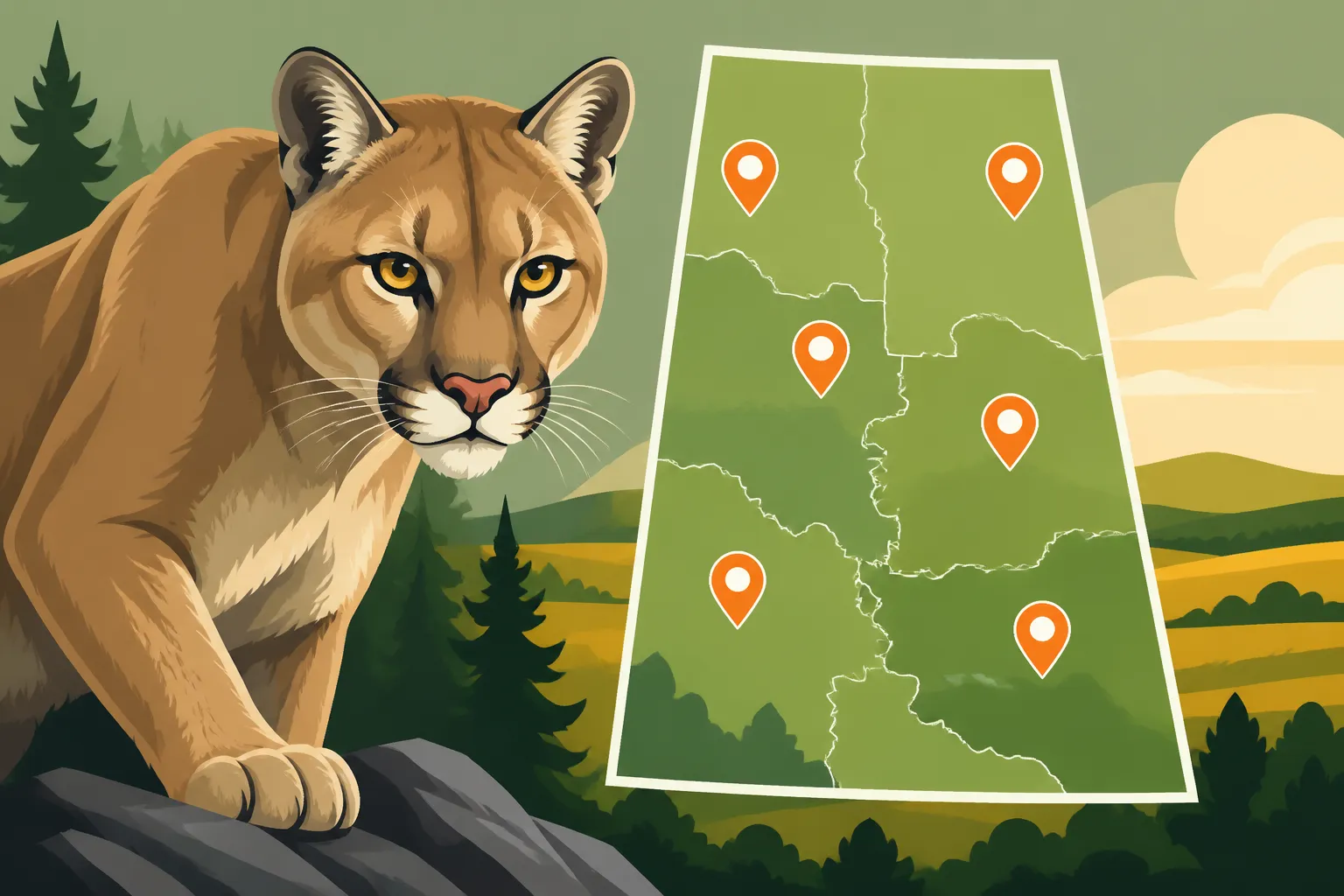
The question on many people's minds isn't just if cougars are in Saskatchewan, but where. Gone are the days when sightings were exclusively dismissed as mistaken identity. Today, there's growing evidence of cougars establishing a more consistent, if still elusive, presence across various regions of the province.
The Traditional Northern Range and Boreal Expansion
Historically, and even into the recent past, the most reliable cougar sightings in Saskatchewan came from the far northern reaches of the province, deep within the boreal forest. This vast wilderness, with its dense spruce and pine stands, abundant moose, deer, and other prey, offers ideal habitat for these secretive predators. Areas around Prince Albert National Park, the Meadow Lake Provincial Forest, and extending north towards the Churchill River basin have long been considered the edge of their known territory. In these remote areas, cougars can maintain large territories, hunt without much human interference, and reproduce successfully.
These northern populations are likely connected to larger, more stable populations in neighboring Alberta and Manitoba, making the Saskatchewan boreal an extension of their natural range. While remote, hunters, trappers, and forestry workers in these areas have consistently reported cougar tracks and occasional fleeting glimpses for years, even decades. This "traditional" range acts as a source population, with younger, dispersing individuals often venturing out in search of new territories.
Unexpected Southern Appearances and Transient Animals
What’s truly caught people’s attention recently are the increasing reports of cougars much further south than traditionally expected – venturing into the aspen parkland and even the open prairie zones. These aren't just one-off, isolated incidents anymore. While some may still be transient animals passing through, there's growing speculation that some individuals might be attempting to establish territories in these unexpected regions.
Confirmed sightings, often through trail cameras, paw prints in snow or mud, or even unfortunate vehicle collisions, have occurred in areas like the Qu'Appelle Valley, the Cypress Hills, and along major river systems like the South Saskatchewan River. These river valleys, with their steep banks, coulees, and patches of dense bush, act as natural travel corridors and provide essential cover for cougars moving through otherwise open country. They offer a surprising amount of habitat for a creature that values stealth above all else. For those Hunting Saskatchewan's Southern Prairie, especially in areas with significant breaks in the landscape, keeping an eye out for larger tracks is becoming more common.
The term "transient animal" is important here. It refers to a cougar that is not resident in an area but is merely passing through, often a young male driven out of its birth territory by an older male, looking to establish its own range. These individuals can cover vast distances. The fact that many of these southern sightings are often young males aligns with this dispersal pattern, but repeated sightings in specific localized areas suggest a more prolonged presence in some cases.
Specific Hotspots and Corridor Travel
While a cougar can technically show up anywhere in Saskatchewan where there's food and cover, certain areas are becoming recognized as more consistent "hotspots" for sightings. These typically coincide with areas offering a blend of dense cover, ample prey, and natural travel routes that connect back to more established cougar country.
- River Valleys and Coulees: The Qu'Appelle Valley, the South Saskatchewan River, and even smaller tributary valleys provide perfect linear habitat. They offer thick bush, natural elevation changes, and often a consistent supply of whitetail deer. Cougars can travel for miles along these features, mostly undetected.
- Forest Fringe and Aspen Parkland: This transitional zone between the boreal forest and the agricultural land is rich in biodiversity. It offers a mosaic of aspen bluffs, dense willow thickets, and mixed forest, interspersed with fields. This habitat is teeming with deer, moose, and other prey. It's a classic example of prime cougar habitat, and naturally, it's where many sightings occur. Hunting the Forest Fringe for Big Bucks often means traversing areas that a cougar would also find appealing.
- Cypress Hills Interprovincial Park: This isolated "mountain" on the prairie, with its unique lodgepole pine forests, steep coulees, and abundant deer and elk, has long been rumored to hold cougars. Recent documented sightings confirm their presence, likely sustained by a combination of resident animals and those dispersing from the nearby Rocky Mountains in Alberta.
The presence of "GoHunt" style mapping applications has even allowed hunters and researchers to better visualize these corridors and potential ambush points. By analyzing satellite imagery and topographical data, one can easily identify the natural funnels and dense cover that a cougar would utilize when traveling or hunting, helping to predict their movement patterns.
Why We're Seeing More Cougars: Factors at Play
It's not just that we're looking harder or have better cameras; there are genuine ecological and environmental reasons behind the observed increase in cougar presence in Saskatchewan. It's a complex interplay of factors that speak to broader wildlife trends across the region.
Population Dynamics from Neighboring Provinces
One of the most significant drivers of cougar sightings in Saskatchewan is the healthy and expanding cougar populations in Alberta and, to a lesser extent, western Manitoba. As these populations grow, particularly in areas like the Alberta foothills and mountains, young, dispersing cougars are pushed out to find new territories. These young adults, often males, will travel hundreds of kilometers in search of suitable, unclaimed habitat. Saskatchewan, with its vast tracts of wilderness in the north and increasingly suitable habitat in the south, becomes a natural destination.
This is a classic ecological phenomenon: when a species' core population thrives, it begins to expand its range. Think of it like a ripple effect; the density of cougars in established areas reaches a point where there's simply not enough territory or prey to support new individuals, forcing them to explore new frontiers. The consistent dispersal of these animals across provincial borders is key to understanding their reappearance in Saskatchewan. We're essentially seeing a natural recolonization process.
Prey Abundance in Agricultural Zones
Saskatchewan is a land of incredible wildlife abundance, and our agricultural zones, perhaps surprisingly, play a huge role in supporting this. The province is renowned for its burgeoning whitetail deer population. These deer thrive in the mosaic of cultivated fields, shelterbelts, willow bluffs, and bush patches found throughout the parkland and even into the more open prairie. The availability of consistent food sources (crops, natural forage) and cover allows deer numbers to remain high. This dense prey base is a massive attractant for a predator like the cougar.
Even in areas that seem "open," a cougar can find adequate cover in a dense bluffs, a deep coulee, or even a standing canola field. The sheer number of deer, combined with other potential prey like Moose in Saskatchewan's Farmland and Forest or even coyotes, provides an irresistible draw. A cougar doesn't need vast, untouched wilderness if there's enough food to be had in a smaller, more fragmented territory. The rich pickings in our agricultural fringes essentially offer a buffet for these big cats.
Human Expansion, Trail Cameras, and Increased Awareness
It's not just more cougars; it's also more eyes and technology observing them. The proliferation of trail cameras, both by hunters and landowners, has revolutionized wildlife monitoring. Where a fleeting glimpse might once have been dismissed, a trail camera now captures undeniable evidence. These cameras are often placed in remote, wooded areas, along game trails, or near bait sites (for other species), precisely where a cougar might travel. This means we're simply detecting their presence more effectively than ever before. Many hunters rely on digital tools, and those using scouting apps like GoHunt often leave cameras out for weeks, increasing the chances of capturing an image of an elusive predator.
Furthermore, general public awareness of cougars has increased. Wildlife agencies actively encourage reporting sightings, and social media platforms amplify verified images and videos, quickly disseminating information. This creates a feedback loop: more reports lead to more awareness, which leads to more people looking for and identifying cougar signs. This improved detection and reporting is undoubtedly contributing to the perceived increase in their numbers and distribution. The days of dismissing every cougar report as a "hoax" are largely behind us.
Interpreting Cougar Sign and Confirming Sightings
Given their secretive nature, actually seeing a cougar is a rare event. More often, evidence of their presence comes in the form of tracks, scat, or prey remains. Being able to correctly identify these signs is crucial for confirming their presence and understanding their movements in the landscape.
Tracks, Scat, and Prey Kills: The Evidence Left Behind
Learning to distinguish cougar signs from those of other predators like coyotes, wolves, or even lynx is a vital skill.
- Tracks: Cougar tracks are distinct. They are typically larger than a coyote's and slightly smaller than a wolf's, but the key is the absence of claw marks. Like all cats, cougars retract their claws when walking, so you'll usually only see the toe pads and the prominent heel pad. The tracks are also more rounded than canine tracks, which tend to be more oval. A typical adult cougar track might be 3-4 inches long and equally wide. Look for four distinct toe pads and a large, three-lobed heel pad. In soft snow or mud, they can be particularly clear.
- Scat: Cougar scat is usually tubular, segmented, and blunt at the ends. Because they are carnivores, it often contains hair and bone fragments from their prey. Its size will vary depending on the cougar's age and what it has eaten, but it's generally larger than coyote scat and might be similar in diameter to large dog scat. They often attempt to bury their scat, similar to a domestic cat, though this isn't always the case.
- Prey Kills: Cougars are known for their distinctive kill patterns. They typically kill prey by biting the neck or base of the skull. After a kill, they will often drag the carcass to a secluded spot and cache it by covering it with leaves, dirt, snow, or debris to protect it from scavengers. They return to these kills over several nights. Look for signs of struggle, drag marks, and especially the tell-tale covering of debris over the partially eaten carcass. This is a significant indicator of cougar presence, as other predators usually don't bother to cache their kills in the same way.
When you're out Reading Sign After Fresh Saskatchewan Snow, these details become particularly clear and offer valuable clues.
Distinguishing Cougar Evidence from Other Predators
It's easy to mistake signs from other animals for cougars, especially when you're excited or not entirely sure what you're looking for. Here’s how to differentiate:
- Coyotes: Coyote tracks are smaller, more oval, and almost always show claw marks. Their scat is typically smaller and often contains berry seeds or vegetable matter in addition to hair and bone. Coyote kills are usually messier and rarely cached.
- Wolves: Wolf tracks are larger than cougar tracks (often 4-5 inches long) and also show distinct claw marks. Wolf scat is much larger and more rope-like. Wolves often hunt in packs, and their kills show signs of multiple animals feeding, with less attempt at concealment.
- Lynx: Lynx tracks are distinctive for their very large, round, and furry pads, designed for walking on snow. They appear much bigger than the actual paw due to the fur, but they are generally smaller than a cougar's. Like cougars, lynx tracks rarely show claw marks. Lynx scat is similar to cougar scat but much smaller.
Here's a quick comparison table:
| Sign Type | Cougar | Coyote | Wolf | Lynx |
|---|---|---|---|---|
| Tracks | Rounded, no claw marks, 3-4" long | Oval, claw marks visible, 2-3" long | Large oval, claw marks visible, 4-5" long | Very large, round, furry, no claw marks, 3-4" long (but looks bigger) |
| Heel Pad | Three-lobed | Two-lobed | Two-lobed | Two-lobed (less distinct due to fur) |
| Scat | Tubular, segmented, blunt, hair/bone | Tubular, tapered, smaller, mixed diet | Large, rope-like, hair/bone | Small, tubular, hair/bone |
| Prey Kills | Cached, covered with debris, neck/head bite | Messy, often left exposed, various bite locations | Messy, multiple feeding signs, various bite locations | Often smaller prey, may be cached if abundant |
Being able to confidently identify these signs is not just interesting, it's a vital component of wildlife management and understanding the true distribution of Saskatchewan's predators and furbearers.
Coexisting with Cougars: Safety and Management
The increasing presence of cougars in Saskatchewan brings with it a responsibility to understand how to coexist safely and responsibly. While attacks on humans are exceedingly rare, especially in our province, knowing how to react and how to report sightings is crucial for both human and animal welfare.
Safety Protocols for Outdoor Enthusiasts
Encountering a cougar in the wild is an incredibly rare event, and they typically avoid human contact. However, if you spend a lot of time outdoors – hunting, hiking, or even just living in rural areas – it's wise to be prepared.
Here are some safety tips:
- Travel in groups: Cougars are less likely to approach multiple people.
- Make noise: Let them know you're there. This reduces the chance of surprising one.
- Keep children and pets close: Small, fast-moving targets can sometimes trigger a cougar's prey drive.
- Be aware of your surroundings: Scan your environment, especially in dense cover or at dawn/dusk. Tools like a GoHunt subscription, which allows you to analyze terrain features on your phone, can help you visualize areas where a cougar might be more likely to appear.
- If you encounter a cougar:
- Do NOT run: Running can trigger a chase response.
- Stand your ground: Face the cougar, make yourself look as large as possible (e.g., raise your arms, open your jacket).
- Make noise: Shout firmly.
- Pick up small children and pets: Do not bend down or turn your back.
- Throw objects: If it approaches, throw rocks, sticks, or anything you have.
- Fight back: If attacked, fight back with all your might. Aim for the face and eyes.
These protocols are not just for cougars but are generally good practice when sharing the landscape with any large predator, including Black Bears in Saskatchewan's Boreal Forest or Wolves in Saskatchewan's North.
Reporting Sightings and Conservation Efforts
Accurate reporting of cougar sightings is invaluable for wildlife management. It helps the Ministry of Environment track their distribution, understand population trends, and develop appropriate management strategies. If you see a cougar or find compelling evidence (tracks, a cached kill), it's important to report it.
How to Report a Sighting:
- Take photos or videos: If it's safe to do so, photographic evidence is incredibly helpful.
- Note the location: Specific GPS coordinates are ideal, but a precise description of the area (e.g., "3 miles north of Smalltown on Range Road 123, in the bluffs by the creek") is sufficient.
- Note the date and time.
- Describe the animal: Size, colour, behavior.
- Contact the Saskatchewan Ministry of Environment: You can usually find a local conservation officer's number or contact the Turn In Poachers and Polluters (TIPP) line. While the TIPP line is primarily for illegal activities, it is also a vital resource for reporting significant wildlife sightings like cougars.
Saskatchewan doesn't have an open hunting season for cougars, and their management focuses on monitoring and education. The long-term presence of these apex predators is a strong indicator of a healthy ecosystem, particularly robust deer and elk populations. By understanding their movements and ensuring responsible interactions, we can support the natural return of these magnificent animals to their ancestral lands. It’s a testament to the resilience of nature and the health of Saskatchewan’s wild spaces that these secretive hunters are once again making their presence known.
Disclaimer
This article is for informational purposes only and should not be considered legal advice regarding hunting regulations. Hunting laws and regulations in Saskatchewan can change frequently. Always consult the official Saskatchewan Hunters' and Trappers' Guide published by the Ministry of Environment, or contact a Conservation Officer directly, before planning any hunting activity. Ensure you understand and comply with all current licensing requirements, season dates, zone restrictions, and safety protocols.