Saskatchewan Trespass Penalties for Hunters
It’s a heart-sinking moment for any hunter: you’re deep in the bush, following a promising track or tracking a wounded animal, and suddenly you realize you might not be where you’re supposed to be. The fear of inadvertently trespassing is a very real and valid concern for hunters across Saskatchewan, and the thought of facing legal repercussions can cast a shadow over an otherwise exciting day afield. This comprehensive guide is here to shed light on Saskatchewan's trespass laws, the penalties involved, and most importantly, how to navigate property boundaries confidently so you can enjoy your hunt worry-free.
Understanding Saskatchewan's Trespass Law
Saskatchewan's land is a mosaic of private property, Crown land, and various leasehold arrangements, making it crucial for hunters to understand who owns what and what rules apply. Ignorance of the law is never an excuse, and respecting land ownership is fundamental to responsible hunting.
The Basics of Private Land Access
In Saskatchewan, the law is quite clear: you need permission to access private land for recreational purposes, and hunting certainly falls into that category. Unlike some jurisdictions where "unposted" land is considered open for access, that's not the case here. If it's private land, you need to have explicit permission from the landowner or occupier. This isn't just a courtesy; it's a legal requirement designed to protect property rights and ensure public safety. For a deeper dive into these specifics, you can explore the guidelines on Saskatchewan Landowner Permission Law.
This requirement stems from the Trespass to Property Act, which outlines what constitutes trespass and the powers of landowners to address it. Many landowners in Saskatchewan are incredibly generous, often granting access with a simple conversation. However, that conversation is critical. Showing up unannounced, or assuming access based on a previous year’s permission without reconfirming, is a risk no hunter should take. This act is in place to provide clear boundaries for both landowners and those wishing to access the land, helping to prevent misunderstandings that can sour hunter-landowner relationships.
What Constitutes "Posted Land"
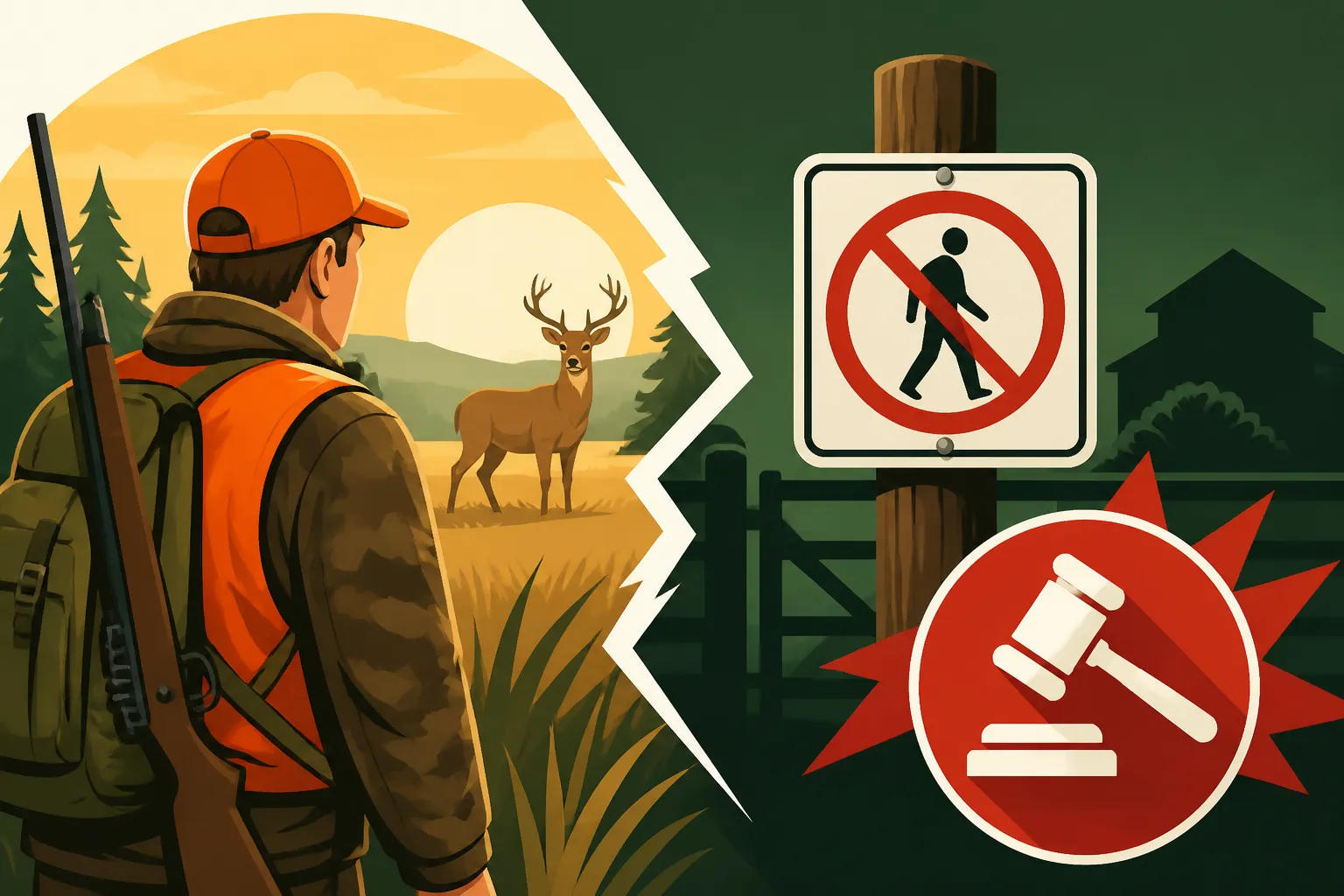
While all private land requires permission, "posted land" carries an additional layer of clarity regarding the landowner's intent. Posted land refers to private property that has clear signs indicating that trespass is prohibited. These signs aren't just a suggestion; they are a legal declaration by the landowner. The signs must meet specific criteria to be legally enforceable, as detailed in What Saskatchewan's Posted Signs Must Say. Typically, these signs are required to be visible, reasonably sized, and placed at regular intervals along the boundary of the property to ensure adequate notice.
The presence of "No Trespassing" or "Hunting Prohibited" signs leaves no room for doubt about the landowner's wishes. Entering such land, even accidentally, after seeing these signs is a much more serious offense. It moves from an unwitting mistake to a blatant disregard for clear directives. It's important to remember that even if you don't see a sign but are on private land without permission, you are still trespassing. Posted signs simply make the landowner's prohibition explicit and strengthen the legal standing for enforcement.
Landowner Rights and Hunter Responsibilities
Landowners in Saskatchewan have fundamental rights to control who enters their property. They can permit, deny, or revoke access at any time. This right extends to specifying the type of activity allowed (e.g., hunting for deer but not waterfowl), the specific areas accessible, and the duration of the access. Hunters, in turn, have a non-negotiable responsibility to respect these rights. This means not only securing permission beforehand but also adhering strictly to any conditions set by the landowner.
Beyond direct permission, hunters also have a responsibility to be educated on property boundaries. Relying solely on a fence line, which might not be the actual property line, or anecdotal advice from others is insufficient. Tools like satellite imagery and digital mapping apps, such as those offered by GoHunt, have revolutionized how hunters can identify property lines and stay on the right side of the law. Checking these resources diligently is part of your due diligence as a responsible hunter. It’s also wise to understand the broader context of Saskatchewan Hunter Education and Firearms Safety to ensure you're fully prepared.
Common Scenarios Leading to Trespass
Even the most conscientious hunters can find themselves in situations where trespass becomes a risk. Understanding these common pitfalls can help you prepare and avoid them.
Misreading Property Lines
One of the most frequent reasons for accidental trespass is simply misreading or misinterpreting property lines. Old fence lines might not align with current legal boundaries, and natural features like creeks or tree lines can be misleading. On top of that, Saskatchewan's vast landscape, with its sweeping fields and rolling parkland, can make distinguishing where one parcel ends and another begins incredibly difficult, especially in areas with limited visual markers or during low light conditions. You might be focused on a buck in a distant bluff, inadvertently crossing onto a quarter section you don't have permission for.
This issue is compounded when you're hunting in unfamiliar territory or transitioning between different types of land, such as moving from Crown land into adjacent private agricultural fields. A lack of clear signage, or signs that have fallen down or been obscured, only adds to the challenge. This is precisely where robust scouting and modern technology become invaluable. Before you even set foot in an area, spend time studying maps and satellite imagery. A service like GoHunt can layer property ownership data over topographical maps, giving you a clear visual representation of where you can and cannot go, helping you to understand Reading a Saskatchewan WMZ Map Before You Go.
Retrieving Wounded Game
This is perhaps the most emotionally charged and ethically complex trespass scenario. You've made a good shot, but the animal runs onto adjacent land where you don't have permission. Your immediate instinct is to recover your game, but doing so without permission is still considered trespassing. The law doesn't make an exception for retrieving wounded animals. While some landowners may grant permission quickly in such circumstances, others might not be reachable or may outright refuse. The rules around Retrieving Game From Private Land in Saskatchewan are clear, even if they feel frustrating in the heat of the moment.
The best course of action is always to attempt to contact the landowner immediately. If you can't reach them, or if permission is denied, you face a difficult decision. It's a testament to responsible hunting to ensure an animal isn't wasted, but that responsibility must be balanced with legal obligations. This scenario underscores the critical importance of having permission for adjacent properties, if possible, especially when hunting close to boundaries, or at least knowing who owns them and how to contact them. It's far better to have a contingency plan in place before you pull the trigger.
Unmarked or Ambiguous Boundaries
Saskatchewan is vast, and not every parcel of land is perfectly fenced or clearly marked. This can lead to ambiguous situations where a hunter genuinely believes they are on legal ground, only to find out later they were mistaken. This is particularly common in areas transitioning between farmed land and brushy fringes, or in remote areas where natural boundaries are the only markers. Imagine a willow run that weaves through multiple property lines, or a slough that spans two different quarter sections—without clear markers, it's easy to drift.
This ambiguity often stems from historical land use, where landowners might not have felt the need to post every boundary, or where old survey markers have long since disappeared. In such cases, the onus remains on the hunter to verify boundaries. This means being proactive, utilizing digital mapping tools like GoHunt, and, if possible, physically walking the boundaries beforehand during your scouting efforts. When in doubt, it’s always safest to err on the side of caution and either clarify the boundary or avoid hunting near it altogether. Proactive communication, like Knocking on Doors in Saskatchewan Farm Country, can also clarify these ambiguous spots.
The Legal Ramifications: Penalties and Consequences
Trespassing while hunting isn't just a minor inconvenience; it carries real legal weight and can result in significant penalties. These aren't just abstract rules; they're enforced by conservation officers and local law enforcement.
Fines and Enforcement
Under Saskatchewan's Trespass to Property Act, individuals found guilty of trespassing can face substantial fines. The exact amount can vary depending on the severity of the offense, whether it was intentional, and if it's a repeat offense. A first offense might result in a fine, but subsequent infractions can see these penalties escalate dramatically. For instance, the general penalties for a hunting violation can range significantly, and trespassing often falls within a serious category. Fines are determined by the courts and are often meant to be a significant deterrent.
Conservation officers have the authority to issue these tickets and enforce the Wildlife Act and the Trespass to Property Act. They don't need a landowner to be present to issue a trespass notice or charge, particularly if signs are clearly posted or if they witness the act. In addition to the fines, there can be administrative costs and court fees, which can quickly add up, turning a hunting trip into a very expensive lesson. This table outlines some potential scenarios and their typical consequences, though specific outcomes always depend on the individual case and judicial discretion:
| Offense Type | Typical Action Taken | Potential Fines (Approximate) | Additional Consequences |
|---|---|---|---|
| Accidental Trespass (First) | Warning, or minor fine | $100 – $500 | Reprimand, required to leave property |
| Intentional Trespass | Significant fine, possible court appearance | $500 – $2,000+ | Hunting licence suspension, confiscation of equipment |
| Trespass on Posted Land | Higher fine, stronger legal action | $1,000 – $5,000+ | Extended licence suspension, potential civil action |
| Repeated Offenses | Escalated fines, longer suspensions, criminal record | $2,000 – $10,000+ | Permanent hunting ban, potential jail time (rare for trespass) |
| Trespass with Property Damage | Fines for trespass + costs for damages | Varies, potentially very high | Civil lawsuit, loss of equipment, possible criminal charges |
Loss of Hunting Privileges
Perhaps even more impactful than financial penalties is the potential loss of your hunting privileges. If you are convicted of trespassing while hunting, the court or the Ministry of Environment may suspend or even revoke your hunting license for a period of time, which could range from one year to a lifetime ban depending on the severity and frequency of the offenses. This consequence can be devastating for passionate hunters, putting an end to years of tradition and enjoyment. This is why understanding Penalties for a Hunting Violation is so crucial.
The suspension of hunting privileges isn't limited to just big game tags; it can extend to all forms of hunting, including migratory birds or upland game. This means your entire season, or even multiple seasons, could be forfeit. For many, the ability to hunt is a privilege earned through respect for the land, wildlife, and laws. Losing that privilege is a stark reminder of the serious nature of trespass and the importance of responsible conduct in the field. It’s not just a slap on the wrist; it’s a direct hit to your identity as a hunter.
Civil Liability and Other Damages
Beyond government-imposed fines and license suspensions, a hunter who trespasses could also face civil action from the landowner. If your trespass results in any damage to private property—such as damaging fences, driving through crops, or disturbing livestock—the landowner can sue you in civil court to recover the costs of those damages. This can include repairing fences, replacing damaged crops, or compensating for any losses incurred due to disturbed animals.
Furthermore, if you are deemed to have put the landowner or their property at risk, there could be additional legal ramifications. For example, discharging a firearm unsafely or in close proximity to residences, even if unintentional, while trespassing can lead to very serious charges. These civil suits are separate from any criminal or provincial charges and can result in significant financial judgments against you. It’s a sobering reminder that disrespecting property boundaries has wide-ranging potential consequences that extend beyond what a conservation officer might issue a ticket for.
Preventing Accidental Trespass and Staying Legal
Avoiding trespass is achievable with careful planning, diligence, and respectful communication. It’s about being proactive rather than reactive.
The Importance of Permission
This cannot be stressed enough: always get permission. Before you head out, identify the landowners whose property you intend to hunt, or whose property borders your hunting area. Make a sincere effort to contact them in advance. This might involve Knocking on Doors in Saskatchewan Farm Country, a phone call, or even a letter of introduction. Be polite, be respectful, and be clear about your intentions. A well-mannered hunter is far more likely to gain access than someone who shows up at dawn with a rifle.
When you do get permission, confirm the exact boundaries you're allowed to hunt, any specific rules (e.g., no vehicles off the main trail, avoid certain areas, specific dates), and how they prefer to be contacted if you have an issue (like tracking wounded game). Having contact information for landowners of adjacent properties is also a smart move, especially if you're hunting near a boundary. This preemptive step can turn a potential trespass crisis into a manageable situation. Always carry written permission if possible, or at least a text message or email confirmation, as a record.
Utilizing Mapping Tools
Modern technology is your best friend when it comes to navigating property lines. Gone are the days of relying solely on paper maps and vague directions. Apps like GoHunt offer invaluable features for hunters, displaying detailed property boundaries, landowner names, and land ownership types (Crown, private, lease). These tools allow you to pinpoint your exact location in real-time, preventing accidental incursions onto private land.
Before your hunt, spend time studying the area on your chosen mapping app. Mark key boundaries, access points, and potential game corridors. During the hunt, keep your GPS-enabled device handy and check it frequently, especially when moving through dense cover or approaching known property lines. Services like GoHunt allow you to download maps for offline use, which is critical in Saskatchewan's more remote areas where cell service can be spotty or non-existent. This level of preparation is crucial for Scouting With Satellite Imagery in Saskatchewan and ensures you stay on the right side of the law.
Best Practices for Hunter-Landowner Relations
Beyond the legalities, fostering positive relationships with landowners is vital for the future of hunting in Saskatchewan. Landowners are the stewards of much of the province's prime hunting habitat, and their willingness to allow access is a privilege we must safeguard.
Here are some best practices:
- Be Respectful: Always approach landowners with respect, regardless of whether they grant permission. A "no" simply means "no" for that piece of land, not for all land.
- Communicate Clearly: State your intentions, the number of hunters in your party, the dates you plan to hunt, and what species you're after.
- Follow All Rules: Stick to the agreed-upon conditions precisely. If they say no driving in the fields, don’t do it. If they say hunt only this quarter, don’t venture onto the next.
- Leave No Trace: Pack out everything you pack in. Leave gates as you found them (open or closed). Avoid disturbing livestock or damaging crops and fences.
- Offer Help: A small gesture, like offering to help with a chore if they're busy, or even just offering a piece of your harvest, can go a long way in building goodwill.
- Say Thank You: A simple thank you, either in person or with a follow-up note, demonstrates your appreciation.
- Report Concerns: If you notice something amiss on their property (e.g., downed fences, suspicious activity), inform the landowner. It shows you're looking out for their interests.
By consistently applying these principles, you not only avoid trespass penalties but also contribute to a positive perception of hunters within the community. This ensures that the tradition of hunting access on private land can continue for generations to come.
Disclaimer
The information provided in this guide is for general informational purposes only and does not constitute legal advice. While efforts have been made to ensure accuracy, laws and regulations can change. Hunters are responsible for understanding and complying with all current Saskatchewan hunting regulations and trespass laws. It is always recommended to consult the official Saskatchewan Hunting and Trapping Guide and, if necessary, seek legal counsel for specific situations.