Hunting Farmland Moose in Saskatchewan
The idea of hunting moose conjures images of vast northern forests, impenetrable muskeg, and epic canoe trips. But for many hunters in Saskatchewan, a surprising and increasingly common reality is finding these majestic giants right in the heart of our agricultural landscapes. It can be incredibly frustrating to figure out how to approach these intelligent animals in such open, human-influenced terrain, where traditional bush hunting tactics simply don't apply. This guide will walk you through everything you need to know about successfully hunting farmland moose in Saskatchewan, from understanding their unique behaviors to the best strategies and gear for this challenging pursuit.
Understanding Farmland Moose Behavior
Moose, despite their reputation as creatures of the deep woods, have adapted remarkably well to certain agricultural areas in Saskatchewan. This isn't just a sporadic occurrence; it's a trend that's been observed for decades, leading to unique hunting challenges and opportunities. Understanding why they're there and how they utilize these altered landscapes is the first step to successful hunting.
Why Moose Move Into Farmland
The primary driver behind moose colonizing farmland is often a simple one: food and refuge. While the boreal forest offers extensive browse, it can also be a tough environment, particularly in areas with high wolf populations or intense logging pressure. Farmland, especially the transition zones known as the forest fringe or areas interspersed with bluffs and riparian corridors, provides an unexpected buffet. Fields of alfalfa, canola, peas, and even standing corn offer highly nutritious forage that can support larger body sizes and antler growth.
Beyond food, these areas often present a mosaic of cover. Small bluffs, dense willow thickets along slough edges, and untouched riparian zones provide excellent bedding cover and escape routes from predators, including wolves and coyotes, which can be less prevalent or more easily avoided in these human-dominated landscapes. The availability of water, often in sloughs, dugouts, or small creeks, rounds out the essential elements, making these areas surprisingly attractive to moose, even if it seems counter-intuitive to those accustomed to hunting them in more traditional habitats like in Moose in Saskatchewan's Farmland and Forest.
Diet and Habitat Preferences in Agricultural Areas
Farmland moose are opportunists. Their diet shifts significantly from the typical woody browse of the boreal forest. They will readily consume agricultural crops, with alfalfa and various grain stubbles being particularly favored. Standing cornfields, especially later in the season, offer both a dense food source and incredible cover, allowing moose to virtually disappear within them. Beyond the crops themselves, they'll still seek out natural browse species found along field edges, shelterbelts, and sloughs. Think of willow, red-osier dogwood, and aspen shoots that grow in these transitional areas.
Their habitat preference isn't just about food; it's about blend. They seek areas where small pockets of dense cover — a bluffy quarter, a deep slough ring, a river break, or even a large, unharvested section of a field — are close to abundant food sources. These areas allow them to feed heavily at night or during low-light periods and then retreat to security cover before human activity in the fields picks up. They master the art of being "close to home" in their cover, making short forays into the open, then quickly melting back into the brush. Understanding this daily pattern is crucial.
Seasonal Movements and Rut Behavior
Like their northern counterparts, farmland moose exhibit seasonal movements, though these are often dictated by agricultural cycles and the availability of water and cover. In spring and summer, when crops are green and cover is abundant, they might be more widely dispersed. As harvest approaches and fields are cut, their available cover shrinks, often concentrating them into remaining patches of bush, standing crops, or along river valleys. This concentration can be a double-edged sword: easier to locate but also potentially more visible to other hunters.
The rut, which typically peaks in late September and early October for moose, creates unique opportunities. Bulls become more vocal and less cautious, actively seeking cows. While the typical calling scenarios of vast wilderness might not translate directly, the principles still hold. Cows will often congregate in prime feeding areas adjacent to thick cover, and bulls will follow. During the rut, you might find a bull patrolling a shelterbelt edge or checking out a willow run between two fields, actively seeking out cows. This is when patience and a keen understanding of their breeding behaviors, even in these unusual settings, pay off immensely.
Scouting Strategies for Farmland Moose
Successful farmland moose hunting hinges heavily on thorough scouting. These animals are masters of concealment, and the open nature of agricultural land means they can be easily spooked if you blunder in unprepared. Your scouting needs to be strategic, blending modern technology with boots-on-the-ground effort and a healthy dose of good old-fashioned neighborly engagement.
Pre-Season Digital Scouting with Mapping Tools
Before you even step foot on the land, leverage technology. Satellite imagery from platforms like GoHunt, onX Hunt, or even Google Earth is invaluable. Look for those "islands" of cover: treed bluffs, large willow rings around sloughs, uncultivated creek bottoms, and shelterbelts. Pay close attention to any areas that connect these pockets of cover—these are your potential travel corridors. Identify potential bedding areas within the densest cover and feeding areas in adjacent fields. Digital scouting allows you to narrow down vast tracts of land into manageable zones, giving you a starting point for physical reconnaissance.
I personally spend hours pouring over these maps, looking for patterns. Are there specific drainages that lead from thick bush out into fields? Are there any unharvested standing crops, especially corn or tall fescue, that provide dense cover year-round? I'm also looking for natural pinch points or funnels that moose might use, even if they're subtle, like a narrow strip of bush between two open fields. This initial phase helps you prioritize where to focus your efforts once you're out in the field, making your time more efficient and effective. Think of it as a virtual scouting trip, allowing you to cover hundreds of square miles from your couch.
On-the-Ground Reconnaissance and Permission
Once you have your digital hotspots identified, it’s time for some serious legwork, and crucially, some serious door-knocking. Farmland moose often reside on private land, making landowner permission an absolute non-negotiable. Approach landowners respectfully, explain your intentions clearly, and always offer to share game or help with any issues they might have (like crop damage). A good relationship with a landowner is priceless, not just for access, but for invaluable local insights into moose movement patterns they've observed. Remember, landowners are often your best resource, as they see these animals daily.
When you're out on the ground, focus on confirming what you saw on the maps. Walk the edges of bluffs, sloughs, and shelterbelts. Look for fresh tracks, rub signs on small trees, and moose droppings. Pay attention to how moose enter and exit fields. Are there specific crossings they use regularly? Are they hitting certain crops more than others? During this phase, you’re not necessarily looking to jump a moose, but rather to understand their routines and preferred areas. Identifying a Willow Run for Whitetails is a good start, but now you're thinking about how a much larger animal like a moose would use it. This level of detail in your scouting is what separates a lucky encounter from a planned, strategic hunt.
Reading Sign and Identifying Travel Corridors
Reading sign effectively for moose in farmland requires a slightly different approach than in heavy timber. While rubs and tracks are still important, look for broader patterns. Moose leave substantial tracks, and you’ll often find them along field edges, creek beds, or in softer ground near water sources. Rubs on small trees, especially aspen or willow, can indicate a bull's presence, though they might not be as widespread as in the thick bush.
More indicative are consistent travel corridors. These might not be as obvious as deer trails. Instead, look for subtly pushed-down grass, broken branches, or disturbed ground where moose consistently move between bedding cover and feeding areas. A fence line that's been consistently bent or broken in a specific spot could be a regular crossing. Consider water access points to sloughs or dugouts, as moose are highly dependent on water. Pay attention to the "soft edges" where denser cover meets open fields—these are often primary travel lanes during low light. Early morning and late evening drives (from public roads, with permission for private access) can reveal these movements without disturbing the animals. Using a Scouting With Satellite Imagery in Saskatchewan strategy can really help you pinpoint these hidden travelways from above before you even set foot on the ground.
Hunting Tactics for Success in Farmland
Hunting moose in Saskatchewan's agricultural landscapes demands a blend of patience, stealth, and adaptability. The open nature of much of the terrain means that long shots are common, and getting close often requires masterful use of whatever cover is available. Forget the typical bush-crashing approach; farmland moose are often more wary due to increased human presence.
Still-Hunting and Stalking in Cover
Still-hunting is a highly effective tactic for farmland moose, particularly when you're working the edges of bluffs, thick slough rings, or shelterbelts. The key is to move incredibly slowly, pausing frequently to scan and listen. Moose have excellent hearing and a powerful sense of smell, so paying attention to wind direction is paramount. As you move, use every piece of natural cover—even a few small shrubs or a dip in the terrain—to break up your silhouette. Think about the subtle changes in elevation, the way a small creek bed provides concealment, or how a line of mature poplars can hide your approach.
When you spot a moose, a successful stalk often relies on patience and exploiting terrain. If they're bedded down in a bluff, circle downwind, using the densest cover available to approach. If they're feeding in a field, you might need to wait for them to move closer to cover or for a change in light conditions. This can be a game of inches and hours. Sometimes, the best stalk is no stalk at all; instead, it's a slow, deliberate still-hunt that puts you in a shooting position without them ever knowing you were there. Remember, these moose are used to seeing humans and vehicles, but they're not used to being approached silently on foot.
Ambush Hunting from Stands or Blinds
Given the often-open nature of farmland, ambush hunting from a stand or blind can be a highly productive strategy. This works especially well if your scouting has revealed consistent travel patterns between bedding and feeding areas. Setting up a treestand on the edge of a bluff overlooking a field where moose regularly feed can offer an excellent vantage point. Consider the natural travel corridors they use, such as a narrow neck of bush, a fence line crossing, or a path along a creek bank.
Ground blinds, particularly those that blend well with the agricultural environment like hay bales or a dense patch of standing cattails, can also be very effective. The advantage of a blind is concealment and scent control, allowing you to sit undetected for long periods. Pay attention to prevailing wind patterns when placing your stand or blind. For a mature bull, one whiff of human scent can send him packing for miles. Remember that in agricultural areas, moose might move more at night, so focus your ambush efforts during the crucial dawn and dusk hours when they are most active. Learning about Hanging a Stand on a Saskatchewan Bush Edge can provide a solid foundation for adapting to farmland settings.
Calling Strategies Adapted for Open Country
Calling for moose in open farmland requires a nuanced approach compared to the deep woods. While traditional bull grunts and cow calls can still be effective, the sound carries much further in open country, meaning you need to be strategic about volume and frequency. Start with softer calls, especially if you suspect a moose is nearby. A loud, aggressive call in open terrain can alert and potentially spook an animal that might have been cautiously approaching.
During the rut, a series of estrous cow calls can be highly enticing, drawing curious bulls out of cover or towards a particular area. Bull grunts, particularly challenging grunts, can provoke a response from an established bull, but again, use them judiciously. Positioning is critical: try to call from a position of concealment, ideally with a clear shooting lane, but without exposing yourself too early. Consider the wind and terrain; if you can get the sound to carry over a ridge or through a thicket, it can be more effective. Sometimes, just mimicking the subtle sounds of a cow feeding or a bull raking antlers can be enough to pique their interest without overdoing it. Don't forget that even in farmland, rattling antlers, as detailed in Rattling Volume in Open Parkland, can sometimes bring a bull in close, though it's less common for moose than for deer.
Gear and Logistics for Farmland Moose Hunting
Hunting farmland moose presents its own set of gear and logistical considerations. While some aspects overlap with general big game hunting, the specific environment of agricultural land demands thoughtful choices in firearms, clothing, optics, and especially game recovery.
Weapon Choices and Ammunition Considerations
For farmland moose, where shots can be long and animals are often wary, a flat-shooting, powerful rifle is generally preferred. Calibers like .300 Win Mag, .338 Win Mag, .30-06, or even a robust .270 or 7mm Rem Mag with heavy-for-caliber bullets are excellent choices. Accuracy is paramount; practice shooting at longer distances (200-300 yards) from various field positions, as you likely won't have the luxury of a perfect bench rest when a moose appears at the edge of a field. Bullet construction is equally important. Choose a premium bullet designed for large, tough game that will retain weight and penetrate deeply, ensuring a clean kill. Brands like Nosler Partition, Barnes TSX, or Hornady InterLock are great options.
Bowhunters face a significant challenge in open farmland. Getting within typical bowhunting range (30-50 yards) of a wary moose in limited cover requires exceptional stealth and patience. A fast, powerful compound bow with heavy arrows and fixed-blade broadheads designed for deep penetration is essential. Practice shooting from elevated positions if you plan to use a treestand, and be prepared for shots that might not be perfectly broadside due to the animal's movement in and out of cover.
Clothing and Optics for Varying Conditions
Saskatchewan weather can be notoriously unpredictable, from warm fall days to bitter cold, especially during the later moose seasons. Layering is key. Start with a good moisture-wicking base layer, add insulating layers (fleece or down), and top it off with a waterproof and windproof outer shell. Blaze orange is a legal requirement during rifle seasons and is always a good safety measure, particularly with other hunters and landowners potentially in the area. Invest in warm, waterproof boots, as you'll likely be walking through damp fields, sloughs, and possibly snow. Good gloves and a warm hat are also critical for long sits.
High-quality optics are not a luxury; they are a necessity for farmland moose hunting. A good pair of binoculars (10×42 or 12×50) will be your primary scouting tool, allowing you to glass distant field edges and bluffs for any sign of movement. A spotting scope can be invaluable for identifying moose at extreme distances and assessing their size before making a move. A reliable rangefinder is non-negotiable for accurate shot placement in open terrain. Having a clear understanding of the distances you're comfortable shooting at will prevent costly errors. Many hunters also use a GPS or mapping app like GoHunt on their phone to track their movements and mark key locations, ensuring they stay on permissioned land and can find their way back to their vehicle.
Game Recovery and Meat Care in Farmland
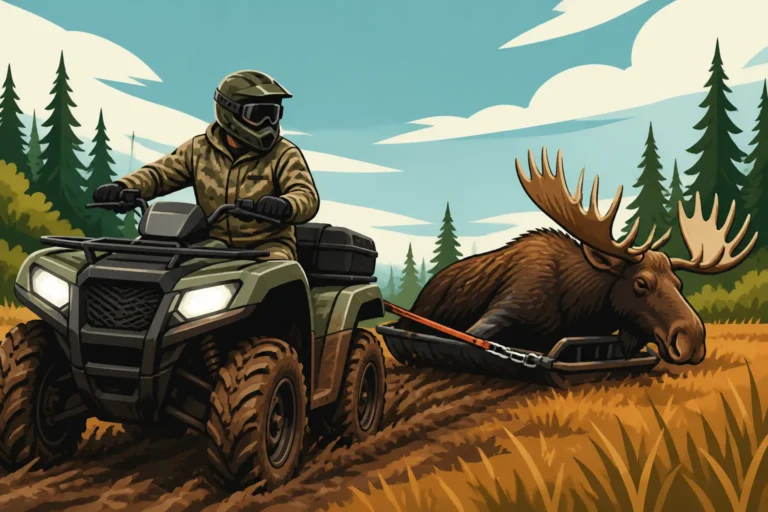
Successfully harvesting a moose is only half the battle; recovering it, especially in farmland, can be a major logistical undertaking. These are enormous animals, and a downed moose in the middle of a cut stubble field, or worse, in a mucky slough bottom, presents unique challenges. Have a plan for game recovery before you even pull the trigger. Consider bringing a sturdy cart, a block and tackle system, or even coordinating with a landowner who might have a tractor or ATV that can assist. A good headlamp or two is crucial if you're tracking or recovering in low light.
Meat care is paramount, especially if temperatures are mild. Meat Care in Saskatchewan's Cold Snaps is a useful guide, but milder conditions require even more immediate action. Get the animal field-dressed as quickly as possible to allow the carcass to cool. If you can, quarter the animal in the field to make extraction easier and to facilitate faster cooling. Have plenty of game bags to protect the meat from dirt, flies, and debris. Consider packing a cooler with ice if the weather is unseasonably warm. Respect for the animal means ensuring its meat is properly cared for, regardless of the challenging circumstances. Having a cooler for transport and knowing where the nearest butcher shop is located will save you a lot of stress.
Regulations and Ethical Considerations
Hunting farmland moose in Saskatchewan isn't just about strategy and gear; it's deeply rooted in understanding and respecting the regulations and, perhaps even more importantly, the unwritten rules of ethical conduct, especially when dealing with private landowners and other recreational users of the land.
Understanding Saskatchewan Moose Season Dates and Zones
Saskatchewan's moose seasons vary significantly by Wildlife Management Zone (WMZ) and species. Moose are primarily draw-only for antlered animals in many zones, while antlerless opportunities might be available through over-the-counter tags or specific draws. It is absolutely critical to consult the most current Saskatchewan Hunters' and Trappers' Guide before planning your hunt. This guide will provide detailed information on Saskatchewan Moose Season Dates, specific WMZ boundaries, weapon restrictions, and any changes from previous seasons. Pay close attention to the specific tag you hold (antlered, antlerless, bull, cow, calf) and ensure you are hunting within the correct zone and dates.
Ignorance of the rules is never an excuse. Always double-check your licence validity, tag conditions, and any special regulations that apply to the area you intend to hunt. Some zones might have different rules for residents versus non-residents, or for archery versus rifle seasons. Being diligent about understanding these details ensures a legal and enjoyable hunting experience.
Landowner Relations and Respectful Hunting
This cannot be stressed enough: landowner permission is paramount when hunting farmland moose in Saskatchewan. The vast majority of agricultural land is privately owned, and hunting without explicit, informed consent is trespassing and illegal. More than that, it damages the reputation of all hunters. Always ask for permission well in advance of your hunt. Be polite, articulate your intentions, and respect their decision if they decline. Offer to share information about wildlife on their land, or even offer to help with a task.
When granted permission, treat the land and the landowner's property with the utmost respect. Close all gates, drive only on designated trails or field approaches, avoid driving on cultivated fields, and pack out all your trash. Leave no trace. Be mindful of their livestock and farm operations. If you happen to harvest a moose, notify the landowner promptly and offer to show them where the animal was taken, especially if it's near their property or could cause damage. Maintaining good landowner relations is not just about getting access for one hunt; it's about preserving hunting opportunities for everyone in the long run. Remember the principles of Knocking on Doors in Saskatchewan Farm Country, as it applies just as much to moose as it does to deer or birds.
CWD Testing and Carcass Transport Rules
Chronic Wasting Disease (CWD) is a serious concern for Saskatchewan's cervid populations, including moose. The province has mandatory CWD testing zones, and moose harvested in these zones are required to submit a sample for testing. Even outside of mandatory zones, voluntary testing is highly encouraged. Understand the Saskatchewan's CWD Testing Rules and the locations of CWD drop-off sites. Proper handling of the carcass to obtain the necessary sample is also important.
Furthermore, there are strict regulations regarding the transport of carcasses and certain parts of cervids across WMZ boundaries and international borders to prevent the spread of CWD. Generally, only de-boned meat, skull plates with antlers (cleaned of all brain tissue), hides, and finished taxidermy products can be transported out of certain zones. Whole carcasses, especially heads and spinal columns, are restricted. These rules are in place to protect our wildlife resources, and every hunter has a responsibility to adhere to them. Being aware of these regulations before you head into the field will save you significant headaches and potential legal issues later on.
| Aspect | Traditional Bush Moose Hunting | Farmland Moose Hunting |
|---|---|---|
| Terrain | Dense forest, muskeg, remote wilderness | Open fields, bluffs, shelterbelts, riparian zones |
| Cover | Abundant, often continuous tree cover | Scattered, patchy cover (bluffs, sloughs, standing crops) |
| Primary Food | Woody browse (willow, aspen, dogwood) | Agricultural crops (alfalfa, canola, corn), natural browse |
| Calling Strategy | Loud, aggressive calls to draw from deep cover | Softer, more subtle calls; careful with volume and frequency |
| Shot Opportunities | Often close-range, quick shots in thick cover | Potentially longer range, often in open sight lines |
| Scouting | Extensive walking, canoe access, tracking in remote areas | Digital mapping, landowner engagement, road scouting |
| Game Recovery | Challenging due to terrain, often requires quartering in field | Challenging due to animal size/weight, often requires vehicle access |
| Land Access | Predominantly Crown Land | Primarily private land, requires explicit permission |
| Human Presence | Minimal to none | Moderate to high, requires awareness of others |
Disclaimer
The information provided in this guide is for general informational purposes only and does not constitute legal advice. Hunting regulations in Saskatchewan can change. It is the responsibility of every hunter to consult the most current Saskatchewan Hunters' and Trappers' Guide and to understand and adhere to all provincial and federal hunting laws before engaging in any hunting activities. Always prioritize safety, ethics, and respect for wildlife and landowners.