Walking Up Sharptails on Saskatchewan Grassland
There’s a unique kind of thrill to walking across the vast, open grasslands of Saskatchewan, scanning the horizon, not for big game, but for the subtle movements of a covey of sharp-tailed grouse. Many hunters find themselves frustrated, however, by the sheer scale of the prairie, wondering how to effectively cover ground and locate these elusive birds without a dog, or even with one. This comprehensive guide will break down the strategies, gear, and mindset you need to successfully walk up sharptails on Saskatchewan's diverse grassland terrain, turning those endless fields into your personal upland paradise.
Unraveling Saskatchewan's Sharp-Tailed Grouse Habitat
Sharp-tailed grouse, often simply called "sharptails," are true birds of the prairie, but their habitat preferences are more nuanced than just "grass." Understanding where these birds live, feed, and hide is the first step to finding them.
Identifying Prime Grassland Areas and Cover
Saskatchewan’s grasslands are incredibly diverse, ranging from pristine native prairie to mixed-use pastures, and even reclaimed agricultural lands. Sharptails thrive in areas that offer a mix of tall grass for cover and nesting, shorter grassy areas for dusting and foraging, and crucial pockets of brush for protection from predators and the elements. Think about the edges of native prairie pastures where the grass grows thick and undisturbed, particularly those bordering cultivated fields. These edges often provide both food and excellent sanctuary.
You'll often find sharptails congregating in areas with subtle topographical changes, such as coulees, draws, and small creek bottoms that weave through the landscape. These features provide natural travel corridors and crucial thermal cover during colder days or shade on warm ones. Bush pockets, especially those formed by willow or aspen bluffs, are magnets for sharptails, offering dense protection. These bluffs provide not just shelter, but also a source of buds and berries, which become an important food source as the season progresses. Using advanced mapping applications like GoHunt can be incredibly beneficial here, allowing you to scout these specific features from an aerial perspective before you even step foot in the field, marking potential hot spots.
Furthermore, consider the transition zones between different types of cover. A fence line where a grazed pasture meets a dense patch of native grass, or the edge of a harvested stubble field next to a bush bluff, are all high-percentage areas. These "edge habitats" provide easy access to varied food sources and escape routes. Hunters often find success by focusing their efforts where several of these elements converge. For more on finding these strategic locations, check out our guide on Hunting a Prairie Coulee Bottom.
How Weather and Season Influence Sharptail Locations
Sharptail behavior is heavily dictated by the weather and the progression of the hunting season. Early in the season, when temperatures are mild and insects are abundant, birds tend to be more dispersed across open grasslands, feeding on a variety of forage. They might be found in shorter grass areas, dusting in exposed spots, or even near water sources. As fall progresses and temperatures drop, especially with the first frosts, their diet shifts more towards grains, berries, and buds, and their need for thermal cover increases.
In colder, windier conditions, sharptails will seek out the thickest cover available. This often means hunkering down in the dense willow and aspen bluffs found along coulees or on slight rises. A sharp, cold wind can push birds deep into these protected pockets. Conversely, on warm, sunny days, they might be more active in the open, often found loafing in the mid-morning in areas that offer dappled shade or light cover for dusting. After a fresh snowfall, you might find them concentrated around areas where food sources are still accessible, or seeking shelter in coniferous patches if available, which is more common as you move into the parkland transition zones. Our article on Reading Sign After Fresh Saskatchewan Snow offers valuable insights that can be applied to finding sharptails in winter conditions.
Understanding these patterns allows you to adjust your approach. On a blustery November day, you'll want to focus your efforts on methodically working the dense pockets of brush and the sheltered sides of draws. On a calm, sunny September afternoon, you might cover more open ground, keeping an eye out for birds dusting or feeding. This adaptability is key to consistent success when walking up sharptails.
Gear Up for the Walk-Up: Essentials for Success
Walking up sharptails is a physically demanding pursuit that requires covering many miles. Having the right gear isn't just about comfort; it's about safety, efficiency, and maximizing your opportunities.
The Right Footwear, Clothing, and Navigation Tools
Your feet are your most important asset when walking up sharptails. Invest in a pair of high-quality, broken-in hunting boots that offer excellent ankle support and waterproof protection. You'll be traversing uneven ground, crossing sloughs, and busting through heavy cover, so durability and comfort are paramount. For those long days, good wool socks are non-negotiable, wicking away moisture and preventing blisters. Many experienced upland hunters find that a mid-height boot with good traction, like those offered by Kenetrek or Crispi, performs exceptionally well in prairie conditions.
Saskatchewan weather can be notoriously fickle, with wide temperature swings even within a single day. Layered clothing is the answer. Start with a moisture-wicking base layer, add an insulating mid-layer (fleece or down vest), and top it with a durable, briar-resistant outer shell. Make sure your outer layer is quiet and allows for unrestricted movement when shouldering your shotgun. Blaze orange is a legal requirement in Saskatchewan during specific hunting seasons and for particular species, so ensure you have sufficient visibility. While not always mandatory for upland, it's always a good idea to wear some for safety. You can review the specifics in our guide on Saskatchewan Blaze Orange Rules.
Navigation is crucial on the vast prairie. A handheld GPS unit or a reliable hunting app on your smartphone, such as GoHunt, is essential. These tools allow you to track your path, mark bird flushes, and ensure you always know your position relative to roads, property lines, and your vehicle. Batteries for these devices can drain quickly in cold weather, so always carry a portable power bank. Additionally, carry a physical map of the area – topographic maps are excellent for identifying those subtle terrain features that hold birds.
Choosing Your Shotgun, Ammunition, and Choke
When it comes to shotguns, quick handling and a relatively light swing are desirable for sharptails, as they tend to flush explosively and quickly put distance between themselves and the hunter. A 12-gauge or 20-gauge shotgun is typically preferred. The 12-gauge offers a bit more payload and reach, which can be advantageous on the open prairie, but a 20-gauge is lighter and can be quicker to shoulder, making it a favorite for those long walks. Either a pump-action or an over-under/side-by-side shotgun works well; the choice often comes down to personal preference.
For ammunition, a good quality field load with shot sizes #6 or #7.5 is ideal. Number 6 shot provides a bit more knockdown power for those longer shots often encountered on the prairie, while #7.5 offers a denser pattern for closer flushes. It’s always a good idea to pattern your shotgun with your chosen ammunition to understand its effective range and shot distribution. As for chokes, an Improved Cylinder (IC) choke is excellent for the fast, close-range flushes that sharptails are known for. If you anticipate longer shots or are hunting later in the season when birds are wilder, a Modified (Mod) choke in the second barrel of an over-under or as a single choke in a pump-action can be a good choice.
Remember, practice is key. Being able to quickly mount your gun and swing on a fast-flushing bird is paramount. Spend time at the range practicing snap shooting and tracking moving targets to build that muscle memory.
The Role of Hunting Dogs vs. Going Solo
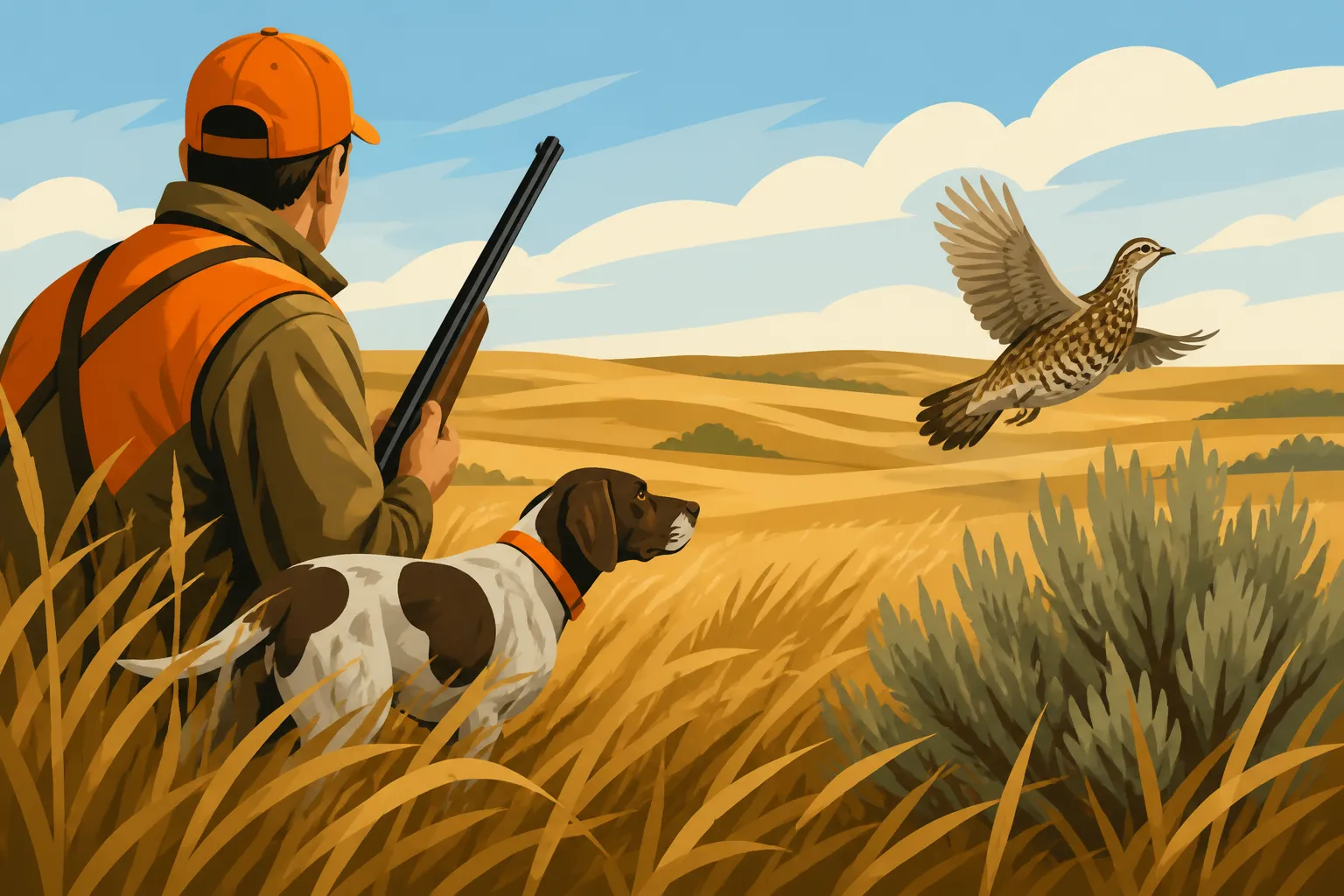
Hunting sharptails with a well-trained dog is an absolute game-changer. Pointing breeds like German Shorthaired Pointers, English Pointers, or Setters excel at finding birds, locking up on point, and holding them until you can get into position for the flush. Flushing dogs, such as various Spaniel breeds or Labradors, can also be highly effective at working cover and sending birds airborne. A good dog saves you countless miles of walking, retrieves downed birds, and generally enhances the entire hunting experience. For specific strategies on training and hunting with canine companions, consider reading about Using a Pointing Dog on Saskatchewan Prairie or Using a Flushing Dog in Thick Cover.
However, many hunters enjoy the challenge of walking up birds without a dog, and it's certainly doable with the right tactics. When hunting solo, you become the "dog," meticulously working cover, paying close attention to every detail of the terrain, and trying to anticipate where birds might be holding. It requires a more deliberate, slower pace, and often more ground covered, but the satisfaction of flushing a covey through your own efforts is immense. Solo hunters must be extra vigilant about marking fallen birds, as losing a downed bird in dense prairie grass is a common frustration.
Mastering the Walk-Up Strategy
Successfully walking up sharptails is less about random wandering and more about methodical, strategic movement across the landscape. It's a blend of keen observation and understanding bird behavior.
Effective Walking Patterns and Terrain Analysis
Simply walking in a straight line across a vast field is rarely the most effective approach. Instead, think about "working" the cover. A common strategy is to walk in a zig-zag pattern, especially across large, uniform blocks of grass. This allows you to effectively cover a wider swath of terrain and approach potential holding areas from multiple angles, increasing the likelihood of flushing birds. When approaching a bush bluff or a prominent coulee, try to walk a semi-circle around it or criss-cross through it, ensuring you hit all the likely escape routes and pockets of dense cover.
Always try to walk into the wind if possible. Birds tend to flush into the wind, giving you a slightly slower shot opportunity, and it helps your scent carry away from them, allowing for a closer approach. Pay close attention to subtle changes in elevation, density of cover, and any topographical features. Sharptails often prefer the edges of these features. Imagine you're pushing a bluff edge, systematically working one side, then the other, knowing that birds will likely be tucked into the leeward side away from the prevailing wind. If you're hunting with a partner, walking parallel lines about 20-30 yards apart can be highly effective, ensuring thorough coverage of a strip of habitat. For more detailed guidance on how to read a specific landscape, our article on Hunting a Saskatchewan Bush Bluff offers further insights.
Deciphering Sharptail Sign and Behavior
Learning to read the land for subtle clues is a critical skill for any upland hunter. While sharptails can be elusive, they do leave behind evidence of their presence. Keep an eye out for droppings, which are typically small and dark, often found in dusting bowls or under roosting cover. Dusting bowls are shallow depressions in the soil where birds have ruffled their feathers to clean them and remove parasites. These are a sure sign of recent bird activity.
Look for fresh tracks, especially in soft soil or after a light rain or snow. Sharptail tracks are distinctive and can tell you if birds are moving through an area. Feathers, particularly primary wing feathers, can indicate a recent roosting spot or even a predator kill. Listening is also key; the soft clucking or "coo" of sharptails can sometimes be heard before a flush, especially when they are undisturbed. When you do flush birds, pay careful attention to their flight path. If they flush wild and sail over a distant ridge, you know where to follow up. If they simply drop back into cover a short distance away, a second flush might be imminent. The ability to quickly locate fallen birds after the shot is crucial, so always mark the spot.
Executing the Flush and the Follow-Up Shot
The sharptail flush is often an explosive burst of wings and cackles that can startle even the most seasoned hunter. When birds go airborne, your reaction needs to be immediate and smooth. Resist the urge to rush your shot. Instead, focus on cleanly mounting your shotgun, swinging through the bird, and pulling the trigger just as your barrel passes it. Don't stop your swing! Many missed birds are the result of stopping the swing. Aim for the lead bird, or the one that offers the clearest shot, then focus on making that shot count.
Sharptails often fly in a somewhat erratic pattern initially, then settle into a strong, direct flight. If you miss on the first shot, quickly regain your composure and look for an opportunity for a second shot if your gun allows. If the covey flushes and sails a long distance, pay close attention to where they land. Often, they will regroup in new cover, and you can try to walk them up again. This "re-flushing" strategy can be very productive, as scattered birds are generally easier to approach and flush individually or in smaller groups. Sometimes, if you see them land, waiting a few minutes before approaching can allow them to settle, making your second stalk more effective.
Beyond the Shot: Ethics, Conservation, and Game Care
Hunting is more than just the pursuit of game; it's about respect for the land, the animals, and the traditions that bind us to the outdoors.
Respecting the Land and Ensuring Future Hunts
Saskatchewan is blessed with abundant wildlife, but access to private land is a privilege, not a right. Always ensure you obtain explicit permission from landowners before hunting on their property. A simple knock on the door, a polite request, and offering to share your harvest can go a long way in building positive relationships. Never assume access, even on unposted land. Understanding Saskatchewan Landowner Permission Law is critical for any hunter.
Furthermore, respect the resource by adhering to bag limits and season dates. Overharvesting or disrespecting regulations can have long-term negative impacts on sharptail populations and hunting opportunities for everyone. Consider the broader impact of your actions on the ecosystem. Sharptail numbers, like many upland species, can fluctuate due to habitat changes, weather patterns, and predation. Contributing to conservation efforts, such as those by the Saskatchewan Wildlife Federation, helps ensure healthy populations for generations to come. Understanding Why Sharptail Numbers Rise and Fall provides a deeper context for these considerations.
Field Dressing and Preserving Your Harvest
Once a sharptail is harvested, proper field dressing is essential to ensure the meat is of the highest quality. On warmer days, this should be done as quickly as possible to prevent spoilage. You can either breast out the bird, removing only the breast meat, or field dress it whole by removing the entrails. Many hunters prefer to breast them out immediately, as it lightens the load and allows the meat to cool more rapidly. Simply make an incision along the keel bone, peel back the skin and feathers, and cut the breast meat away from the bone.
Place the meat in a breathable game bag or a Ziploc bag with a paper towel to absorb moisture, then get it cooled as soon as possible. A cooler with ice is ideal for transport. Avoid stacking warm birds in a confined space, as this can trap heat and lead to spoilage. For whole birds, ensure they are thoroughly cleaned and cooled. The delicious, lean meat of a properly cared-for sharptail is a true culinary reward for your efforts on the prairie. Our guide on Meat Care in Saskatchewan's Cold Snaps offers broader tips that are applicable to smaller game as well.
Sharptail Hunting Strategies by Cover Type
| Cover Type | Description | Walking Strategy | Key Considerations |
|---|---|---|---|
| Native Grassland | Tall, unbroken prairie grass, often interspersed with forbs. | Wide zig-zag patterns, focusing on subtle dips and rises. Work edges thoroughly. | Birds can be anywhere; patience and thorough coverage are key. Wear good boots. |
| Mixed Pasture/Fencelines | Grazed areas adjacent to taller grass or light brush. | Concentrate on the taller grass strips, brushy fence lines, and ungrazed corners. | Check for old homesteads or abandoned machinery that provides shelter. |
| Coulees and Draws | Natural depressions or creek beds with dense willow/aspen bluffs. | Systematically work through the thickest cover, approaching from downwind if possible. | Birds will hold tight; be ready for explosive, close flushes. Can be physically demanding. |
| Field Edges/Stubble | Transition zones between cultivated fields and grass/brush. | Walk the edge where cover meets stubble. Periodically make short incursions into the stubble. | Birds feed in stubble but retreat to cover. Focus on the first 50-100 yards of cover. |
| Aspen/Willow Bluffs | Isolated clumps of trees and brush, often on rises. | Circle the bluff tightly, then work through the densest parts. Push all the way through. | Prime thermal and escape cover. Always expect birds here, especially on windy days. |
Disclaimer
Hunting laws and regulations in Saskatchewan are subject to change. Always consult the most current Saskatchewan Hunter's and Trapper's Guide and obtain the necessary licenses and permits before heading out on your hunt. This guide is for informational purposes only and does not constitute legal advice.