Saskatchewan’s Duck Species and Where They Nest
If you've ever stood on the edge of a prairie pothole, watching a flock of ducks burst from the cattails, you've likely wondered about the incredible diversity of waterfowl that call Saskatchewan home. This province, often dubbed the "Duck Factory of North America," is a critical breeding ground for countless species, and understanding where they nest is key to appreciating this rich ecosystem and planning future hunts. This guide will walk you through the various duck species found here and unveil their preferred nesting grounds across our vast and varied landscape.
The Breadbasket of North America: Why Saskatchewan is a Duck Paradise
Saskatchewan’s unique blend of geology, climate, and agriculture creates an unparalleled environment for waterfowl. It’s not just a fly-through zone; it's where generations of ducks are born and raised, making it an ecological cornerstone for North American duck populations. The sheer volume of water, coupled with vast food sources, creates conditions that are simply irresistible to ducks looking to raise a brood.
The Abundance of Water and Wetlands
Picture a landscape dotted with countless shimmering jewels – that’s Saskatchewan during a wet spring. The legacy of ancient glaciers has left behind an astounding number of shallow depressions, known affectionately as prairie potholes, sloughs, and wetlands. These aren't just puddles; they are vibrant, biodiverse mini-ecosystems teeming with insect life and aquatic vegetation. These wetlands vary in size from small, temporary ponds that last only a few weeks to permanent lakes that sustain life year-round.
This incredible network of wetlands provides everything a breeding duck needs: secure nesting cover on their edges, abundant invertebrate life crucial for egg-laying hens and rapidly growing ducklings, and relatively safe havens from terrestrial predators once the ducklings hatch. In many ways, the health of Saskatchewan’s duck population is directly tied to the health and abundance of these vital water bodies. Without them, the cycle of life for countless ducks would simply grind to a halt.
Prime Agricultural Land and Food Sources
Beyond the water, Saskatchewan offers another critical ingredient for duck success: prime agricultural land. Our vast grain fields, cultivated for wheat, barley, peas, lentils, and canola, might seem like an unlikely ally for waterfowl, but they provide an enormous buffet, especially during the crucial late summer and fall staging periods. While ducks don't nest directly in these fields, the proximity of abundant food post-hatch means hens can quickly replenish their energy reserves and ducklings can grow strong on protein-rich insects and spilled grain.
The landscape adjacent to these fields, often comprised of native grasslands, hayfields, and even road ditches, serves as vital nesting habitat. Once ducklings are mobile, these harvested fields become an easy source of high-energy food, helping them gain weight rapidly for their southward migration. This combination of wetland-rich breeding grounds and nutrient-rich agricultural landscapes is a powerful one, contributing significantly to why Saskatchewan is so important for the overall health of North America's duck populations. For hunters interested in Waterfowl Hunting Saskatchewan's Grain Fields, these agricultural areas are also crucial for attracting birds in the fall.
Diving into Saskatchewan's Diverse Duck Species
Saskatchewan hosts an impressive array of duck species, each with its own preferred habitat and nesting strategy. From the familiar dabblers of shallow potholes to the deep-diving specialists of larger lakes, our province caters to them all. Understanding these different groups helps you appreciate the nuanced ecosystems they inhabit.
Puddle Ducks: The Shallow Water Specialists
Puddle ducks, also known as dabbling ducks, are perhaps the most common and recognizable ducks in Saskatchewan. They prefer shallow wetlands where they can "dabble" or tip-up to feed on seeds, grains, and invertebrates close to the surface. Their nesting habits generally involve concealed nests in upland grasses near water.
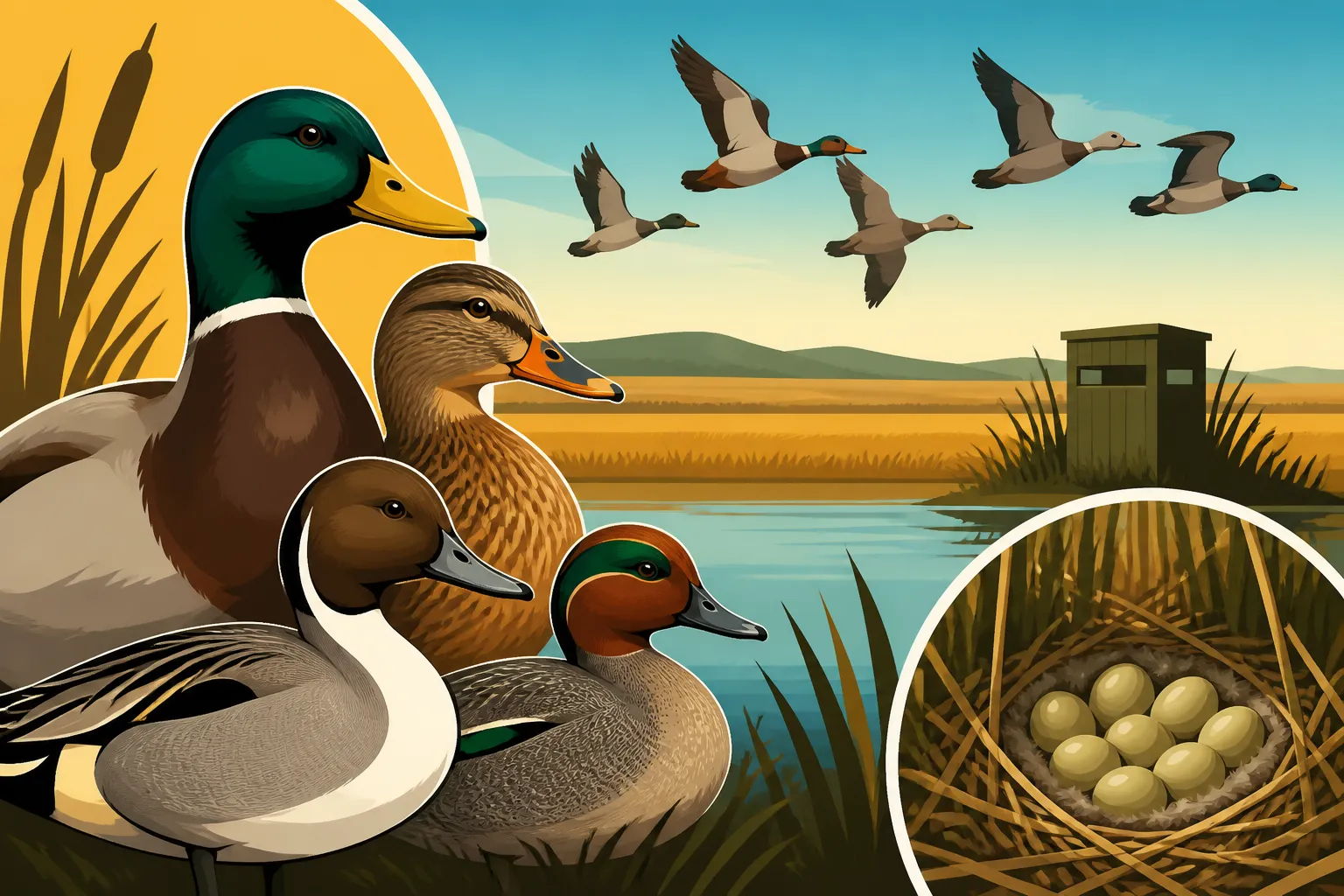
Mallards: The iconic green-headed drakes and mottled brown hens are perhaps the most widespread duck in Saskatchewan. Mallards are highly adaptable, nesting in everything from dense native prairie grass, hayfields, and emergent vegetation right next to a slough, to even relatively sparse cover further from water. They build cup-shaped nests on the ground, carefully camouflaged with surrounding vegetation and down feathers pulled from the hen's breast. You'll find them almost anywhere there's water and a bit of cover. For hunters seeking them out, knowing Which Ducks Nest in Saskatchewan's Potholes is invaluable.
Pintails: Sleek and elegant, the northern pintail is easily identified by the drake's long, slender tail feathers. Pintails often nest in more open, short-grass prairie environments, sometimes further from water than other dabblers, though always with a wetland or slough within walking distance for the newly hatched brood. Their nests are shallow depressions lined with grass and down, often less concealed than a mallard's. They are among the earliest nesters to arrive in Saskatchewan, taking advantage of early spring meltwater.
Wigeon and Gadwall: American wigeon, with their distinctive white crown patches, and gadwalls, with their subtly patterned grey bodies, are also prolific breeders here. Wigeon often nest in dry, grassy uplands near water, sometimes favouring native prairie habitat. Gadwalls are known for nesting in denser, often taller, grassy cover, sometimes on islands or peninsulas to gain extra protection from predators. Both species are excellent examples of the diversity found even among our common dabblers.
Green-winged and Blue-winged Teal: These smaller, agile ducks are often found in huge numbers. Blue-winged teal are particularly abundant in Saskatchewan, renowned for their early migration south. They typically nest in dense upland cover, usually within a short distance of a prairie pothole, and are often among the last duck species to hatch their broods. Green-winged teal, slightly smaller, often nest in similar grassy habitats, but tend to prefer wetlands with more emergent vegetation. Their rapid flight and quick maneuvers make them a favourite among hunters.
Northern Shovelers: With their distinctively large, spatulate bills, northern shovelers are unmistakable. Their unique bill is perfectly adapted for filtering small invertebrates and seeds from the water's surface. Shovelers typically nest in dense grassland cover, often right on the edge of a shallow, productive wetland. They are particularly drawn to potholes rich in plankton and small insects, which are crucial food sources for their specialized feeding technique.
Diving Ducks: Deep Water and Submerged Foragers
Diving ducks are generally found on larger, deeper bodies of water where they can dive for submerged vegetation, mollusks, and fish. Their legs are set further back on their bodies, making them efficient underwater swimmers but a bit awkward on land. Their nesting habits reflect this preference for aquatic environments.
Canvasbacks: Often called the "King of Ducks," the canvasback is a prized bird for many hunters. These magnificent divers are strongly associated with large, deep marshes rich in submerged aquatic vegetation, particularly wild celery and sago pondweed. Canvasbacks build elaborate overwater nests, often a floating platform of cattails or bulrushes, securely anchored to emergent vegetation in deeper water. They are less common than puddle ducks but a significant part of Saskatchewan’s diving duck population.
Redheads: Similar in shape to canvasbacks but with a distinctive red head and blue bill, redheads are another common diving duck in Saskatchewan. They are well-known for their habit of "parasitic nesting," where hens will often lay eggs in the nests of other redheads or even other duck species like canvasbacks. When they do build their own nests, they prefer dense emergent vegetation over shallow water, similar to canvasbacks. Their nests are usually well-concealed masses of vegetation.
Lesser Scaup: The lesser scaup, or "bluebill," is one of the most numerous diving ducks and a familiar sight on Saskatchewan's larger wetlands and lakes. While many lesser scaup breed further north in the boreal forest and tundra, a significant number also nest on the prairies, often utilizing uplands adjacent to large, permanent wetlands. Their nests are typically well-hidden in dense grass or shrubs.
Ring-necked Ducks: These handsome ducks, named for a subtle chestnut ring on the drakes' necks (though the white ring on the bill is more visible), are often found in areas with a mix of water and timber. While they do nest on the prairies, they become more prevalent as you move north into the Hunting Saskatchewan's Boreal Forest Fringe, favouring wetlands surrounded by trees, often with floating vegetation. Their nests are typically well-concealed in dense vegetation near water, sometimes on floating islands of emergent plants.
Goldeneyes and Buffleheads: These fascinating ducks are cavity nesters. While they might be seen on prairie wetlands during migration, their primary nesting grounds are typically in the boreal forest further north, where suitable tree cavities or abandoned woodpecker holes are available. However, in the northern parts of Saskatchewan's parkland and forest fringe, you can find them nesting in these tree hollows close to water. The Barrow's goldeneye is a rarer sight, primarily western in distribution, while the common goldeneye and bufflehead are more widespread.
Understanding Duck Nesting Habits Across the Province
Saskatchewan's vastness means a variety of landscapes, and each offers different appeal to nesting ducks. From the expansive southern prairies to the aspen parkland and the edge of the boreal forest, ducks adapt their nesting strategies to the available resources.
Prairie Potholes: The Nests in the Grass
The prairie pothole region, stretching across southern Saskatchewan, is arguably the most crucial duck nesting habitat in North America. This landscape is a mosaic of small, ephemeral wetlands and grasslands, a direct result of glacial activity. Ducks here are master opportunists, timing their nesting to coincide with the availability of water and abundant insect life.
Ducks nesting in this region, predominantly puddle ducks, rely heavily on dense, undisturbed residual grass cover for concealment. They'll choose a spot within a few hundred yards of a reliable water source, often a deeper pothole that can sustain a brood through the summer. The thick, matted vegetation of a previous year's growth provides excellent camouflage from avian predators like hawks and crows, and ground predators like coyotes and foxes. The importance of leaving sufficient grassland cover cannot be overstated; it's the very foundation of their reproductive success. Many conservation efforts, including those supported by the purchase of a Saskatchewan's Wildlife Habitat Certificate, focus on protecting and restoring these critical grassland habitats around potholes.
However, modern agricultural practices, while providing food, can pose challenges. Intensive farming often means converting grasslands to cropland, reducing available nesting cover. Furthermore, draining smaller, temporary potholes for easier cultivation reduces the overall wetland complex ducks rely on throughout the breeding season, especially during dry years. The success of a duck's nesting attempt in this region is a delicate balance of water, cover, and minimized disturbance.
Parklands and Forest Fringe: Diverse Habitats
As you move north from the open prairie, Saskatchewan transitions into the aspen parkland and then the boreal forest fringe, offering a different suite of habitats for nesting ducks. This zone is characterized by a mix of aspen bluffs, scattered conifers, small lakes, beaver ponds, and numerous sloughs, along with agricultural fields.
In the Aspen Parkland, ducks benefit from a more sheltered environment. Here, you'll still find abundant mallards, pintails, and teals nesting in grassy areas, but you'll also start to see more ring-necked ducks and some goldeneyes utilizing beaver ponds and small, wooded lakes. The bluffs provide vertical cover and sometimes even tree cavities for species like common goldeneye or bufflehead, although these are more common further into the true boreal forest. The mixture of dense underbrush, treed edges, and wetlands creates diverse nesting opportunities. Hunters often find great opportunities for Hunting the Forest Fringe for Big Bucks and diverse waterfowl populations.
The Boreal Forest Fringe, further north, offers an even greater variety of nesting sites. Here, species like common goldeneye and bufflehead become more common, often using natural tree cavities or artificial nest boxes near beaver dams and small forest lakes. Ring-necked ducks also thrive in these boggy, wooded wetlands. The dense forest offers excellent protection from many predators, though bears and wolves are also part of this ecosystem. This region might see fewer sheer numbers of ducks compared to the pothole-rich prairie, but it supports a crucial segment of the overall population, particularly for certain diving duck species.
River Systems and Large Lakes: Less Common, Still Important
While the prairie potholes and parkland wetlands are paramount for nesting, Saskatchewan's larger river systems and major lakes also play a role, albeit a different one, for nesting ducks. These larger water bodies often serve more as staging areas during migration, but they do offer some specialized nesting habitat.
Along major river systems like the South Saskatchewan River, ducks, particularly mallards and common mergansers, may nest on islands or in dense riparian vegetation along the banks. These areas offer some protection from terrestrial predators and access to the river's rich food sources. However, the fluctuating water levels and faster currents of rivers make them less ideal for widespread duck nesting compared to the calmer, shallower wetlands.
Large lakes, such as Last Mountain Lake or Lake Diefenbaker, while massive and attractive to migratory birds, are generally too open and deep to be primary nesting grounds for most duck species. However, their shallower bays, protected inlets, and marshy edges can support nesting canvasbacks, redheads, and scaup, especially where dense stands of cattails or bulrushes offer concealment and food. Islands within these larger lakes can also be critical nesting sites, offering refuge from ground predators. These areas become incredibly important staging grounds for thousands of birds before they head south, making them prime spots for Pothole Hunting Prairie Ducks or similar field hunting in the surrounding areas.
Key Factors Influencing Nesting Success and Duck Populations
Saskatchewan's ducks face a dynamic environment, with their nesting success heavily influenced by natural cycles and human activity. Understanding these factors is critical for appreciating the challenges and triumphs of our waterfowl populations.
Water Levels and Weather Patterns
Nothing dictates the success of a duck breeding season in Saskatchewan more than water. We've all seen the dramatic shifts: a wet spring fills every depression on the landscape, creating a duck paradise, while a dry year leaves many potholes as cracked mud, severely limiting breeding opportunities. Ducks are highly attuned to these conditions. In wet years, more pairs spread out, reducing competition and predation pressure, leading to higher nesting success and larger broods. In dry years, pairs concentrate on the few remaining water bodies, which can increase predation and reduce overall productivity.
Severe winters, especially if followed by a late, cold spring, can also impact ducks. Returning hens, already stressed from migration, might find food scarce and nesting cover slow to develop. This can delay nesting, reduce clutch sizes, or even prevent some hens from nesting at all. Conversely, a mild winter and early spring can kickstart the breeding season, giving ducks a head start. The long-term health of our duck populations is intrinsically linked to these unpredictable weather patterns and the resulting water availability. Indeed, understanding How Drought Moves Saskatchewan Game is crucial for all types of hunting here.
Predation and Habitat Loss
Even with ideal water conditions, nesting ducks face an array of challenges, with predation being a significant one. Skunks, raccoons, red foxes, coyotes, and even various avian predators like crows and magpies are constantly on the lookout for vulnerable nests and ducklings. A well-concealed nest is a hen's best defense, which is why dense nesting cover is so vital. When nesting cover is scarce, predation rates soar, devastating reproductive output.
Habitat loss remains the single biggest long-term threat to Saskatchewan's duck populations. The conversion of native grasslands to cropland, the drainage of potholes, and the degradation of riparian zones all directly reduce the amount of available nesting and brood-rearing habitat. While conservation efforts are always underway, the incremental loss of habitat over decades has profoundly impacted duck numbers. Protecting what remains and actively restoring degraded areas is paramount for ensuring future generations can enjoy the spectacle of migrating ducks. GoHunt and similar mapping tools can actually help identify areas of intact habitat that might be under less pressure.
The Role of Conservation and Hunter Contributions
Amidst these challenges, conservation efforts play an absolutely vital role in sustaining Saskatchewan's duck populations. Organizations like Ducks Unlimited Canada work tirelessly on the ground, restoring drained wetlands, planting nesting cover, and educating landowners on habitat management. Their efforts, combined with the dedicated work of provincial agencies, are a constant fight against habitat loss.
Hunters, through their licence fees and the purchase of federal and provincial stamps, are significant contributors to these conservation efforts. The funds generated directly support habitat protection, research, and management programs that benefit not only ducks but countless other wildlife species. For instance, the federal The Habitat Conservation Stamp Requirement directly channels funds towards wetland conservation projects across the country. It's a prime example of how hunters are often the most passionate and effective conservationists, directly funding the health of the very resource they cherish.
Scouting for Nesting Habitat and Future Hunting Success
Knowing where ducks nest isn't just academic; it's incredibly practical for hunters. Understanding breeding habitats gives you insights into population trends and helps you scout for productive areas during the hunting season. After all, healthy breeding grounds lead to abundant birds in the fall.
Reading the Landscape for Productive Areas
Successful scouting starts long before hunting season, often during the spring and summer months when ducks are actively breeding. When looking for nesting habitat, you're essentially looking for the ingredients that make a successful duck factory: water and cover. Tools like GoHunt or other digital mapping applications are invaluable here. You can identify wetland complexes, slough chains, and areas with large blocks of uncultivated grassland or dense bush that border water. Look for those willow rings around a pothole or a slough edge for whitetails that also offer incredible nesting cover.
On the ground, pay attention to the quality of the cover. Is it dense and tall enough to hide a hen and her nest? Are there enough small, isolated wetlands for broods to disperse and find security? Look for signs of past water levels – high water marks, healthy stands of emergent vegetation like cattails and bulrushes, and a diverse array of aquatic plants. The more varied and undisturbed the habitat, the more likely it is to be a productive nesting area. Scouting in this way not only increases your knowledge of duck behaviour but also helps you find those hidden gems that others might overlook come hunting season.
Timing Your Scouting Efforts
The best time to understand duck nesting habits and identify prime areas is actually outside of hunting season. Spring scouting, as soon as the snow melts and potholes begin to fill, allows you to gauge water levels and observe returning pairs. You can get a sense of which wetlands are holding water and which might dry up later in the summer. This early assessment is crucial, as areas that are dry in spring won't be productive later.
Summer scouting, particularly in July and August, is when you can identify successful broods. Look for hens with their ducklings on smaller, protected wetlands. Note areas where multiple broods are congregating, as these often indicate excellent brood-rearing habitat with abundant food and cover. These areas, particularly those near agricultural fields, are often magnets for ducks during the early fall hunting season. Understanding the breeding cycle and identifying these successful areas translates directly into better hunting decisions when the season opens. It's all about connecting the dots from spring breeding to fall migration. For a deeper understanding of the hunting landscape, checking out resources like Scouting a Saskatchewan Wildlife Management Zone is also highly beneficial.
Here's a quick look at some of Saskatchewan's key duck species and their nesting preferences:
| Duck Species | Primary Nesting Habitat | Key Nesting Characteristics | Common Diet |
|---|---|---|---|
| Mallard | Upland grasses, hayfields, dense cover near potholes | Well-concealed ground nests, often near water | Seeds, grains, aquatic plants, invertebrates |
| Northern Pintail | Open, short-grass prairie, sometimes further from water | Shallow ground nests, less dense cover | Seeds, grains, invertebrates |
| American Wigeon | Dry, grassy uplands near water, native prairie | Ground nests, well-hidden in grass | Aquatic vegetation, some insects |
| Gadwall | Dense, tall grass, often on islands or peninsulas | Ground nests, often well-camouflaged | Aquatic vegetation, seeds |
| Blue-winged Teal | Dense upland grass near shallow potholes | Ground nests, often late nesters | Seeds, invertebrates |
| Green-winged Teal | Grassy edges of wetlands, denser vegetation | Ground nests, typically in thick cover | Small seeds, invertebrates |
| Northern Shoveler | Dense grassland cover adjacent to shallow, productive wetlands | Ground nests, often near rich, shallow water | Invertebrates, small seeds |
| Canvasback | Large, deep marshes with dense emergent vegetation | Floating overwater nests, anchored to plants | Submerged aquatic plants, tubers |
| Redhead | Dense emergent vegetation over shallow water | Overwater nests, known for parasitic nesting | Submerged aquatic plants, seeds, mollusks |
| Lesser Scaup | Upland grasses near permanent wetlands, boreal forest | Ground nests, often in dense cover | Mollusks, aquatic insects, seeds |
| Ring-necked Duck | Boggy wetlands with wooded edges, beaver ponds | Well-concealed nests near or over water | Aquatic plants, insects, mollusks |
| Common Goldeneye | Tree cavities near wooded wetlands and lakes | Cavity nests in natural holes or nest boxes | Aquatic insects, crustaceans, small fish |
| Bufflehead | Tree cavities near wooded wetlands and lakes | Smallest cavity nester, prefers old woodpecker holes | Aquatic insects, crustaceans, mollusks |
Disclaimer
This article is for general informational purposes only and does not constitute professional advice. Laws, prices and regulations vary by location and change over time. Consult a qualified professional for guidance on your specific situation.