Cell Service at a Saskatchewan Camp
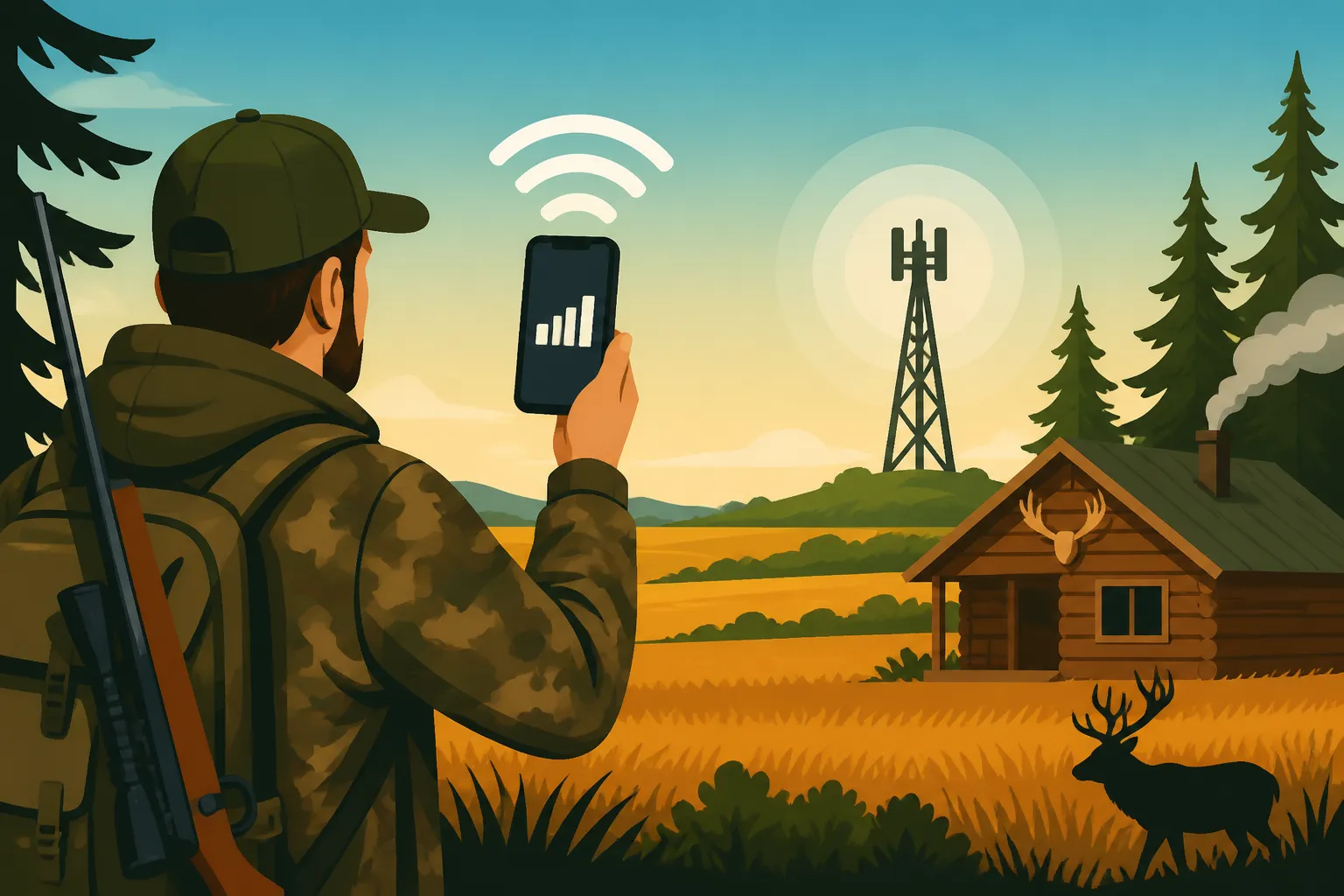
One of the most common questions that comes up when planning a remote hunting trip to Saskatchewan is about cell service. It's a valid concern in our increasingly connected world, and the reality is, if you're heading into many of the province's best hunting grounds, you're likely going to find yourself in a communication black hole. This guide will walk you through what to expect regarding cell service at a Saskatchewan hunting camp, why it's often a challenge, and how to prepare so you can hunt safely and enjoyably, even when completely off the grid.
The Harsh Reality of Saskatchewan's Remote Hunting Zones
Let's be blunt: if you're chasing big whitetails in the northern forest fringe, calling moose deep in the boreal, or tracking bear miles from the nearest paved road, reliable cell service is a pipe dream. Saskatchewan is a massive province, and while its cities and major highways have excellent coverage, the vast majority of its prime hunting habitat is simply too remote and too sparsely populated to justify the extensive infrastructure needed for consistent cell signals. It's a frustration many hunters face, particularly those coming from more densely populated areas where a signal is almost always taken for granted.
Imagine setting up camp deep in the Pasquia Hills or the Nipawin Provincial Forest, surrounded by miles of dense timber, rolling hills, and muskeg. There are no towns for an hour or more, and the only "roads" are often overgrown logging trails or cutlines. Cell towers need line of sight, and the terrain and tree cover in these areas actively work against any signal trying to reach you. It's not just an inconvenience; it's a fundamental aspect of hunting in truly wild country. Outfitters that cater to hunters in these remote spots often have to implement their own communication solutions, knowing their clients will be completely cut off from the outside world during their stay. When researching potential outfitters, platforms like BookYourHunt can sometimes offer insights into camp amenities, including whether they provide any form of Wi-Fi or satellite communication, but assuming cell service will be there is a mistake.
The "Coverage Map" Illusion
It's tempting to pull up an online coverage map from a major carrier like Bell, Rogers, or Telus and see those optimistic green blobs stretching out into what looks like your hunting area. However, these maps can be incredibly misleading when it comes to the specific conditions a hunter faces in the field. They often depict theoretical maximum coverage under ideal conditions (flat ground, no obstructions, clear weather), which rarely applies when you're tucked into a coulee, deep in a willow run, or nestled in a spruce bluff.
What those maps don't show is the terrain variability, the density of the tree cover, or the true distance from the nearest tower. A small pocket of trees or a slight rise in the land can completely block a weak signal. Many times, the "coverage" you see on a map for a remote area is simply a fringe signal that might be picked up by a powerful, high-mounted antenna, not the modest antenna in your smartphone. Always assume that if you're not within a few miles of a town or major highway, the actual cell service will be significantly worse than any map suggests, if it exists at all. Trusting these maps implicitly could leave you in a bind when you truly need to communicate.
Understanding Different Providers
While Canada has a few major cell service providers, the reality in remote Saskatchewan is that no single carrier offers a magic bullet for widespread, reliable service. Bell, Rogers, and Telus all have extensive networks, but their primary focus, understandably, is on populated areas and major transportation corridors. Once you venture off the beaten path, their coverage tends to drop off dramatically and equally.
You might find slight variations in specific fringe areas, where one carrier might have a tower slightly closer or with better line-of-sight to a particular camp. However, this is more the exception than the rule. In the deep bush or vast prairie, all providers often struggle. Don't waste time switching SIM cards or trying multiple phones from different carriers, hoping for a breakthrough in a truly remote camp; it's unlikely to make a significant difference. The problem isn't usually which provider you have, but rather the fundamental lack of infrastructure in that particular remote locale. Hunters need to plan for a complete absence of service, regardless of their chosen provider.
Planning for Limited or No Connectivity
Since you can't rely on cell service, proactive planning becomes absolutely paramount for safety and peace of mind. This isn't just about calling home; it's about emergency preparedness when you're miles from help. The silence of the wilderness is part of its allure, but it also demands a higher level of self-reliance and pre-planning. Many seasoned hunters will tell you that the ability to truly disconnect is a gift, but that doesn't mean forsaking safety.
When you're Hunting Saskatchewan Winter Weather Safely, for example, a simple slip or unexpected equipment failure can turn serious quickly. Without the ability to call for help, a minor incident can escalate into a life-threatening situation. So, think ahead about how you'll communicate with the outside world, or at least with your hunting partners, when your phone becomes nothing more than a camera. This is where dedicated communication devices earn their keep.
Essential Communication Strategies
Given the unlikelihood of cell service, your primary communication strategy needs to revolve around devices specifically designed for off-grid use. Satellite phones are the gold standard for two-way voice communication, offering the ability to make and receive calls from virtually anywhere. While they come with a higher cost for the device and service, they provide unparalleled peace of mind for group leaders or those venturing into truly extreme isolation. The clarity and reliability of a sat phone can be a literal lifeline.
More common and increasingly popular are satellite messengers. Devices like Garmin inReach or Zoleo offer two-way text messaging, GPS tracking, and an SOS button that connects you directly to emergency services. They are smaller, more affordable, and require less power than a satellite phone. Many hunters consider these an absolute necessity, not a luxury. For shorter-range communication within your hunting party, robust two-way radios (walkie-talkies) are invaluable, especially when spread out in thick cover. These allow you to coordinate movements, share observations, and maintain contact without relying on any external network. Always pack extra batteries for all your devices.
| Communication Device | Primary Function | Best Use Case | Pros | Cons |
|---|---|---|---|---|
| Satellite Phone | Two-way voice/text | Critical emergencies, remote expedition lead | Full communication, global coverage | Expensive, bulky, high subscription |
| Satellite Messenger | Two-way text, SOS, GPS | General backcountry safety, check-ins | More affordable, compact, emergency beacon | Text-only (mostly), subscription needed |
| Two-Way Radio (UHF/VHF) | Short-range voice | Party communication, camp-to-stand | No subscription, instant local comms | Limited range, line-of-sight dependent |
| Personal Locator Beacon (PLB) | One-way SOS | Life-threatening emergencies | Single-purpose, highly reliable emergency | No two-way communication, only SOS |
Informing Loved Ones and Emergency Contacts
Beyond the devices you carry, one of the most important communication strategies is managing expectations and establishing a clear plan with those back home. Nothing causes more worry than unexpected silence when a loved one is hunting in a remote area. Before you even head out, provide a detailed itinerary, including your expected hunting area (using a Reading a Saskatchewan WMZ Map Before You Go can help), your planned dates, and when they should expect to hear from you.
Give them the contact information for your outfitter, if applicable, or the local authorities (e.g., RCMP detachment, conservation officer phone numbers) if you’re self-guided. Show them how to use your satellite messenger's tracking or check-in features, so they can monitor your progress or receive pre-programmed messages. Ensure someone knows your "trip plan" for Planning a Saskatchewan Hunting Trip. This way, if you don't check in by a certain time, they know precisely who to call and where to direct help. This kind of thoughtful preparation is just as crucial as packing your rifle or bow when you consider the potential for What to Do If You Get Stuck in the Bush. Even if you book through an experienced outfitter, it's a good practice to share this information with your personal emergency contacts.
Strategies for Boosting Weak Signals (If You Get Any!)
Sometimes, you might find yourself in a "fringe" area – not completely off the grid, but with a signal so weak it's almost useless. This often happens near the edges of population centres, or in specific topographical sweet spots. In these situations, while not guaranteed, there are a few things you can try to coax a bit more life out of your phone. Remember, these strategies are for boosting an existing, albeit weak, signal, not for creating one out of thin air in the middle of Hunting Saskatchewan's Boreal North.
Consider your specific camp location. If you’ve chosen your camp spot carefully, maybe you're on a slight rise, or near the edge of a field where a tower might be distantly visible. Outfitters who operate on the edge of the true wilderness might have invested in fixed solutions for their lodges. For independent hunters, however, you're looking for marginal gains that might allow for a quick text or a very short, choppy phone call. It's about maximizing every photon of signal that makes it your way.
Cell Boosters and Antennas
For those with a semi-permanent camp setup or an RV, a dedicated cell signal booster can be a game-changer. These systems typically consist of an external antenna (often a directional Yagi antenna), a booster unit, and an internal antenna. The external antenna is mounted high (on a pole, tree, or camper roof) and pointed towards the nearest cell tower (which you might need to find using an app or compass). It captures a weak signal, sends it to the booster, which amplifies it, and then broadcasts it to your devices via the internal antenna.
These can take a one-bar signal and turn it into three or four bars, enough for basic communication and even some slow data. However, they require some existing signal to amplify. They won't work if there's no signal whatsoever. They're an investment, but for those who spend a lot of time in fringe areas, or run a camp where guests appreciate occasional connectivity, they are highly effective. For mobile use in a truck or quad, smaller vehicle-mounted boosters are also available, though their effectiveness depends heavily on speed and constant signal acquisition.
Finding That Elusive Signal Spot
Even without a booster, you can often find a "sweet spot" for a weak signal. Think about line of sight. Climb to the highest point available – a small hill, a rock outcrop, or even the roof of your vehicle (safely!). Sometimes, just walking 50 yards in one direction can make a difference due to a slight change in elevation or clearing of trees. Look for open areas, like a cutline, a field edge, or a clearing in the bush.
The orientation of your phone also matters. Some phones have stronger internal antennas in specific directions. Try holding it up high, rotating slowly, and watching the signal bars. It might feel a bit like a rain dance, but often, there's a particular spot or angle that allows just enough signal to squeak through for a quick text. Be patient, and don't assume no service until you've tried scouting a bit for a signal – just like you'd scout for game. Remember, your primary goal is safe communication for situations like Emergency Plans in Saskatchewan's Bush, not browsing social media.
The Unplugged Advantage: Embracing the Wilderness Experience
While the lack of cell service can initially feel like a hurdle, many veteran hunters consider it one of the greatest benefits of hunting in Saskatchewan's wilderness. It forces a complete disconnection from the constant demands of modern life, allowing you to fully immerse yourself in the hunting experience. This isn't a problem to be solved; it's an opportunity to truly unplug and recharge in a way few other activities allow. Many outfitters embrace this, offering a chance to escape the digital world entirely. For those considering Hunting Guides and Outfitters in Saskatchewan, discuss their camp's connectivity options (or lack thereof) openly.
Think of it as a digital detox, a forced sabbatical from emails, notifications, and endless scrolling. It's a rare chance to truly be present, to focus on the sounds of the forest, the subtle signs of game, and the company of your hunting partners. In an era of constant connectivity, a break from the screen can be incredibly revitalizing, improving mental clarity and allowing for a deeper appreciation of nature.
Focusing on the Hunt
When your phone isn't constantly buzzing with updates from the outside world, your mind is freed to focus entirely on the task at hand: the hunt. You'll find yourself more attuned to the environment, noticing subtle details like a distant crow call, the rustle of leaves that might be a deer, or the faint scent of moose. Your senses sharpen, and your awareness expands beyond the small screen in your hand.
This heightened focus isn't just about success in the field; it's about the richness of the experience. You'll spend less time distracted and more time observing, learning, and truly hunting. Many hunters find that without the pull of digital distractions, they are more patient in the stand, more observant on a stalk, and simply enjoy the quiet contemplation that hunting often provides. Consider tools like GoHunt for planning and research before your trip, so that once you're in camp, your focus can shift entirely to the pursuit of game. This dedicated attention to the hunt is why many seek out remote experiences in the first place, like hunting for Why Saskatchewan Bucks Grow So Large in the solitude of the wilderness.
Bonding with Your Hunting Party
Another fantastic benefit of being off-grid is the unparalleled opportunity for camaraderie and connection with your hunting partners. Without everyone buried in their phones, conversations flow more freely around the campfire, at the dinner table, or while sharing stories in the blind. Laughter echoes, memories are forged, and bonds are strengthened in a way that modern distractions often prevent.
This shared experience, stripped of digital interference, is a cornerstone of the hunting tradition. Whether you're discussing tactics, reliving the day's events, or simply enjoying quiet fellowship, the absence of cell service fosters genuine interaction. It’s a chance to truly connect with friends, family, or even new acquaintances in your hunting camp, creating a deeper, more meaningful experience that transcends the harvest itself. For a comprehensive list of items, not just tech, that you'll need, check out What to Bring to a Saskatchewan Deer Camp.
Disclaimer
This article is for general informational purposes only and does not constitute professional advice. Laws, prices and regulations vary by location and change over time. Consult a qualified professional for guidance on your specific situation.