Judging a Mule Deer Buck at Distance
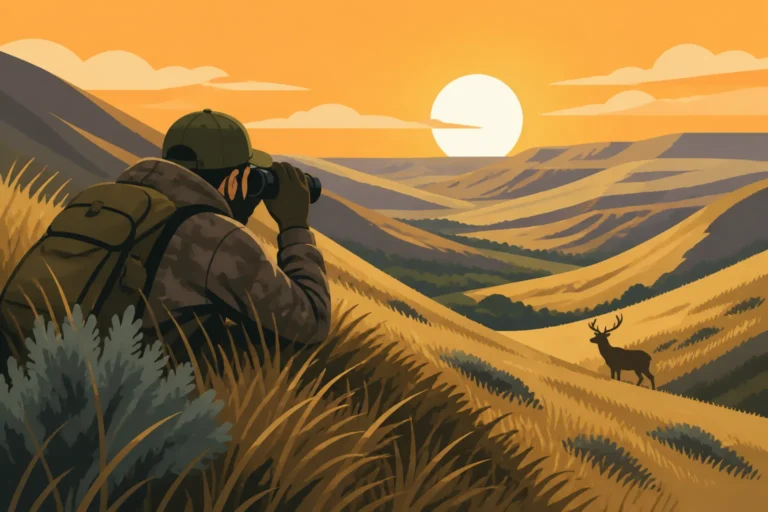
There’s almost nothing more frustrating for a hunter than getting a good look at a mule deer buck from a distance, seeing that tell-tale wide rack, and then having that little voice of doubt creep in: "Is he really as big as he looks? Or is it just the distance playing tricks?" It’s a classic dilemma that leads to either passing on a great deer or, worse, taking a shot at one that doesn't quite live up to expectations once you walk up to it. This guide is all about equipping you with the knowledge and techniques to confidently assess a mule deer buck's size, even when he’s a speck on a distant Saskatchewan prairie.
The Inherent Challenges of Distance Judging
Judging any animal at extreme distances is tough, but mule deer, with their wide antlers and often solitary nature, present a unique set of challenges. The vast, open landscapes of Saskatchewan, while beautiful, can make things even trickier.
The Deceptive Nature of Optics and Terrain
One of the biggest hurdles is how distance itself, combined with optics, can distort your perception. That majestic buck you're seeing through your binoculars at 800 yards might appear massive, but it's crucial to remember that magnification compresses perspective. A wide-racked buck can look even wider, and a tall set of antlers can seem taller, simply because the brain struggles to accurately gauge scale without familiar reference points. Add to this the undulating prairie terrain or the deep cuts of coulees, and you suddenly lose the ability to compare the deer to a standard tree or fence post. A buck standing on a slight rise can appear significantly larger than one nestled in a dip. Even the time of day and the angle of the sun can play tricks, casting long shadows that exaggerate antler length or mass. It's a mental game as much as it is a visual one.
Then there's the infamous mirage. On a warm, sunny day, especially across a stubble field or a sun-baked hillside, heat waves can make a deer shimmer, distorting its outline and making accurate judgment nearly impossible. What looks like a massive G2 might just be atmospheric distortion. This is why having quality optics that perform well in varying conditions is paramount, but even the best glass can’t completely eliminate nature’s visual tricks. When you're glassing a Saskatchewan coulee for mule deer, these challenges are amplified by the broken ground and numerous hiding spots.
Lighting Conditions and Their Impact
The sun is both your best friend and worst enemy when judging deer at a distance. Early morning and late evening light, often referred to as "golden hour," can illuminate a buck's antlers beautifully, highlighting tines and mass. However, low-angle light can also create dramatic shadows that make a rack seem larger or more intricate than it actually is. Imagine a buck silhouetted against a setting sun; his antlers might appear as a solid, imposing mass, making it hard to discern individual points or true width.
Mid-day sun, while bright, can wash out details, making it difficult to pick out brow tines or subtle curves in the main beam. Overcast days offer more consistent, softer light, which can be ideal for judging if the visibility is good, as it reduces harsh shadows and glare. However, on heavily overcast or foggy days, the lack of contrast can make it hard to distinguish details against a muted background. When you're Hunting Mule Deer After a Snowfall, the bright white snow can reflect light and create its own challenges with glare, though it often makes a deer's dark body stand out clearly. Every type of light demands a slightly different approach to judging.
Key Antler Characteristics for Accurate Assessment
To reliably judge a mule deer buck at distance, you need a systematic approach, focusing on specific antler characteristics rather than just the overall "wow" factor. It’s about breaking down the rack into its component parts and evaluating each one.
Width, Mass, and Main Beam Length
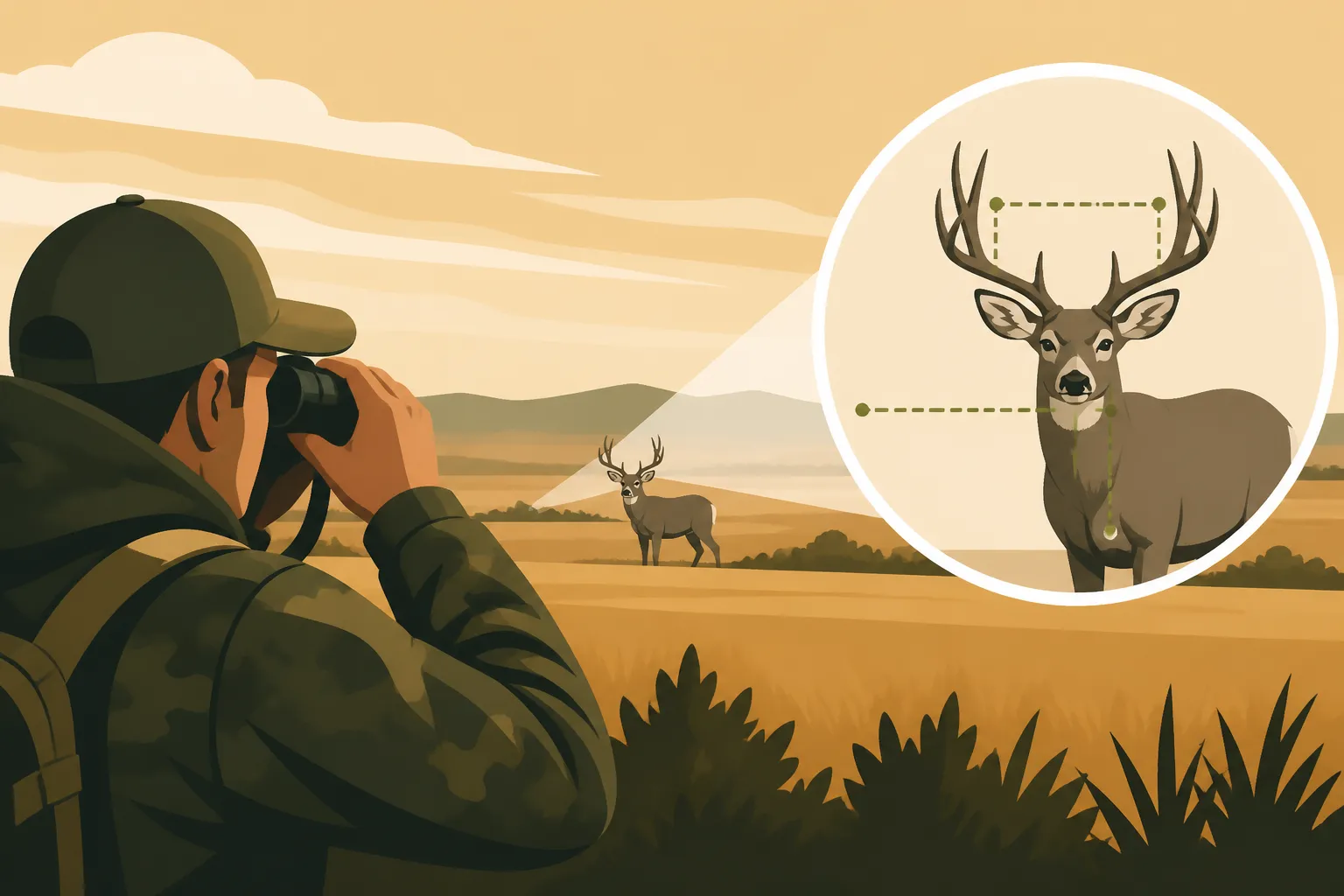
These three elements are often the first things hunters look for, and for good reason. A truly mature Saskatchewan mule deer buck will display significant width. The goal is to estimate whether the main beams extend beyond the ears when the deer is alert and facing you. A good rule of thumb is that if the antlers appear to extend significantly past the ear tips, you're likely looking at a buck with an inside spread of at least 22-24 inches, which is a solid mature deer in most areas. Truly exceptional bucks will push past 26 inches. However, angle is everything here; a buck quartering away or towards you can make a narrow rack look wide, and vice-versa. Always try to see the buck broadside or straight on to get an accurate width assessment.
Mass refers to the thickness of the antlers. This is harder to judge at extreme distances, but a heavy-antlered buck will have bases that appear thick and ropey, maintaining that thickness well up the main beams before tapering. Young bucks often have spindly, thin antlers. Look for bulk. When a buck turns his head, does the mass fill out your binocular view, or does it look thin and delicate? The best place to gauge mass is at the bases and the lower half of the main beams. Paired with width, good mass is a strong indicator of age and maturity, factors that contribute to Why Saskatchewan Bucks Grow So Large.
Main beam length is the third pillar. A mature mule deer will have long, sweeping main beams that extend back, up, and then forward. Younger bucks often have shorter, more upright beams. Try to visualize the arc of the main beam. Does it look like it could easily exceed the length of the buck’s head? Long main beams are crucial for adding overall score and visual appeal.
Tine Length and Fork Development
Mule deer are defined by their characteristic forked antlers, and the development of these forks, particularly the G2s (the first fork back from the brow tine) and G3s (the second fork), is critical. For a mature buck, you want to see deep, well-defined forks. The tines themselves should be long and symmetrical.
- G2s (First Forks): These are perhaps the most important tines for judging. Look for G2s that are significantly longer than the ears. Many younger bucks will have G2s that are only as long as or shorter than their ears. A mature buck's G2s will often appear to be half the length of his entire head or longer. These are usually the longest tines on the rack.
- G3s (Second Forks): On a typical mule deer, the G3s come off the G2s, creating the classic double-forked look. Assess their length in relation to the G2s. Are they short nubs, or are they well-developed and adding significant mass and height to the rack?
- Brow Tines: While not as prominent as on a whitetail, many mule deer will have brow tines (G1s). Look for their presence and length. They contribute to the overall score and can be an indicator of a quality buck.
- Symmetry: While perfect symmetry is rare, a generally balanced rack often signifies a healthy, mature animal. Look for similar tine lengths and fork development on both sides.
A good rule of thumb for antler quality is to compare the tines to the deer's ears. If the G2s are much longer than the ears, and the G3s are also well-developed, you're likely looking at a good buck. The GoHunt app can be a great tool for visualizing these proportions if you use its mapping features to estimate distance and then adjust your mental image based on field experience. Knowing the difference between Telling a Whitetail From a Mule Deer is also crucial, as their antler growth patterns are distinct.
Practical Techniques and Tools for Distance Judging
Beyond just knowing what to look for, employing proper techniques and utilizing modern tools can significantly improve your accuracy when judging mule deer at long range.
Using Body Size as a Reference
One of the most effective ways to avoid "ground shrinkage" – where a deer looks bigger than it is until you walk up to it – is to use the buck's body as a reference point. A truly mature mule deer buck will have a substantial body. They're barrel-chested, deep through the brisket, and their neck will often appear thick and powerful, especially during the rut. Younger bucks, even with decent antlers, will typically have a more slender, "leggy" appearance.
When you're glassing, try to gauge the buck's body relative to its head and neck. Does his body look disproportionately large compared to his head? Does his brisket almost touch the ground? Is his neck blending seamlessly into his shoulders, creating a powerful, thick profile? Compare the overall size of the buck to other deer in the area, if present, or even to nearby cows if you're Hunting a Cattle Pasture Draw. A big-bodied buck often correlates with a mature rack. Remember, a mature Saskatchewan mule deer buck can weigh significantly, so a substantial body indicates that age and nutritional history.
Spotting Scopes, Binoculars, and Rangefinders
This is where your gear truly shines. Good quality optics are not just for seeing deer, but for judging them.
- Binoculars (10x-15x): These are your primary scouting tool. Use them to locate deer, quickly assess general size, and scan for potential shooters. A clear, bright image is paramount for picking up subtle details in the antlers. Consider models from brands like Vortex, Zeiss, or Swarovski for their clarity and low-light performance.
- Spotting Scopes (20x-60x or higher): For detailed judgment at extreme distances, a spotting scope is indispensable. Set it up on a sturdy tripod and crank up the magnification. This allows you to really pick apart the antlers – counting points, assessing mass, and scrutinizing tine length. Look for characteristics like palmation, kickers, or even broken tines that might not be visible with binoculars. When you're trying to judge a buck from across a wide prairie expanse, or from one side of a deep coulee to the other, the extra magnification makes all the difference. Many experienced hunters will spend hours behind a good spotter before deciding to make a move on a distant buck.
- Rangefinders: You absolutely need a reliable rangefinder. Knowing the exact distance is critical for judging. An animal at 500 yards will always look smaller than one at 200 yards, but without a range, you can't accurately apply your mental scale. The GoHunt app, while not a rangefinder itself, often integrates with external rangefinders or provides topographical maps to help you plan your approach after you've made a judgment. Using a rangefinder helps you avoid the common mistake of underestimating distance, which makes a deer appear larger than it is.
Utilizing Digital Tools and Scouting Techniques
Modern technology has given us powerful tools that assist in distance judging, even before you step foot in the field.
- Mapping Apps (like GoHunt): Before your hunt, use mapping apps to scout potential areas. Look for natural landmarks, fence lines, and elevation changes that you can use as reference points for judging size in the field. If you mark a distant rock or tree in the app, you can then use your rangefinder to get its exact distance and then mentally compare the buck to that known distance. The GoHunt app is excellent for this, allowing you to create waypoints and measure distances between points, giving you a better understanding of the scale of the landscape you're looking at. This can be especially helpful when you're considering Glassing a Saskatchewan Coulee for Mule Deer or Hunting Mule Deer in Prairie Coulees, where varying elevations can confuse the eye.
- Photography and Video: If possible and ethical, sometimes taking a photo or video through your spotting scope can help. You can then zoom in on the image and take your time analyzing the rack without the pressure of the moment. Many modern spotting scopes have digiscoping adapters for smartphones. This allows for peer review among hunting partners, too.
- Pre-Season Scouting: Nothing beats putting in the time before the season. Scout as much as possible, become intimately familiar with the deer in your hunting area. Learn their travel patterns, bedding areas, and feeding habits. This allows you to see them multiple times, in different lighting and from various angles, which helps immensely with accurate judgment. If you know what a 160-inch buck generally looks like in your specific hunting zone, you’ll be much more confident when a new buck steps out. This ties into understanding Why Mule Deer Numbers Rise and Fall in your specific WMZ.
Here’s a quick comparison table for judging mule deer characteristics:
| Characteristic | Young Buck (2.5-3.5 yrs) | Mature Buck (4.5+ yrs) | Trophy Class Buck (Exceptional) |
|---|---|---|---|
| Antler Width | Equal to or slightly outside ears | Significantly outside ears (22-26"+) | Well beyond ears (28"+) |
| Antler Mass | Thin, spindly, quick taper | Thick bases, good mass throughout beams | Very heavy, ropey, deep forks |
| Main Beam Length | Shorter, upright, less sweep | Long, sweeping, extend well past head | Exceptionally long and flowing |
| G2 (First Fork) | Equal to or shorter than ear length | Significantly longer than ear length | Very long, often equal to head length |
| G3 (Second Fork) | Short or non-existent | Well-developed, adds height | Deep, well-defined, adds significant mass |
| Body Size | Lean, leggy, narrow chest | Deep chest, thick neck, barrel-chested | Massive, robust, powerful build |
| Neck | Slender, clearly defined from shoulders | Thick, blends into shoulders, powerful | Very thick and muscular, especially during rut |
Common Mistakes and How to Avoid Them
Even with the best tools and knowledge, hunters still make mistakes. Recognizing these pitfalls is the first step to avoiding them and ensuring a successful, ethical hunt.
Underestimating Distance and Overestimating Antlers
This is probably the most common mistake. Our brains are wired to perceive objects at distance as smaller, but combine that with the excitement of seeing a buck, and suddenly the perceived size of the antlers can be greatly exaggerated. The flat, open expanses of Saskatchewan, particularly when Stalking Mule Deer in Open Prairie, can make judging distance incredibly difficult without a rangefinder. What looks like 300 yards can easily be 450, and at that increased distance, a decent buck can appear truly monumental.
To avoid this, always, always range the deer and any nearby landmarks multiple times. Don't rely on your "eye-ometer." Before you even consider taking a shot, know the exact distance. If you're hunting with a partner, have both of you range the animal and compare notes. If there's a discrepancy, re-range. Moreover, try to get multiple angles if the deer is moving. A buck might look narrower head-on than broadside, but then appear to have incredible mass when quartering. Slow down, breathe, and use your tools.
Rushing the Decision
The adrenaline of seeing a big buck can be overwhelming. The urge to act quickly, to make a move, or to take a shot before the opportunity vanishes, is a natural but dangerous instinct. Rushing leads to poor decisions, misjudgments, and potentially missed shots or, worse, wounding an animal. Saskatchewan hunting conditions, with often fickle weather and wary mule deer, demand patience.
Take your time. Get settled. Deploy your spotting scope. Critically evaluate the buck using the criteria discussed above. Don't let "buck fever" cloud your judgment. If the buck is moving, wait for him to stop and present a clear, broadside view. If you can't get a good read, or if you feel rushed, it's always better to pass and wait for another opportunity. There's no shame in letting a buck walk if you're not 100% confident in your judgment. The experience of seeing him, studying him, and then deciding to pass is still a valuable part of the hunt. This patient approach is especially important when you're hunting species that require a drawn tag, such as the ones discussed in Saskatchewan's Big Game Draw. You don't want to burn a hard-earned tag on a buck you regret.
Misidentifying Species or Sex
While less common for experienced hunters, in moments of extreme excitement or poor visibility, it's possible to misidentify. Always confirm it's a mule deer and a buck. Ensure there are no antlerless tags needed (if applicable for your zone and season) or that you're not mistaking a whitetail for a mule deer, especially in areas where both species overlap, like the forest fringe or certain parkland zones. This is where those clear distinguishing features, like mule deer's large ears, ropey antlers, and typically non-branching brow tines (unlike whitetails), become crucial. The characteristic black tip on the mule deer's tail is also a dead giveaway if you can see it clearly.
Before putting your crosshairs on a deer, take a moment to confirm all identification points. This ethical responsibility is paramount for every hunter. If you're ever unsure about rules or regulations, refer to the official Saskatchewan Hunting Licences and What They Cost guide or the local Ministry of Environment website.
By taking a systematic, patient, and tool-assisted approach to judging mule deer bucks at a distance, you'll dramatically increase your confidence and the satisfaction of your hunt in Saskatchewan's beautiful wild spaces.
Disclaimer
The information provided in this article is for general guidance and informational purposes only. Hunting regulations, seasons, and requirements can change. Always consult the official Saskatchewan hunting regulations guide, available from the Saskatchewan Ministry of Environment, or contact a local conservation officer for the most up-to-date and accurate information before planning any hunting trip. Hunter safety and adherence to all laws are paramount.