Where Saskatchewan Whitetails Bed in Snow
Finding whitetail deer in Saskatchewan during the winter, especially when the snow starts piling up, can feel like an impossible task. They don't just disappear, but they sure do change their patterns, making those familiar haunts from the fall rut seem empty. If you've spent frustrating days trudging through drifts, wondering where all the deer went, you're not alone. This guide will help you understand the crucial role snow plays in whitetail bedding choices and equip you with the knowledge to pinpoint their winter hideouts, turning those cold, quiet days into productive hunts.
Understanding Winter Whitetail Behavior in Saskatchewan Snow
When Saskatchewan truly embraces winter, with its biting winds and deep snow, whitetail deer switch into survival mode. Their primary concerns become conserving energy, finding reliable food, and escaping the elements. Their bedding choices are a direct reflection of these priorities, far more so than in milder seasons.
The Critical Role of Thermal Cover
In the face of sub-zero temperatures and relentless winds, thermal cover isn't just a comfort for whitetails; it's a lifeline. They seek out areas that offer the best insulation and protection from the elements. Think dense stands of evergreens like spruce or pine, which act as natural blankets, trapping warmth and breaking the wind. Even thick, brushy aspen bluffs, with a dense understory of young saplings and willow, can provide significant relief from the cold. A deer bedded down in a dense cluster of conifers will be exponentially warmer than one exposed to the open prairie wind.
These areas create microclimates where the air temperature is noticeably higher, and the wind chill is drastically reduced. Deer will often bed in the lee of hills, ridges, or thick bush, where prevailing winds are blocked. This strategic placement helps them minimize energy expenditure, as they don't have to burn as many calories simply trying to stay warm. A common scenario is finding multiple deer bedded tightly together in the deepest part of a thicket, sharing body heat, especially during particularly brutal cold snaps or after a fresh snowfall. They'll even create shallow depressions in the snow, essentially forming a bowl that further insulates them from the ground and wind.
Food Sources and Their Proximity to Bedding
Winter food is scarce, and every calorie counts. Whitetails in Saskatchewan will instinctively choose bedding areas that are relatively close to their most reliable winter food sources. This isn't just about convenience; it's about survival. The less energy they expend traveling to feed, the more energy they conserve for warmth and health.
Common winter food sources include browse such as willow, aspen, red osier dogwood, and various shrubs, especially those in overgrown clearings or along forest edges. In agricultural areas, deer will often turn to residual grain in swathed fields, standing corn, or even hay bales left out for livestock. They'll also paw through shallower snow to access acorns or other mast if available in specific regions. Therefore, if you're Reading Whitetail Sign in Saskatchewan Bluffs, look for heavy trails leading directly from thick cover to nearby fields or browse. The distance between these two critical points will often shrink considerably in deep winter compared to other seasons. The balance is always between the security of the bedding cover and the accessibility of food. A deer won't bed in the absolute thickest, most secure cover if it means a long, arduous trek through deep snow to get to its meal.
Adapting to Different Snow Depths
The depth and consistency of the snow cover significantly dictate where and how whitetails bed. A light dusting or shallow snow might not change their patterns much; they may still bed in slightly more open areas, using terrain for windbreaks. However, once the snow starts piling up, say eight inches or more, their choices become more restricted and predictable.
In deep snow, whitetails seek out areas with less snow accumulation, often under dense canopy cover where snow is intercepted by branches, or on south-facing slopes that receive more sun and melt faster. They'll also create networks of trails, often referred to as "deer yards," in these areas of deeper snow. These compacted trails allow them to move more easily between bedding sites and food sources without expending too much energy. During blizzards or heavy snowfall, deer will hunker down in the most impenetrable cover they can find, often staying bedded for extended periods until the storm passes. This is a crucial time for them, as visibility is low, and movement is extremely difficult. By paying close attention to track depth and pattern, as discussed in Reading Sign After Fresh Saskatchewan Snow, you can glean a lot of information about snow depth and deer activity levels.
Prime Bedding Locations in Saskatchewan's Diverse Winter Landscape
Saskatchewan's landscape is a patchwork of boreal forest, aspen parkland, and vast prairies, each offering unique challenges and opportunities for whitetails seeking winter sanctuary. Understanding these diverse habitats is key to locating their bedding sites.
Forest Fringe and Aspen Parkland Havens
The forest fringe and aspen parkland zones, particularly in central and northern Saskatchewan, are prime wintering grounds for whitetails. These areas offer the perfect combination of dense cover, browse, and proximity to agricultural fields. Whitetails here will gravitate towards:
- Thick Aspen Bluffs and Poplar Stands: These dense stands, especially those with a healthy understory of young trees and shrubs, provide excellent thermal protection and windbreaks. Deer will often bed on the lee side of these bluffs, protected from the prevailing northwesterly winds. When Hunting a Saskatchewan Bush Bluff, look for the thickest, most impenetrable sections, particularly where older growth has created a dense canopy.
- Willow Bottoms and Slough Edges: These low-lying areas, often choked with dense willow thickets, offer incredible cover, especially if there's standing water or frozen ground beneath that discourages human intrusion. The willows themselves are also a primary food source. Deer often find relief here, especially if the surrounding terrain offers a slight rise to block wind. Hunting a Frozen Slough Crossing can be productive, as deer often use these as travel corridors between bedding areas.
- Evergreen Pockets: Any patch of spruce, pine, or tamarack in the parkland will be a magnet for deer. These conifers offer superior thermal cover compared to deciduous trees, retaining their needles all winter. Whitetails will often create dense bedding areas within these pockets, sometimes referred to as "winter yards." The thick canopy intercepts snow, creating shallower, more manageable conditions on the forest floor.
Prairie Coulees and River Bottoms
In the more open, southern prairie regions of Saskatchewan, whitetails must adapt their bedding strategies to a landscape with less widespread forest cover. Here, geological features become critical.
- Deep Coulees and Ravines: These natural depressions offer significant protection from the wind, especially the steep-sided, brushy ones. Deer will bed on the leeward slopes, out of the wind, often in dense shrubbery or willow thickets at the bottom. The deeper the coulee, the better the thermal protection. This is why Hunting a Prairie Coulee Bottom can be so effective in winter, as these natural troughs funnel deer movement and provide essential cover.
- River Valleys and Breaks: Major river systems like the South Saskatchewan River or the Qu'Appelle River create extensive networks of broken country, offering a mix of deciduous trees, evergreens (in some areas), and dense brush. The steep banks and floodplains provide abundant cover and food, making them critical wintering areas. Deer will often bed high on south-facing slopes to catch the sun, or down in the thickest brush near the river for maximum protection.
Farmland Cover and Shelterbelts
Even in the most intensively farmed areas, whitetails find ways to survive the winter by utilizing whatever cover is available, often in close proximity to nutrient-rich agricultural fields.
- Standing Crops: Fields of standing corn, or unharvested patches of grain, offer both food and surprisingly effective thermal cover. Deer will bed directly within these fields, using the stalks for concealment and wind protection. This can be challenging to hunt, but scouting for entry and exit points along the edges can be productive.
- Bush Pockets and Abandoned Farmyards: Isolated patches of bush, often remnants of old homesteads or uncultivated land, become vital bedding areas. These small islands of cover, often surrounded by open fields, provide concentrated areas of safety. Abandoned farmyards, with their overgrown trees, old buildings, and brush, can also serve as excellent winter bedding, offering a surprising amount of shelter.
- Shelterbelts and Tree Rows: Planted tree lines, primarily for windbreaks around fields and farmsteads, provide crucial linear cover. While not as extensive as natural bush, a dense shelterbelt can offer enough protection for deer to bed, especially if it connects to larger blocks of cover or runs along a field edge with available food. Hunting a Shelterbelt Between Two Fields is a common strategy, as deer will often bed within or near these linear features.
Reading the Snow: Sign and Strategy for Locating Beds
The snow itself becomes your greatest ally in winter hunting, transforming the landscape into a giant, readable signpost. Learning to interpret the stories etched in the snow is critical for success.
Interpreting Tracks and Trails
Fresh snow offers an unparalleled opportunity to understand deer movement. Tracks tell you not only that deer are present but also their recent activity, direction of travel, and even their approximate size.
- Fresh Tracks: Focus on tracks that are crisp, with sharp edges, and show no signs of melting or refreezing. These indicate very recent activity, likely within the last few hours. Following fresh tracks can lead you directly to a bedding area or a feeding site. Pay attention to the stride length and depth; a deer walking normally will have a consistent stride, while a running deer will show longer, more erratic strides and deeper depressions.
- Travel Patterns: Deer typically establish predictable travel corridors between their bedding areas and food sources. In snow, these become well-worn trails, especially in deep snow where they try to minimize energy expenditure. Look for main trails entering and exiting dense cover, particularly those that parallel the edge of a field or follow a natural contour like a ridge or a creek bottom. These trails are hotspots for intercepting deer moving between sleep and sustenance. Understanding How Deep Snow Moves Deer Into Cover is paramount, as these trails will often lead to the most sheltered pockets.
Key Indicators Beyond Tracks
While tracks are invaluable, other signs confirm the presence and habits of wintering whitetails.
- Actual Bed Impressions: Nothing beats finding an actual bed, a depression in the snow where a deer has recently rested. These are often oval-shaped, with a clear outline of the deer's body. Fresh beds might still have warmth radiating from them, or show signs of melting. Multiple beds in close proximity indicate a family group or a preferred bedding location. Look for these in the thickest parts of cover, often with an escape route in mind.
- Browse Lines: In areas where deer are heavily wintering, you'll often see distinct browse lines on trees and shrubs. This is where deer have nipped off twigs and branches within their reach. Freshly browsed twigs will show clean, ragged breaks (deer lack upper incisors), indicating recent feeding. The height of the browse line can also give you an idea of snow depth in relation to available food.
- Droppings and Urine: Fresh droppings, usually found along trails or in feeding areas, can tell you about the deer's recent diet and how long ago they passed through. Urine stains in the snow, especially if they haven't frozen solid, are another strong indicator of very recent presence.
Using Technology for Scouting
Modern technology can significantly enhance your winter scouting efforts, even when you can't be physically in the field.
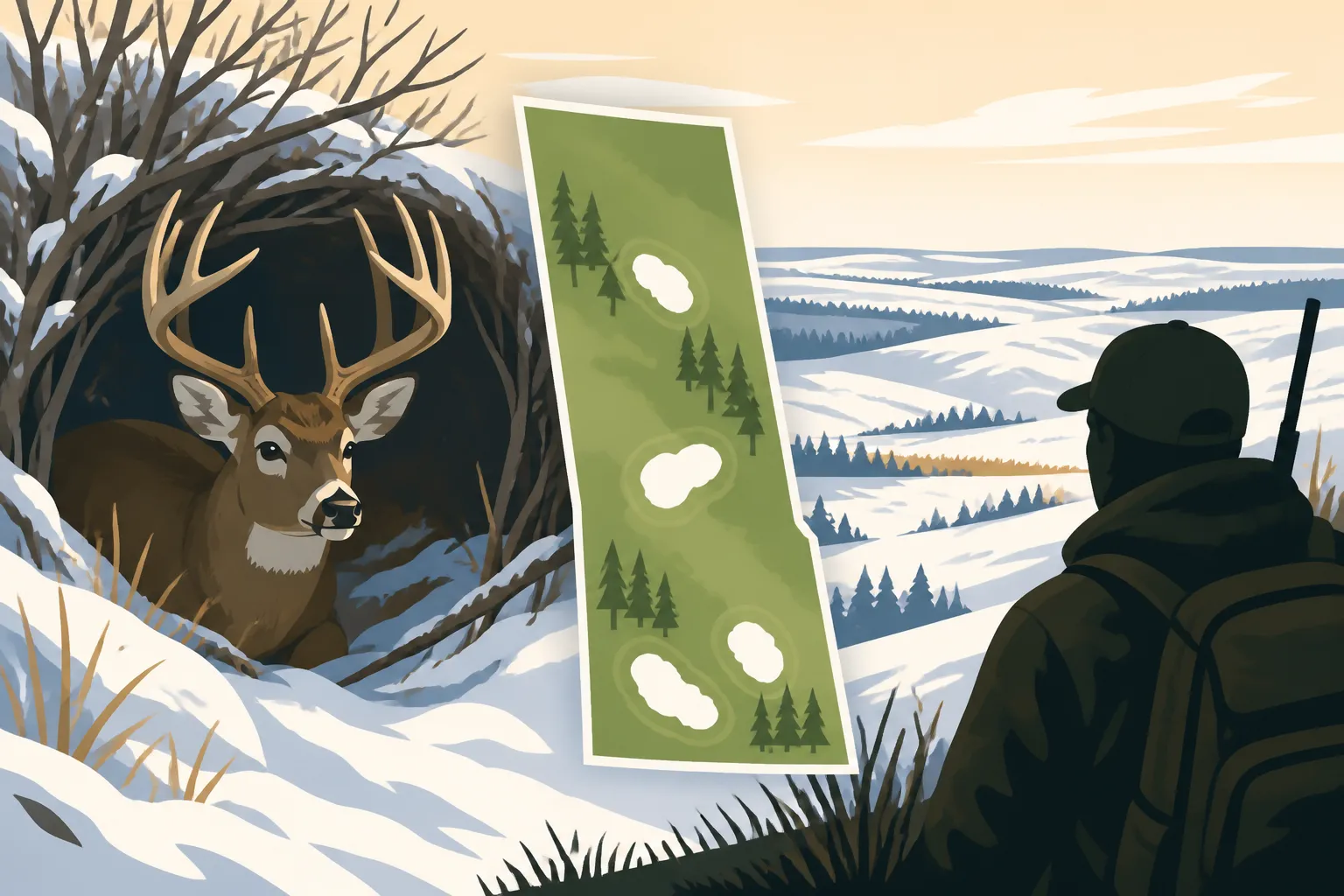
- Mapping Applications: Tools like GoHunt or other topographic mapping apps are incredibly useful for identifying potential bedding areas before you even set foot in the snow. Look for areas with dense canopy cover (often darker green on satellite imagery), steep south-facing slopes, or a confluence of different cover types. You can use these apps to overlay public and private land boundaries, helping you focus your efforts on accessible areas. Identifying features like dense aspen stands, creek bottoms, or evergreen pockets on a map helps you narrow down where deer might seek refuge from the cold.
- Satellite Imagery: Analyzing satellite imagery, especially recent photos if available, can reveal patterns of deer use that might not be obvious from the ground. Look for established trails in open fields leading to cover, or areas of heavy cover that might not be visible from the road. The "thermal cover" you're looking for will often appear as darker, denser patches on high-resolution satellite views. Remember, Scouting With Satellite Imagery in Saskatchewan allows you to cover vast amounts of ground from the comfort of your home, saving precious hunting time.
Hunting Strategies for Bedded Whitetails in Winter
Once you've identified potential bedding areas and confirmed recent deer activity in the snow, it's time to adjust your hunting tactics to these colder, often more challenging, conditions.
The Art of Still-Hunting and Stalking
Winter snow provides a unique advantage for the still-hunter and stalker: quiet movement. Fresh snow dampens sound, allowing you to move through the woods with much less noise than in dry conditions.
- Slow and Deliberate: Still-hunting involves moving incredibly slowly, stopping frequently to scan, listen, and glass. In winter, this means taking one step, pausing for several minutes, and carefully examining every piece of cover ahead of you. Whitetails will often bed facing downwind, relying on their nose, but their eyes and ears are still critical.
- Use the Wind and Terrain: Always approach a suspected bedding area from downwind or crosswind. The wind will carry your scent away from the deer, preventing them from detecting you. Use terrain features like ridges, hills, or thick brush to your advantage, breaking up your silhouette and providing concealment. When stalking, ensure you're always mindful of your footsteps, aiming for patches of shallower snow or frozen ground that won't crunch as loudly. Spotting a bedded deer in dense winter cover can be incredibly difficult, often only a patch of hide or an antler tip is visible, so keen observation is key.
Group Drives and Push Tactics
In some situations, particularly in large blocks of dense cover like a sprawling bush bluff or extensive river bottom, group drives can be an effective way to move bedded deer.
- Strategic Planning: This tactic requires careful planning and communication among hunters. Drivers walk through the cover, pushing deer towards strategically placed standers who are waiting along known escape routes or edges. The deeper the snow, the more difficult it is for deer to move quickly, which can sometimes work in the hunters' favor.
- Safety First: Safety is paramount with group drives. All participants must know exactly where everyone is, wear plenty of blaze orange, and be aware of shooting lanes and backstops. This method is often employed when hunting larger wintering areas where deer are known to congregate, but are too difficult to still-hunt individually.
Stand Placement Near Bedding
For hunters who prefer to sit, understanding winter bedding patterns is crucial for effective stand placement.
- Intercepting Movement: Rather than placing a stand directly in a bedding area (which risks bumping deer and contaminating the area), set it up on the travel corridors leading to and from the bedding. This might be a pinch point where a deer trail crosses an open area, or a natural funnel between two pieces of cover. During winter, deer often feed during the day, especially if it's not brutally cold, so setting a stand for mid-day movement can be productive.
- Morning vs. Evening: In the morning, deer will often be moving from feeding areas back to their beds. In the evening, they'll be moving from beds to food. Knowing the location of both allows you to set up for the appropriate time of day. Consider Hanging a Stand on a Saskatchewan Bush Edge overlooking a field where deer feed, knowing they will retreat to the heavy cover of the edge to bed down after dark or during daylight hours when disturbed. Remember, staying warm when Hunting Whitetails at Thirty Below is key, so consider insulated blinds.
Here's a quick overview of typical winter whitetail bedding areas in Saskatchewan:
| Habitat Type | Primary Bedding Cover | Key Features & Why Deer Choose Them | Hunting Strategy Considerations |
|---|---|---|---|
| Forest Fringe/Parkland | Dense Aspen Bluffs, Willow Thickets, Evergreen Pockets | Thermal insulation, windbreak, dense concealment, proximity to browse/fields. | Still-hunt slowly, use wind, consider small drives, stand on travel corridors. |
| Prairie Coulees | Steep Coulee Banks, Brushy Bottoms | Wind protection, elevation changes, hidden pockets, natural travel funnels. | Stalk carefully into wind, glass frequently, focus on sheltered slopes. |
| Farmland | Standing Crops, Bush Pockets, Shelterbelts | Food source, concealment, windbreak (even if less thermal), isolated safety. | Identify access points, hunt edges, use GoHunt for identifying bush pockets. |
| River Bottoms | Thick Riverine Forest, Brushy Banks | Extensive cover, diverse browse, protection from wind in low-lying areas. | Follow main trails, look for pinch points, consider small group pushes. |
Remember, Whitetail Hunting in Saskatchewan in the snow is a test of patience, observation, and adaptability. But by understanding the whitetail's winter survival instincts and learning to read the clues the snow provides, you can turn those challenging conditions into incredibly rewarding hunts. Always prioritize safety, especially when Hunting Saskatchewan Winter Weather Safely.
Disclaimer
Hunting is an inherently dangerous activity. Always prioritize safety, understand and follow all local hunting regulations, and ensure you have the necessary training and equipment. The information provided in this guide is for informational purposes only and should not replace professional guidance or official hunting regulations.