Telling a Whitetail From a Mule Deer
There’s nothing quite like the rush of spotting a deer in the vast and varied landscapes of Saskatchewan. But for many hunters, especially those new to our province or even seasoned folks hunting unfamiliar zones, a moment of excitement can quickly turn into a moment of confusion: Is that a whitetail or a mule deer? Making the wrong identification can lead to a missed opportunity, or worse, an illegal harvest. This guide is here to walk you through the key distinctions, ensuring you can confidently tell a whitetail from a mule deer, enhancing both your hunting success and your appreciation for these magnificent creatures.
The Tale of Two Tails: Primary Distinguishing Feature
When you’re trying to distinguish between a whitetail and a mule deer, the absolute first place your eyes should go is the tail. It’s their namesake for a reason, and it offers the most immediate and consistent giveaway.
Whitetail's Flag: Color, Shape, and Movement
A whitetail deer’s tail is truly its signature. When relaxed, it often appears as a relatively thin, long tail, usually dark brown on top with pristine white underneath. It might hang down or be slightly tucked, not particularly flashy. However, the moment a whitetail senses danger or takes off in flight, that tail snaps up like a bright white flag, revealing the pure white underside. This is an unmistakable signal, flashing through the treeline or over a stubble field as the deer bounds away.
This "flagging" action is a crucial communication tool within the herd, warning others of perceived threats. Imagine you’re Hunting Whitetails in Saskatchewan's Forest Fringe and a doe busts out of a willow thicket, her tail waving like a banner. That’s a whitetail, plain and simple. Even from a distance, or in poor light, that flash of white as it raises its tail is often enough to make a positive identification. Observing this behavior is a cornerstone for accurate identification in the field.
The size of the tail is also notable – it's typically quite broad at the base and tapers to a point. When they flick it or raise it, it creates a very distinct visual. This high-contrast signal helps deer maintain visual contact in thick cover, which is often where whitetails prefer to spend their time. So, if you see that unmistakable white flag, you've got yourself a whitetail.
Mule Deer's Rope: Color, Shape, and Movement
Now, contrast that with the mule deer’s tail, which is entirely different. A mule deer’s tail is typically narrower, shorter, and often described as rope-like. It’s usually creamy white at the base, but as it extends, it’s tipped with a distinctive black brush. When a mule deer is alerted or running, its tail generally hangs down, often swaying slightly, and it doesn't "flag" in the same dramatic way a whitetail's does. You won't see that all-white underside flash.
This difference in tail behavior is just as telling as its appearance. If you're Glassing a Saskatchewan Coulee for Mule Deer and a deer jumps up, pay close attention to its hindquarters. If the tail stays down, or maybe gives a gentle swish, and you see that black tip, you're almost certainly looking at a mule deer. They use their tails for communication, but it’s a more subtle affair, lacking the overt "flag" signal.
Sometimes, in dense cover or at a great distance, the black tip might be harder to discern, but the overall lack of a bright, flashing white underside should still guide you. The shape and consistent dark tip are the definitive features. In the more open prairie and badlands environments where mule deer thrive, their tail characteristics are adapted differently from their forest-dwelling whitetail cousins.
Antler Architecture: Branching Out Differently
Beyond the tail, the antlers of mature bucks offer another clear distinction, though it requires a slightly better view and understanding of their unique growth patterns.
Whitetail Antler Characteristics: Main Beam and Tines
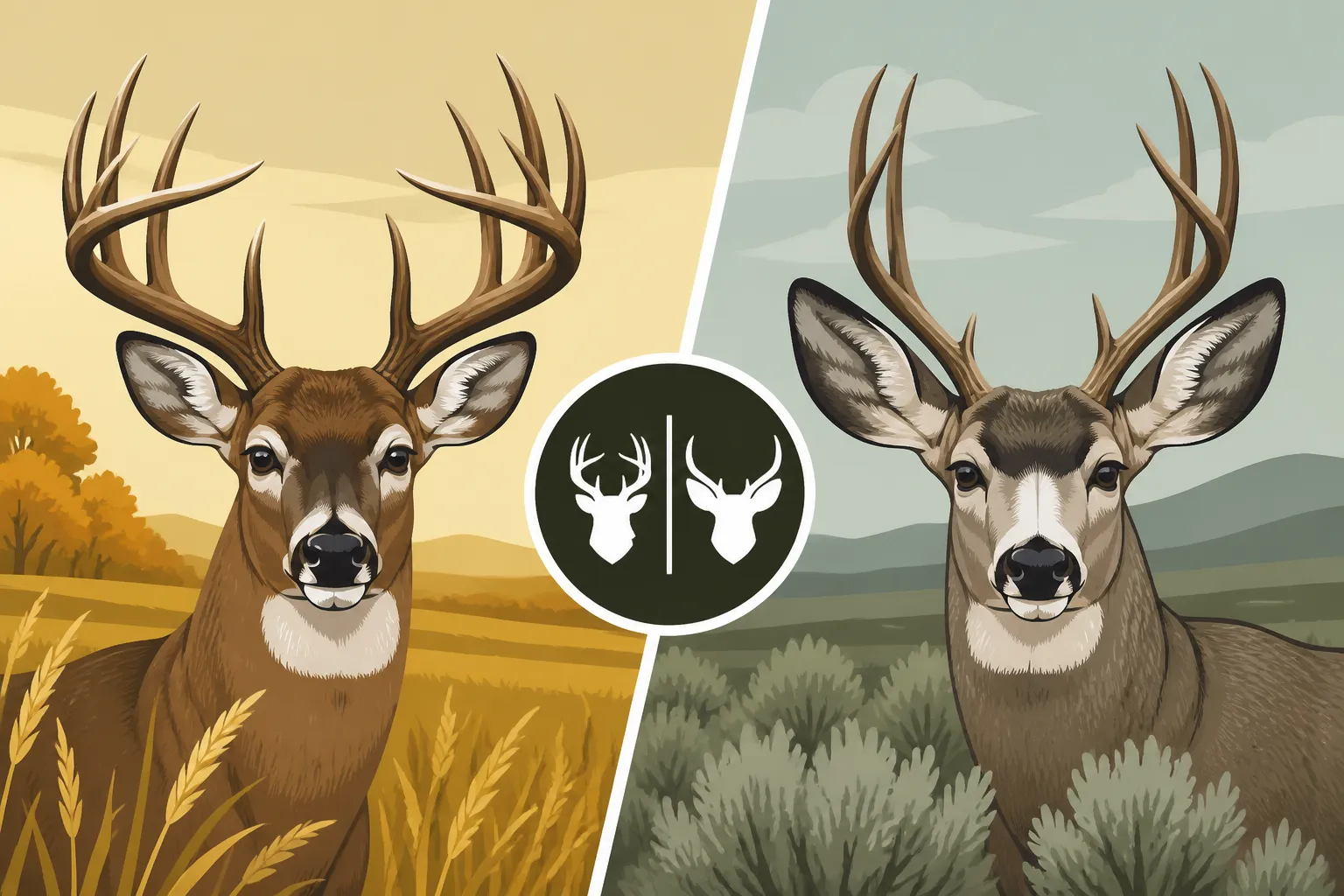
Whitetail bucks are famous for their "main beam" style antlers. This means that a single main beam emerges from the pedicle and sweeps forward and then typically curves back, with individual tines (points) growing upward from this main beam. Think of it like a hand, where the palm is the main beam and the fingers are the tines. Most often, these tines are unbranched.
So, when you look at a typical whitetail rack, you'll see a distinct, strong beam that is the base for all the points. A typical 8-point buck will have four points coming off each main beam, for example. Non-typical racks can complicate this, with additional points, drops, or abnormal growth, but even then, the underlying structure of a main beam with tines growing off it is usually evident. This is especially true of the large bucks often found in the Saskatchewan landscape; it's part of Why Saskatchewan Bucks Grow So Large.
Observing this main beam structure is critical, particularly during the early to mid-November rut when bucks are most active. If you’re trying to distinguish a buck at a distance, focus on that overarching beam from which all other points project. This characteristic is a fairly reliable indicator across most antlered whitetails you'll encounter.
Mule Deer Antler Characteristics: Bifurcation and Forked Tines
Mule deer antlers, on the other hand, are characterized by their "bifurcation" or "forking" pattern. Instead of a single main beam with tines growing off it, the main beam forks, and then each of those forks often forks again. It’s more like a tree branch repeatedly splitting. A typical mule deer might have a 4×4 rack, but instead of individual points, you’ll see the beams splitting into two, then those two split into two again.
This creates a more "basket-like" appearance, or a double-forked configuration. A large, mature mule deer buck often displays deep, heavy forking, making its rack look denser and wider than a whitetail of comparable size. This is particularly noticeable if you're stalking a mule deer in open prairie and get a good look at its head-on profile.
Understanding this branching pattern is key when you're glassing for deer in areas where both species might be present. When a buck turns its head, you can often see if the points are simply rising from a main beam or if the beams themselves are splitting repeatedly. This unique structure contributes to the distinctive profile of a mule deer buck.
Antler Anomaly and Age Considerations
Of course, nature loves to throw curveballs. Young bucks of both species might have small, unbranched antlers (spikes or forks) that can be confusing. A spike whitetail and a spike mule deer can look quite similar, requiring you to rely on other features like the tail, ears, and body. Similarly, antler abnormalities caused by injury, nutrition, or genetics can produce non-typical racks in either species that deviate from the classic patterns.
In such cases, it's essential to not rely solely on antlers for identification. This is where combining all your observational skills comes into play. If you're seeing a non-typical rack, perhaps from a whitetail that has had an injury, it will still have that tell-tale flagging white tail. The overall body proportions, ear size, and how the deer moves will help confirm your identification. Always use a combination of factors, especially if antlers are atypical or small.
Body Language and Gait: How They Move and Act
Beyond static features, the way these deer move and carry themselves can provide critical clues, especially when they are spooked or on the run.
Whitetail's Sneak and Dash: Movement Patterns
Whitetail deer typically move with a more fluid, graceful gait. When they're walking or casually feeding, it’s a typical deer trot. However, when a whitetail is alarmed, it generally attempts to sneak away or, if fully spooked, breaks into a powerful, bounding run. This run is characterized by a series of powerful leaps, often punctuated by that high-held white tail flagging furiously. Their front legs extend, then their hind legs propel them forward, covering ground quickly and efficiently.
This "dash" is an escape tactic perfectly suited for the broken cover, aspen bluffs, and dense brush where they often live. They weave through obstacles, using their speed and agility, with the flagging tail acting as a visual distraction and warning system. If you see a deer running low to the ground, bursting through bushes with explosive speed and its tail flying high, you're looking at a whitetail. This is a common sight when Hunting Whitetails on Saskatchewan Farmland where they might be hiding in a willow run or a bush bluff.
Even when they're simply walking, whitetails tend to have a slightly more slender, athletic build compared to the often stockier mule deer. They often hold their heads a little lower, more poised for quick flight. Pay attention to how the deer clears obstacles; whitetails are adept at jumping fences and logs with a clean, fluid motion.
Mule Deer's Bounding Bounce: The Pronk
The mule deer’s most distinctive movement is undoubtedly the "pronk," also known as stotting or bounding. When alarmed, a mule deer will often gather all four feet beneath its body and spring forward in a stiff-legged, bouncy leap. All four hooves hit the ground simultaneously, and then all four push off together again. This motion is incredibly effective for traversing rough, uneven terrain like coulees, badlands, and rocky hillsides, which is often where you’ll find them.
This stiff-legged bounce gives them an almost cartoonish, spring-loaded appearance. They don't have the same low, weaving dash as a whitetail. Instead, they gain height and an elevated view with each pronk, allowing them to survey their surroundings for threats. The tail, remember, usually stays down during this pronking, perhaps giving a slight flick, but never flagging like a whitetail's. This is a signature move, and once you've seen a mule deer pronk, you won't forget it.
Imagine you're spotting in a deep prairie coulee and a deer pops up and bounds away, stiff-legged and high-bouncing. That’s your mule deer. This movement is a clear, visual indicator, often more reliable than antler configurations, especially at longer distances or in less than ideal lighting conditions. The pronk is an adaptation to open, broken country, allowing them to gain elevation and avoid obstacles like sagebrush or uneven ground with ease.
Habitat Preferences and Overlap in Saskatchewan
While both species can be found in Saskatchewan, their preferred habitats often provide clues. Whitetails are incredibly adaptable and thrive in a wide range of environments, from the dense Boreal Forest fringe to the bluffs and shelterbelts of the agricultural belt. They love thick cover, river bottoms, and areas with abundant browse and escape routes. You’re more likely to see a whitetail deer in the aspen parkland or forested areas.
Mule deer, conversely, are typically creatures of the more open, rugged landscapes. They prefer the prairie grasslands, badlands, coulees, and broken country of southwestern Saskatchewan. They are often found in areas with sagebrush, rocky outcrops, and sparse trees, relying on their keen eyesight and pronking ability to evade predators in open spaces. If you're in the Cypress Hills or the Great Sand Hills, you're probably in prime mule deer country.
However, it's crucial to remember that their ranges do overlap, particularly in the transitional zones like the aspen parkland and the western edges of the agricultural land. It's not uncommon to see both species in the same general area, sometimes even in the same field. This overlap is precisely why understanding the individual physical and behavioral characteristics is so vital. Never assume based solely on habitat, especially in these crossover zones.
Ear Size and Facial Features: Beyond the Obvious
Once you've looked at the tail, antlers, and movement, take a closer look at their heads. The ears and overall facial structure also provide distinct differences.
The Whitetail's More Modest Ears
Whitetail deer have ears that are proportionally smaller and more rounded compared to a mule deer. While still quite large and capable of swiveling to pick up sounds, they don't dominate the head as much. When a whitetail is alert, its ears will be erect and attentive, but they won't typically appear disproportionately large for its head.
Think about the classic picture of a whitetail, and the ears just seem to fit, not stand out. This subtlety in ear size is another consistent identifier. In Saskatchewan, where we have such fantastic whitetail populations, you'll get plenty of chances to observe this feature. If you use a spotting scope or binoculars, even at a distance, you can get a good feel for the relative size of the ears to the head.
Their overall facial profile tends to be a bit more slender and pointed, often with a darker band across the forehead between the eyes. These features, combined, give the whitetail a distinct look that, with practice, becomes easily recognizable.
The Mule Deer's Prominent Ears and Face Shape
The name "mule deer" comes from their large, prominent ears, which are much larger and longer than a whitetail's. They are often described as being similar in size to a mule’s ears, hence the name. These ears are a key adaptation for picking up subtle sounds in open country, where visual cover might be sparse. They can rotate almost independently, allowing the deer to pinpoint the source of a sound without moving its head or body significantly.
When you see a mule deer, those large ears are often the first thing you notice about its head. They create a distinctive silhouette. The face of a mule deer also tends to be broader and a bit blunter than a whitetail's, and the forehead may not have the same dark banding. Many hunters also notice a distinctive white patch around the muzzle and chin of a mule deer.
So, when you spot a deer and its ears seem disproportionately large, almost like it's wearing oversized headphones, you’ve likely found yourself a mule deer. This is a very reliable characteristic, even when other features might be obscured or hard to judge. If you're using a tool like the GoHunt app for identifying game, these details are often highlighted in their species guides.
Unique Vocalizations and Communication
While less common to hear, both species do have their own distinct vocalizations that can sometimes aid in identification. Whitetails are known for their "snort-wheeze," a sharp, explosive sound used to warn other deer of danger or to challenge another buck. They also have a common "bleat" or "mew" that fawns and does use to communicate.
Mule deer, while generally quieter, are also known to snort when alarmed. They also have a softer, almost guttural "grunt" or "mew" that can be heard, though it's less distinctive than the whitetail's snort-wheeze. If you happen to hear these distinct sounds while deer are moving through the brush, it can be a supporting clue to your visual identification. Understanding these nuances can certainly deepen your appreciation for these incredible animals, whether you are trying to tell Telling a Ruffed Grouse From a Spruce Grouse or differentiating between deer species.
Side-by-Side Comparison: Whitetail vs. Mule Deer
To help solidify these differences, here’s a quick comparison table of the key characteristics:
| Feature | White-Tailed Deer | Mule Deer |
|---|---|---|
| Tail | Long, broad, dark brown on top, white underneath; flags high when spooked | Shorter, rope-like, creamy white with black tip; typically held down when spooked |
| Antlers | Main beam with tines growing upward off the beam | Main beam forks, then forks again (bifurcated/forked pattern) |
| Ears | Proportionally smaller, rounded, less prominent | Very large, long, mule-like ears |
| Movement | Fluid run, powerful leaps, "dashing" | Stiff-legged bounce ("pronk"), all four feet land together |
| Facial Profile | More slender, often dark band on forehead | Broader face, often white patch around muzzle, no dark forehead band |
| Coloration | Generally reddish-brown in summer, grayish-brown in winter | Generally tan to brownish-gray, often lighter face, dark forehead patch (not band) |
| Habitat | Forests, brushy areas, river bottoms, agricultural fringes, aspen parkland | Open prairies, badlands, coulees, sparse timber, foothills |
Confidently Identifying Your Deer in Saskatchewan
Learning to distinguish between a whitetail and a mule deer isn’t just about following hunting regulations; it’s about becoming a more skilled and knowledgeable outdoors person. With practice, you’ll start to pick up on these subtle cues faster and more accurately. Take your time, use your optics, and observe carefully. The more time you spend in the field, whether scouting with tools like GoHunt or actively hunting, the more intuitive these distinctions will become.
Remember that while habitat gives you a general idea, it’s the combination of specific physical traits and behavioral patterns—the tail, the antlers, the ears, and especially the gait—that provides definitive identification. Knowing these differences will not only help you make ethical and legal decisions during your hunt but also deepen your understanding and appreciation for the incredible game species that call Saskatchewan home, from White-Tailed Deer, Saskatchewan's Signature Animal to Mule Deer Across Saskatchewan's Prairie and even to understanding Why Moose Moved Into Saskatchewan Farmland. Happy hunting, and good luck identifying those magnificent deer!
Disclaimer
This article is for general informational purposes only and does not constitute professional advice. Laws, prices and regulations vary by location and change over time. Consult a qualified professional for guidance on your specific situation.