Hunting a Railway Line Right-of-Way
Hunting near railway lines in Saskatchewan might sound a bit unconventional, and frankly, it comes with its own unique set of challenges and very real safety considerations. For many hunters, the idea of these long, linear strips of land might seem like a natural corridor for game, offering a unique opportunity to find animals where others aren't looking. This guide is going to walk you through the practicalities, the legalities, and the strategies for successfully and safely hunting near a railway right-of-way in our province, helping you understand how to approach these often-overlooked areas.
Understanding Saskatchewan's Railway Right-of-Way Rules
Before you even think about grabbing your rifle or bow and heading out, you absolutely need to grasp the legal framework surrounding railway lines in Saskatchewan. This isn't just about general hunting regulations; it's about the very specific laws that govern private property and public safety when it comes to railway infrastructure. Ignoring these can lead to serious legal trouble and dangerous situations.
The Legal Landscape: Trespass and Permission
Let's get this straight right off the bat: railway lines and their associated rights-of-way are private property. In Saskatchewan, this means companies like Canadian National (CN) and Canadian Pacific (CP) own these corridors. You cannot, under any circumstances, hunt on the actual railway right-of-way itself without explicit, written permission from the railway company. This is a point of confusion for many, as these strips of land often look like wild, unmanaged areas, particularly when they cut through vast agricultural fields or patches of bush. But make no mistake, setting foot on them to hunt is considered trespassing.
This presents a common frustration: gaining permission from a large corporation like a railway company is incredibly difficult, if not impossible, for individual hunters. They have stringent safety and liability rules, and granting hunting access simply isn't part of their standard operations. So, while the right-of-way might look like prime habitat, directly accessing it for hunting is almost always a non-starter. Your viable strategy, which we'll delve into, involves hunting adjacent to these rights-of-way on land where you do have permission. It's a crucial distinction, and understanding Saskatchewan Trespass Penalties for Hunters should be a strong motivator to stick to the rules.
Safety Zones and Prohibited Areas
Beyond the private property aspect, railway lines come with significant safety concerns and often have specific prohibited areas. Trains are incredibly heavy, fast, and, surprisingly, can be very quiet until they are right upon you. The discharge of firearms near active railway lines is strictly regulated and often prohibited within a certain distance, even if you are on adjacent private land. These safety zones are in place for the protection of railway personnel, the public, and for the safe operation of trains.
It's not just about the direct line of fire; it's about not disturbing railway operations, not leaving anything on the tracks, and being fully aware of your surroundings. A hunter focused on a deer could easily become a hazard if they're too close to the rails. You need to be acutely aware that the railway is a dynamic, industrial corridor, not just another piece of wild land.
Adjacent Land Access: The Key to Hunting Rail Lines
Given the legal and safety restrictions, the ONLY way to legitimately hunt near a railway line in Saskatchewan is to secure permission to hunt on private land that borders the railway right-of-way, or to find public land (like Crown land or Fish and Wildlife Development Fund (FWDF) lands) that backs onto it. This is where your efforts should be focused.
Your hunt, therefore, becomes about using the railway right-of-way as a travel corridor or a source of cover for game, and then intercepting those animals on the permitted land where you are hunting. This requires diligent scouting, careful setup, and an absolute commitment to knowing your boundaries. Without permission from adjacent landowners, the tempting cover of a railway line remains just that – tempting, but off-limits. If you're a resident hunter, this means a lot of Knocking on Doors in Saskatchewan Farm Country to build those crucial relationships.
Why Railway Rights-of-Way Attract Game
Despite the access restrictions, railway rights-of-way are magnetic for certain game species, and understanding why they use these corridors is key to successfully hunting near them. These linear features, often stretching for miles, provide essential resources and pathways through diverse landscapes.
Cover and Corridor for Movement
Imagine a vast, open prairie or an area dominated by agricultural fields. Now picture a narrow, often overgrown strip of brush, trees, and tall grass cutting right through it. To a deer or a moose, that strip isn't just an obstacle; it's a lifeline. Railway rights-of-way act as natural "superhighways" or sheltered corridors, allowing animals to travel relatively undetected between larger blocks of cover, bedding areas, and prime feeding grounds.
For White-Tailed Deer, Saskatchewan's Signature Animal, this means a safe passage from a bush bluff on one side of a section to a pea field on the other, or from a secluded bedding thicket to a standing cornfield. For Moose in Saskatchewan's Farmland and Forest, it provides linear cover, particularly in more open parkland areas where larger tracts of bush might be fragmented. The dense vegetation often found along these lines – willows, poplars, dense shrubs, and thick grass – offers ideal bedding sites and concealment from predators and hunters alike. It's a refuge, and knowing this helps you predict where animals might be moving. Just like deer use a Hunting a Shelterbelt Between Two Fields, they'll use a railway right-of-way.
Food Sources and Edge Habitat
Railway lines frequently cut across various habitat types, creating what ecologists call "edge habitat." This is often where wildlife thrives, as it offers a blend of resources that might not be available in a uniform landscape. Along these edges, you might find a mix of natural browse – like dogwood, saskatoon berries, or chokecherries – alongside grasses and forbs that are excellent forage.
Furthermore, consider areas where railway lines pass near grain elevators or active loading zones. Spilled grain, whether it's wheat, barley, or lentils, can be a significant attractant for deer, especially during the colder months when other food sources are scarce. While you can't hunt directly on the railway property where these spills might occur, understanding that animals are drawn to these areas can inform your setup on adjacent land. The diversity of food sources and the protective cover create an irresistible combination for game.
Water Access
In many parts of Saskatchewan, especially in dryer agricultural zones, accessible water can be a limiting factor for wildlife. Railway lines, by their very nature, often follow natural drainage courses, cross small creeks, or skirt sloughs and potholes. This means that game using the railway corridor for travel or cover also often has ready access to water, which is a critical resource, particularly in early fall.
A small, frozen slough crossing along a railway line could be a consistent travel route for whitetails seeking water or moving between feeding and bedding areas. You'll often see more activity along these sections. Just like understanding how to approach Hunting a Frozen Slough Crossing elsewhere, realizing the same dynamics apply to those intersecting railway lines can give you an advantage. The consistent availability of water makes the right-of-way an even more attractive and reliable corridor for various species.
Strategic Approaches to Hunting Near Railway Lines
Alright, so you understand the rules, you know why game loves these corridors, and you've secured permission on a piece of private or public land adjacent to a railway right-of-way. Now, how do you actually hunt it effectively and safely? It's all about smart scouting, careful setup, and adapting your tactics.
Scouting and Mapping Your Hunt Area
Before you ever step foot in the field with your hunting gear, intense pre-season scouting is absolutely non-negotiable. This is where tools become your best friends. Using a GPS unit or a reliable mapping app like onX Hunt or GoHunt is critical. These apps often have layers that clearly show railway lines, property boundaries, and sometimes even public land access. You need to know exactly where the railway right-of-way begins and ends, and precisely where your permitted hunting land is. There can be no guessing.
When scouting, look for key features along the right-of-way that indicate game activity.
- Pinch Points: Areas where the right-of-way narrows, forcing game into a more concentrated path.
- Crossings: Places where game consistently crosses the tracks (e.g., at a fence line gap, a small culvert, or where cover on both sides meets).
- Thicker Cover: Sections where the vegetation along the right-of-way is particularly dense, offering superior bedding and concealment.
- Sign: Look for fresh tracks, rubs on small trees or brush, and scrapes, particularly near where the right-of-way meets a field edge or a block of timber. Reading Whitetail Sign in Saskatchewan Bluffs applies here, looking for those same indicators in the linear cover. Pay attention to specific points where game enters or exits the right-of-way onto your permitted land. This helps you understand their travel patterns. Scouting With Satellite Imagery in Saskatchewan can also reveal hidden travel corridors or dense cover sections along these lines that you might miss from the ground.
Setting Up on Adjacent Land
Your stand or blind placement is crucial. Remember, you're hunting near the railway, not on it. Position your treestand or ground blind on your approved private or public land, ensuring you have a clear shooting lane away from the railway line. The goal is to intercept game as it moves along the right-of-way or as it transitions from the right-of-way to a feeding area on your permitted property.
Consider wind direction meticulously. Trains can create a significant amount of air movement, especially in open country, which can affect thermals and scent dispersal. Set up downwind of anticipated travel routes. If you're using a treestand, make sure it's safely and securely installed. For ground blinds, ensure they are brushed in naturally and offer a good vantage point without encroaching on the railway property. Think about places where a narrow strip of bush or a fence line on the permitted property parallels the right-of-way, offering a natural funnel. Hanging a Stand on a Saskatchewan Bush Edge provides excellent advice on this, adapting it to the specific challenges of a railway edge.
Drive, Spot-and-Stalk, and Still-Hunting Tactics
Different hunting styles can be effective, depending on the terrain, the amount of cover, and whether you're hunting alone or with a group.
- Small Drives (with permission): If you have a group and explicit permission, small, controlled drives across your permitted property that push game towards standers positioned safely away from the tracks can work. The key here is direction – you want to push animals off the railway corridor onto your land, not along it. Never attempt to drive game along the actual railway right-of-way. The danger to both hunters and railway operations is far too high.
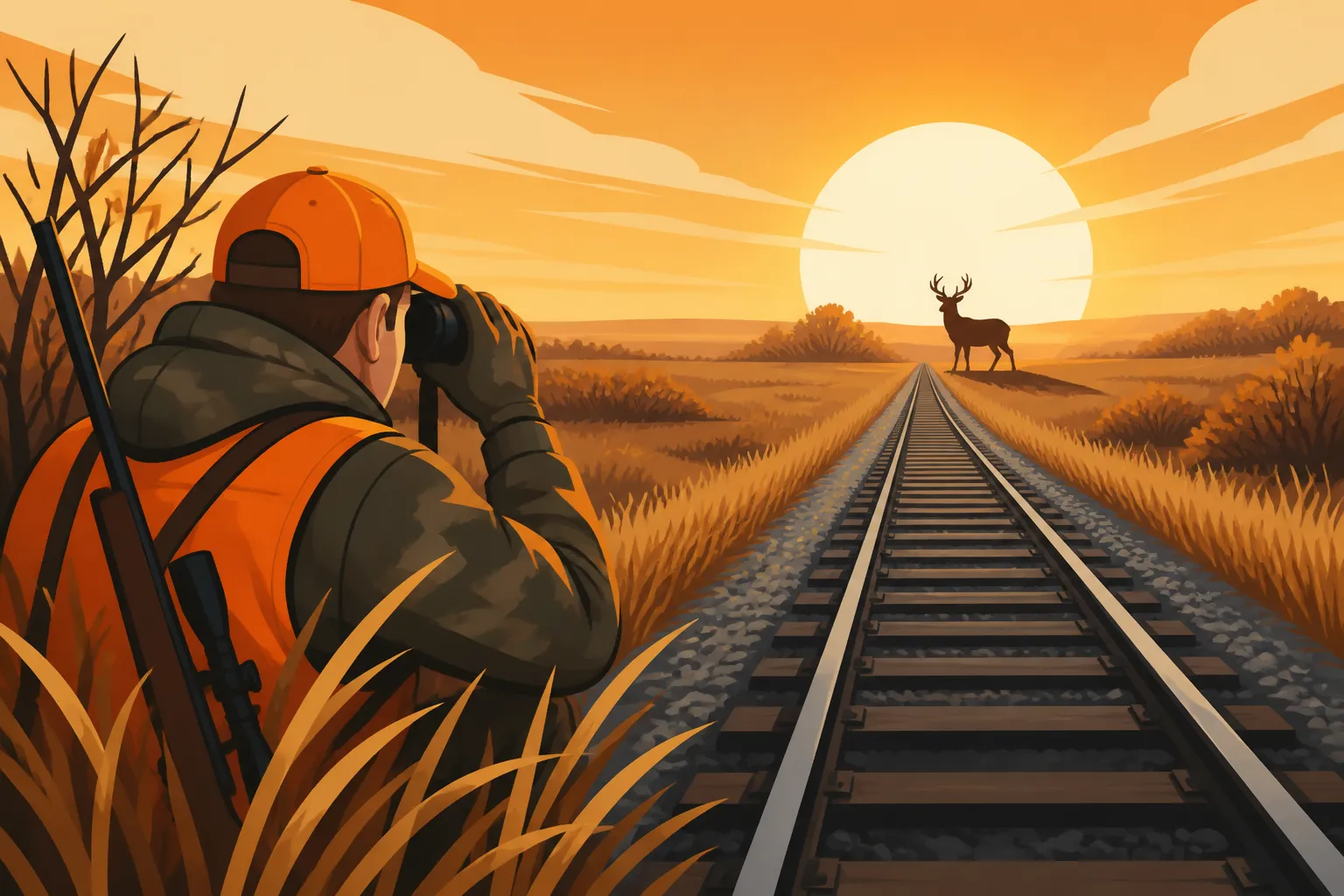
- Spot-and-Stalk: In more open prairie or parkland country, using good optics to glass the edges of the right-of-way from a distance on your permitted land can be highly effective. You might spot a buck bedded down in a thicket of willows or moving along the tree line. Once spotted, you can plan a careful stalk using the available terrain to close the distance on your permitted property. This is particularly useful for Spot-and-Stalk Mule Deer in Saskatchewan, as they often utilize these linear features for concealment in open landscapes.
- Still-Hunting: This involves slowly and deliberately moving along the edge of the railway right-of-way on your permitted land, using the available cover to your advantage. Take a few steps, stop, scan carefully, and listen. Game often feels secure in the thick cover of the right-of-way and might only move when it detects a threat. The noise of a passing train, while potentially disruptive, can also mask your movements for a short period, giving you an advantage if timed right.
Recovering Game Near the Tracks
This is perhaps the most critical and potentially heartbreaking aspect of hunting near railway lines. If you shoot an animal and it crosses onto the actual railway right-of-way, you absolutely cannot pursue it without explicit permission from the railway company. This is not only a matter of trespassing but a severe safety risk. A wounded animal on active tracks poses a danger to itself, to hunters, and to any train that might come along.
The protocol, difficult as it may be, is to mark the location where the animal entered the right-of-way, immediately retreat to a safe, permitted location, and then contact the railway company's local operations office or, failing that, a local conservation officer. They are the only ones who can advise you on how to proceed, and it may involve a significant wait or even a complete loss of the animal, depending on the circumstances.
To minimize this risk, only take high-percentage shots on game that is clearly on your permitted land and unlikely to run onto the railway property. Be realistic about your shooting abilities and the animal's likely reaction. This proactive approach is your best defense against finding yourself in this unenviable situation. Understanding the challenges of Retrieving Game From Private Land in Saskatchewan generally applies here, but with significantly heightened risks due to the railway.
Gear and Safety Considerations for Railway Areas
Hunting near railway lines demands not just specific tactics, but also a heightened focus on safety and some specialized gear. This isn't your typical bush hunt, and taking shortcuts on safety can have dire consequences.
Essential Gear for Right-of-Way Hunting
Beyond your primary weapon and ammunition, there are a few items that become particularly important when hunting near railway lines:
- Quality Optics (Binoculars/Spotting Scope): Being able to identify game from a safe distance without disturbing them or getting too close to the tracks is paramount. A good pair of binoculars will let you scout effectively and confirm targets well before you need to move.
- Reliable Mapping Device (GPS/Phone App): As mentioned, a GPS unit or a phone with a robust mapping app like
onX Huntis non-negotiable. You must know your exact position relative to property lines and the railway right-of-way at all times. Do not rely solely on physical maps; digital tools offer real-time location tracking. - Hearing Protection: Trains are incredibly loud, and the sudden blast of a train horn can be disorienting and damaging to your hearing. Consider wearing electronic hearing protection that allows you to hear ambient sounds while dampening loud noises.
- High-Visibility Clothing: Safety is paramount. How Much Blaze Orange Saskatchewan Requires is a minimum, but consider exceeding it. With the possibility of other hunters, railway workers, or even curious passers-by, making yourself as visible as possible is always a smart move.
- Communication Device: Cell service can be spotty in rural Saskatchewan, but always carry a charged phone. Consider a satellite messenger or a two-way radio if hunting in a group, especially in areas with poor cell reception.
Train Safety and Awareness
I cannot stress this enough: Trains are incredibly dangerous. They are massive, fast, and often surprisingly quiet until they are very close. Always assume a train could be coming from either direction at any moment.
- Look, Listen, Live: This mantra is critical. Look both ways, listen for train horns or rumbling, and stay off the tracks.
- Stay Clear: Never walk on tracks, railway bridges, or within the immediate vicinity of the right-of-way. Maintain a safe distance, generally at least 15 feet from the nearest rail, but more is always better.
- Beware the "Swing Zone": Trains are wider than the tracks. Objects can extend several feet beyond the rails. Keep clear of this "swing zone."
- Never Leave Anything on Tracks: Dropping equipment, leaving trash, or placing anything on the rails is illegal and extremely dangerous.
- Educate Your Party: If hunting with others, ensure everyone understands and adheres to all railway safety protocols.
Respecting Property and Environment
Your access to hunt adjacent to railway lines hinges entirely on maintaining excellent relationships with landowners.
- Leave No Trace: Pack out absolutely everything you pack in. Leave the land cleaner than you found it. This includes spent casings, food wrappers, and any other trash.
- Mind Agricultural Operations: If you're hunting near active fields, be extremely mindful of crops, fences, and farm equipment. Do not damage anything.
- Landowner Relations: Always prioritize positive Saskatchewan Landowner Relations for Hunters. A good relationship is the foundation of future hunting opportunities. Follow any specific rules or requests the landowner has. Their generosity is what makes these unique hunting opportunities possible.
Hunting near a railway line in Saskatchewan offers a distinct challenge and a potentially rewarding experience, but it's not for the faint of heart or the unprepared. By understanding the rules, prioritizing safety, and employing smart hunting strategies, you can responsibly and effectively utilize these unique corridors that game so frequently travels.
Pros and Cons of Hunting Near a Railway Right-of-Way
Hunting near railway lines offers unique advantages but also comes with significant drawbacks. It's important to weigh these carefully before committing to such a location.
| Feature | Pros | Cons |
|---|---|---|
| Game Activity | Acts as a natural travel corridor for big game | Train noise can spook game or make it harder to hear approaching animals |
| Cover & Habitat | Provides dense, linear cover in open landscapes | Often narrow, limiting safe shooting lanes on adjacent property |
| Access Legality | Viable for hunting adjacent to permitted land | Direct access to railway right-of-way is private, illegal, and virtually impossible to obtain |
| Scouting & Observation | Concentrates game movement to predictable paths | Visual obstructions from dense cover can make glassing difficult |
| Safety | Relatively low hunter pressure compared to public lands | High inherent dangers from active train traffic |
| Game Recovery | Clear travel routes can simplify tracking on permitted land | Animal escaping onto railway right-of-way means potential loss of game and serious safety risks |
| Unique Opportunity | Offers unique hunting challenge and learning experience | Requires constant vigilance and adherence to strict safety protocols, reducing enjoyment for some |
Disclaimer
This article is for general informational purposes only and does not constitute professional advice. Laws, prices and regulations vary by location and change over time. Consult a qualified professional for guidance on your specific situation.