Hunting Elk on Saskatchewan Grain Land
Hunting elk on Saskatchewan's vast grain lands can feel like trying to find a needle in a haystack, especially if you're used to chasing whitetails in the bush. These incredible animals are increasingly expanding their range into agricultural areas, drawn by abundant food sources, which offers new opportunities but also comes with unique challenges compared to traditional forest hunting. This comprehensive guide aims to arm you with the strategies and insights you'll need to successfully pursue and harvest elk across Saskatchewan's productive farmland.
Understanding Elk Movement on Saskatchewan Grain Land
The presence of elk in Saskatchewan's agricultural heartland is a relatively newer phenomenon for many areas, and it presents both challenges for landowners and exciting opportunities for hunters. To be successful, you first need to understand why they're here and how they navigate this altered landscape.
Why Elk are Moving into Farmland
It's a hot topic amongst farmers and hunters alike: why are elk showing up where they never used to? The truth is, it's a mix of factors. Firstly, elk are incredibly adaptable creatures, and the sheer abundance of high-energy food sources on grain lands is a massive draw. Imagine a buffet of peas, lentils, wheat, barley, and canola—it’s like an all-you-can-eat feast. This nutrient-rich diet often leads to larger body sizes and impressive antler growth, which is certainly appealing to hunters.
Beyond the food, pressure in traditional forest habitats can push elk into new territories. As human development expands and hunting pressure intensifies in more remote zones, some herds seek refuge and sustenance in areas that were once considered exclusively farmland. Farmers, understandably, are frustrated by the significant crop damage these large animals can cause, leading to programs like Crop Damage Permits for Farmers that aim to mitigate losses. This often creates unique, localized hunting opportunities that weren't available a decade or two ago. For hunters, it’s a double-edged sword: you hate to see crop damage, but the chance to pursue elk close to home is undeniably exciting.
Daily and Seasonal Patterns in Agricultural Zones
Elk, despite their size, are incredibly cunning, especially when navigating open agricultural landscapes. Their daily routine often revolves around feeding under the cover of darkness or low light and seeking secure bedding areas during the day. You’ll typically find them moving into fields at dawn and dusk, much like deer, to graze on crops. This is often the prime time for glassing and planning your approach.
During the day, they need sanctuary. This can be anything from a dense bush pocket, a vast slough system, thick willow and poplar tree lines, or even large, unharvested fields of standing corn or canola. A deep, heavy snow year might see them concentrating in these thicker areas for thermal cover and protection. Understanding these bedding areas is crucial. As the harvest progresses through the fall, what was once a secure block of standing canola becomes an open field overnight. This forces elk to adapt quickly, often pushing them to the remaining cover or into more distant bush. This means your scouting needs to be dynamic, constantly updating as the season and agricultural activity change. For example, knowing how to approach something like Hunting a Swathed Grain Field at Dusk or Hunting a Standing Canola Field Edge becomes incredibly valuable.
Scouting Strategies for Farmland Elk
Hunting elk in Saskatchewan's grain belt isn't just about finding any elk; it's about finding the elk, and understanding where they move, feed, and bed down. This requires meticulous scouting, often blending modern technology with old-school field craft.
Leveraging Technology for Reconnaissance
In today's hunting world, technology is your best friend, especially when dealing with expansive agricultural landscapes. Satellite imagery, found on apps like GoHunt or similar platforms, becomes an invaluable first step in your scouting process. These tools allow you to zoom in and identify potential elk hotspots from the comfort of your home. You're looking for those critical pieces of cover that break up the endless fields: dense bluffs, slough bottoms, river breaks, and uncultivated sections of land. These are the places elk will likely retreat to during the day.
You can overlay land ownership maps with satellite imagery using applications like onX, allowing you to discern Crown land from private property and identify potential access points. This is essential for navigating the complex patchwork of land ownership in Saskatchewan's settled areas. Knowing Reading Saskatchewan Crown Land Layers on onX is a skill that pays dividends. Look for subtle elevation changes, drainage patterns, and even old abandoned farmyards that might provide cover and a travel corridor. This digital reconnaissance, as detailed in guides like Scouting With Satellite Imagery in Saskatchewan, allows you to narrow down your physical scouting efforts, saving you precious time and fuel.
Boots-on-the-Ground and Permission
Once you've done your digital homework, it's time to hit the road and literally put boots on the ground. However, in heavily cultivated areas, this almost always starts with a knock on a farmer's door. Gaining landowner permission is not just a legal requirement, but a crucial component of ethical hunting in Saskatchewan. A friendly, respectful approach can open up incredible hunting opportunities. Many farmers are actively looking for solutions to their elk problems, so approaching them as a potential partner can work wonders. Remember, you're not just asking to hunt; you're offering a service that can help them mitigate crop damage. This topic is so important that we've covered it in detail in articles like Knocking on Doors in Saskatchewan Farm Country and Saskatchewan Landowner Permission Law.
When you finally get permission, your physical scouting begins. Drive the grid roads and access trails, always staying alert for fresh sign. Look for large tracks in muddy field approaches, disturbed areas where elk have bedded, and fresh droppings. Pay close attention to rub lines on small trees or fence posts, indicating where bulls have worked their antlers. Use high-quality optics, like good binoculars or a spotting scope, to glass distant field edges and cover from observation points. Often, you'll see small herds of elk at extreme distances, but having the ability to confirm their presence and get a general direction of travel is critical. This active, on-the-ground scouting, combined with landowner insights, will build a detailed picture of the elk's movements on the specific properties you have access to.
Hunting Techniques for Farmland Elk
Hunting elk on Saskatchewan's grain land is a different ballgame than calling them in the deep timber. The open nature of the landscape often dictates specific tactics, focusing on long-range observation, careful approaches, and exploiting limited cover.
Spot-and-Stalk in Open Country
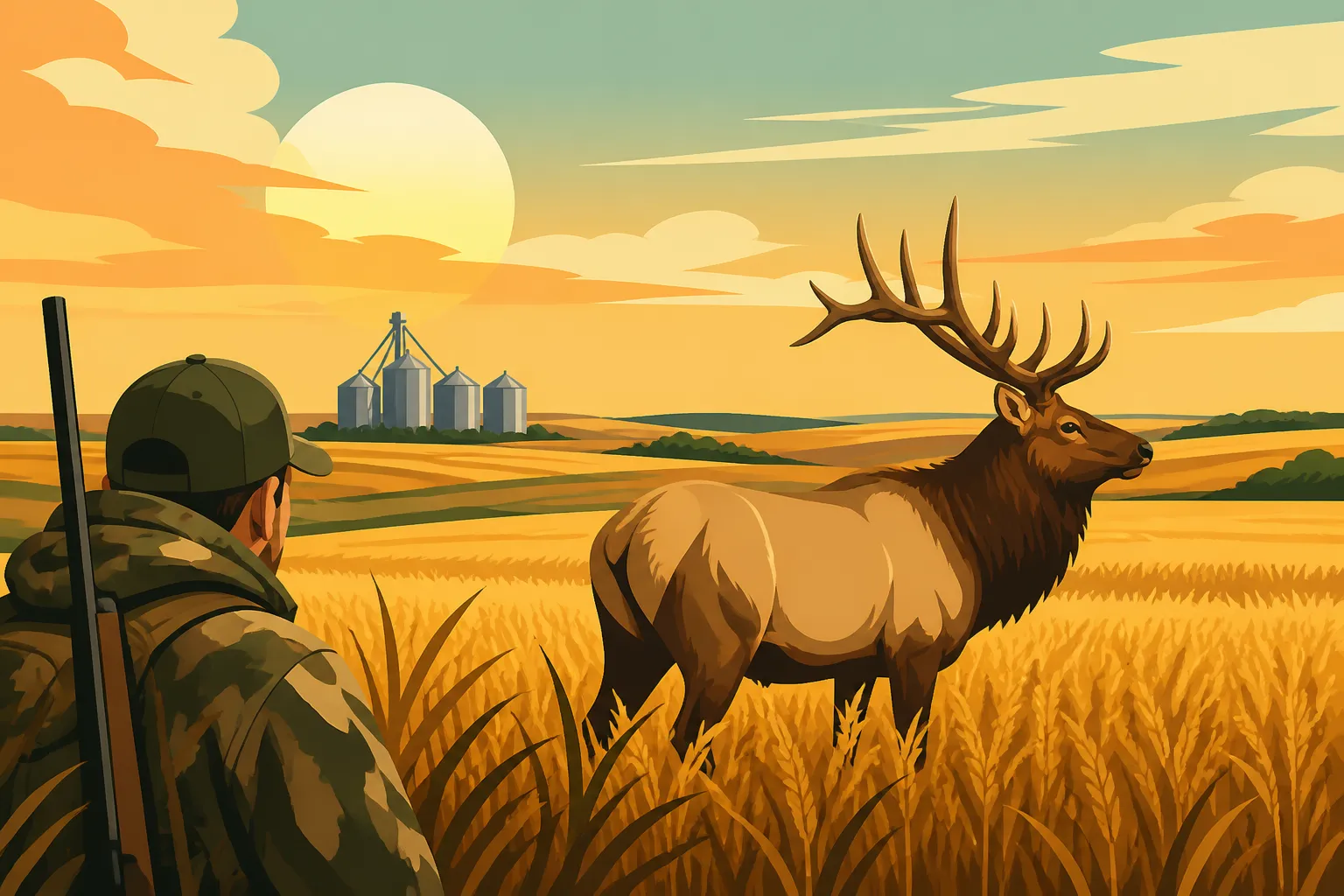
The most iconic image of elk hunting often involves vast, open landscapes, and that's precisely what much of Saskatchewan's grain land offers. Spot-and-stalk is a highly effective, albeit challenging, method here. The key is patience and an intimate understanding of the terrain, even subtle changes. You'll spend a lot of time glassing from elevated positions, looking for those telltale brown bodies against the stubble or the gleam of antlers in a distant bluff. GoHunt mapping tools can help identify these potential vantage points and approach corridors.
Once an animal or herd is spotted, the real work begins. The challenges are immense: lack of cover, unpredictable wind swirling across open fields, and the incredible eyesight of elk. A successful stalk requires using every ditch, hay bale, and contour of the land to your advantage. Wind direction is paramount; elk have an incredible sense of smell, and a single whiff of human scent will send them scattering. You need to move slowly, deliberately, using terrain to conceal your approach. This method shares many principles with Stalking Mule Deer in Open Prairie, where every step must be calculated and silent. It's not about speed; it's about stealth and minimizing your profile against the horizon.
Ambush Hunting Near Cover and Travel Routes
While spot-and-stalk is thrilling, ambush hunting can be equally, if not more, productive in certain farmland scenarios. This tactic focuses on identifying predictable travel routes and pinch points where elk move between feeding and bedding areas. Look for natural funnels: narrow strips of bush between two large fields, the edges of large sloughs or willow runs, or even strategic fence lines where elk are forced to cross in a specific spot.
Once a prime location is identified, setting up a ground blind or even a portable treestand can be effective. The placement of your stand is critical; it must offer concealment, a clear shooting lane, and, most importantly, be downwind of the anticipated travel route. This is where understanding daily patterns really pays off. Elk often use the same trails year after year, and intercepting them on these paths can yield close-range opportunities. Think about locations like Hunting a Slough Edge for Whitetails or Hanging a Stand on a Saskatchewan Bush Edge – the principles apply directly to elk. You'll want to be in your spot well before first light and stay until well after dark, as elk can often move surprisingly late or early, especially during the rut.
Calling and Decoying Strategies
Using calls for elk in wide-open farmland requires a different approach than in dense timber. Elk bugles and cow calls can be incredibly effective, but the open nature of the landscape means elk can pinpoint your exact location much more easily. Therefore, strategic calling, often combined with decoying, is key. During the early season and particularly during the rut, aggressive bugling can challenge a bull to come investigate. However, in open terrain, it's often more effective to use softer, more subtle cow calls to draw them in, especially if you believe they are close but concealed.
Decoys can also play a role, though they are less common for farmland elk than for other species. A life-sized cow elk decoy, strategically placed, can draw a curious bull into range, especially if combined with quiet cow calls. The key is to set up where the elk will come to the decoy, not just see it from a distance. You also need to consider your own concealment and escape route if a bull comes in fast and hot. The art of calling, similar to Calling a Bull Moose in the Rut or Bugling Elk on a Farm Edge, revolves around understanding the animal's mood and the specific situation. Don't overcall, and be ready when they respond.
Here's a quick comparison of these techniques:
| Technique | Best Conditions | Advantages | Challenges |
|---|---|---|---|
| Spot-and-Stalk | Open fields, rolling hills, good visibility | Covers large areas, adaptable, often exciting | Requires extreme stealth, challenging in flat areas, wind |
| Ambush Hunting | Predictable travel routes, pinch points, limited cover | Higher success rate if location is precise | Requires significant pre-scouting, less flexible |
| Calling/Decoying | Rut season, active elk, combined with cover | Can draw elk closer, exciting interactions | Elk can pinpoint location, less effective if overused |
Gear and Safety Considerations
Success in the field often boils down to proper preparation and a commitment to safety, especially when hunting such a large animal in Saskatchewan's diverse conditions.
Essential Gear for Farmland Elk Hunting
Your gear choices can significantly impact your success and comfort. Given the open nature of farmland hunting, quality optics are non-negotiable. Invest in a good pair of 10x or 12x binoculars and a spotting scope on a sturdy tripod. These will be your primary tools for locating elk at long distances. For navigation, a reliable GPS unit or a smartphone with a mapping app like GoHunt is critical. This will help you stay on legal hunting ground, respect property lines, and mark key features like elk sightings or bedding areas.
When it comes to firearms, a flat-shooting rifle capable of accurate shots at longer ranges is often preferred. Elk are big, tough animals, so choose a calibre appropriate for the task, ensuring clean, ethical kills. Options like .270, .30-06, .300 Win Mag, or 7mm Rem Mag are popular and effective. Ensure your rifle is zeroed correctly for the distances you anticipate shooting. For archers, a well-tuned bow with broadheads designed for large game is essential. Always adhere to Legal Firearms and Bows for Big Game regulations. Layered clothing suitable for varying Saskatchewan weather, camouflage that blends with the local stubble and brush, and comfortable, quiet boots are also key. Don't forget a good rangefinder to accurately judge distances, which is paramount in open country.
Safety and Ethics in Agricultural Landscapes
Hunting in agricultural areas comes with unique safety and ethical considerations that go beyond what you might encounter in remote bush. First and foremost, always confirm you are on land you have permission to hunt. Respect private property boundaries as if they were your own. This includes staying off posted land and being mindful of non-hunting agricultural operations.
Safety is paramount. Always be aware of your surroundings, especially if livestock are present. Never shoot in the direction of farm buildings, houses, or roads. Your backstop must be clear and safe. The law in Saskatchewan also mandates wearing blaze orange during many big game seasons, which is crucial for visibility to other hunters and landowners. Familiarize yourself with Saskatchewan Blaze Orange Rules to ensure compliance. Additionally, with the continued spread of Chronic Wasting Disease (CWD), be aware of Mandatory CWD Testing Zones and follow all regulations regarding carcass handling and submission for testing. Practicing good ethics, showing respect to landowners, and prioritizing safety will ensure a positive hunting experience for everyone involved and help maintain a good relationship between hunters and the farming community.
Disclaimer
This guide is intended for informational purposes only and does not supersede official hunting regulations. Always consult the most current Saskatchewan hunting guide and local regulations before heading into the field.