Hunting Saskatchewan’s Snow Goose Migration
There’s nothing quite like the sight and sound of tens of thousands of snow geese descending into a stubble field, but for many hunters, figuring out how to get under that tornado of birds feels like an impossible puzzle. It's a truly overwhelming, almost spiritual experience, yet incredibly frustrating if you don't know the secrets. This guide aims to pull back the curtain on hunting Saskatchewan's snow goose migration, offering seasoned strategies and practical tips to help you turn those aerial ballets into a successful hunt.
Understanding the Snow Goose Migration in Saskatchewan
Saskatchewan is more than just a pit stop for snow geese; it's a critical staging ground, a veritable buffet that draws millions of birds during their incredible journey. Understanding this massive natural phenomenon is the first step to putting more birds in your spread.
The Annual Journey: Routes and Timing
Snow geese embark on an epic migratory journey twice a year, heading north to their Arctic breeding grounds in spring and south to warmer wintering areas along the Gulf Coast in the fall. Saskatchewan sits right in the heart of the central flyway, making it a prime location. In the fall, the migration usually begins in earnest around late September and can run through October, sometimes even into early November, depending on weather patterns further north. The birds move in massive waves, with the initial push often being juvenile birds and the last being more experienced adults. Understanding these patterns is crucial for timing your hunt. The spring migration is often much faster, as birds are eager to reach breeding grounds, but Saskatchewan also offers fantastic spring hunting opportunities, particularly for the conservation season aimed at population control. For more specific details on when the geese pass through, check out our guide on When Snow Geese Pass Through Saskatchewan.
The timing can shift slightly from year to year based on everything from early snows in the Arctic to prolonged warm spells in the prairies. It’s not uncommon for a cold snap to push birds south quickly, while a mild fall might keep them lingering, feeding heavily to build up fat reserves. This dynamic nature means that flexibility and real-time scouting are far more valuable than rigid adherence to a calendar date. It’s about being present when the conditions are right, rather than simply when the calendar says they should be.
Why Saskatchewan is a Snow Goose Magnet
The simple answer is food, and lots of it! Saskatchewan’s vast agricultural landscape, particularly its endless fields of cereal grains like wheat, barley, and peas, provides an irresistible feast for migrating snow geese. After harvest, these fields are often littered with waste grain, offering an incredibly rich and easily accessible food source. Unlike ducks that might prefer potholes or marshes, snow geese are grazers, preferring to feed in open fields where they can see predators from a distance.
Beyond the food, Saskatchewan offers immense, unpressured landscapes. While there are certainly popular hunting areas, the sheer size of the province means birds can spread out and find sanctuary. Large, shallow lakes and sloughs provide safe roosting sites where hundreds of thousands of birds can gather overnight, taking flight at dawn to hit the prime feeding fields. This combination of abundant food and safe roosting makes Saskatchewan an unparalleled destination for snow goose hunting, drawing colossal numbers that can literally darken the sky.
Identifying Different Goose Species
While we often talk about "snow geese," it’s important to remember that the snow goose family actually includes two distinct species frequently found together in Saskatchewan: the greater snow goose and the smaller Ross's goose. Both are predominantly white with black wingtips, but there are subtle yet important differences, especially regarding size and bill structure. Understanding these distinctions helps with identification and sometimes even hunting strategies, as Ross's geese can sometimes be a bit warier or decoy differently.
Ross's geese are noticeably smaller, about two-thirds the size of a greater snow goose, and have much shorter, stubbier bills without the "grinning patch" or black line at the base of the bill that is characteristic of snow geese. Their heads are also rounder. Bag limits often differentiate between species, so being able to tell them apart on the wing is a valuable skill. While often intermingling in massive flocks, understanding the nuances between them adds another layer to your hunting acumen.
Here's a quick comparison:
| Feature | Snow Goose (Greater/Lesser) | Ross's Goose |
|---|---|---|
| Size | Larger (similar to a Canada Goose) | Smaller (similar to a Mallard duck) |
| Bill | Longer, more triangular, often with a "grinning patch" | Shorter, stubbier, triangular, no "grinning patch" |
| Head Shape | More elongated | Rounder |
| Vocalization | Higher-pitched, often two-syllable "kow-luk" or "unk-unk" | Lower-pitched, softer, more guttural "kuh-kuh" |
| Typical Flock | Massive, often hundreds to thousands | Smaller, often within snow goose flocks |
Key Strategies for Successful Snow Goose Hunting
Hunting snow geese isn't like deer hunting; it's a game of numbers, psychology, and sometimes, pure endurance. The sheer volume of birds requires a different approach, often relying on massive decoy spreads and specialized calling techniques.
Field Hunting with Massive Spreads
When you’re talking about snow geese, "massive" isn't an exaggeration. We're talking hundreds, sometimes even a thousand or more, decoys to replicate a truly enormous feeding flock. These birds are conditioned to seek out large groups for safety in numbers and to identify prime feeding locations. A small spread of a dozen decoys will likely be ignored by a large flock; you need to create an illusion that screams "everybody's here, and the food is amazing!" This means investing in a substantial decoy spread. Our guide on Hunting Snow Geese Over a Big Spread delves deeper into this strategy.
The type of decoy also matters. Full-body decoys offer the most realistic look but are expensive and cumbersome to deploy in large numbers. Wind socks and silhouettes offer a more cost-effective way to get high numbers and simulate movement in the wind. Many hunters use a combination: a core of full bodies or shells near the kill hole for realism, surrounded by hundreds of wind socks to create the impression of a vast flock. The spread should be oriented to account for the wind, creating an inviting landing zone where birds can approach comfortably.
Utilizing Electronic Calls Effectively
Electronic calls are absolutely indispensable for snow goose hunting, and in many jurisdictions, Saskatchewan included, they are legal for hunting snow geese during specific seasons, particularly the conservation season. These calls can mimic the cacophony of thousands of feeding, chattering, and excited snow geese – a sound that’s impossible for a human caller to replicate consistently at the necessary volume. The goal is to create an auditory illusion that reinforces the visual appeal of your massive decoy spread.
Placement of your e-caller speakers is crucial. You want to surround your spread with sound, making it seem like the entire field is alive with geese. Many hunters use multiple speakers, strategically placed within the spread and often elevated to project sound further. Experiment with different sound files – feeding chatter, excited landing calls, and general flock noises – to see what the birds respond to best on any given day. Remember, the goal is to draw them in, then quiet down a bit as they get close to make them commit to your kill hole.
The Art of Concealment and Blinds
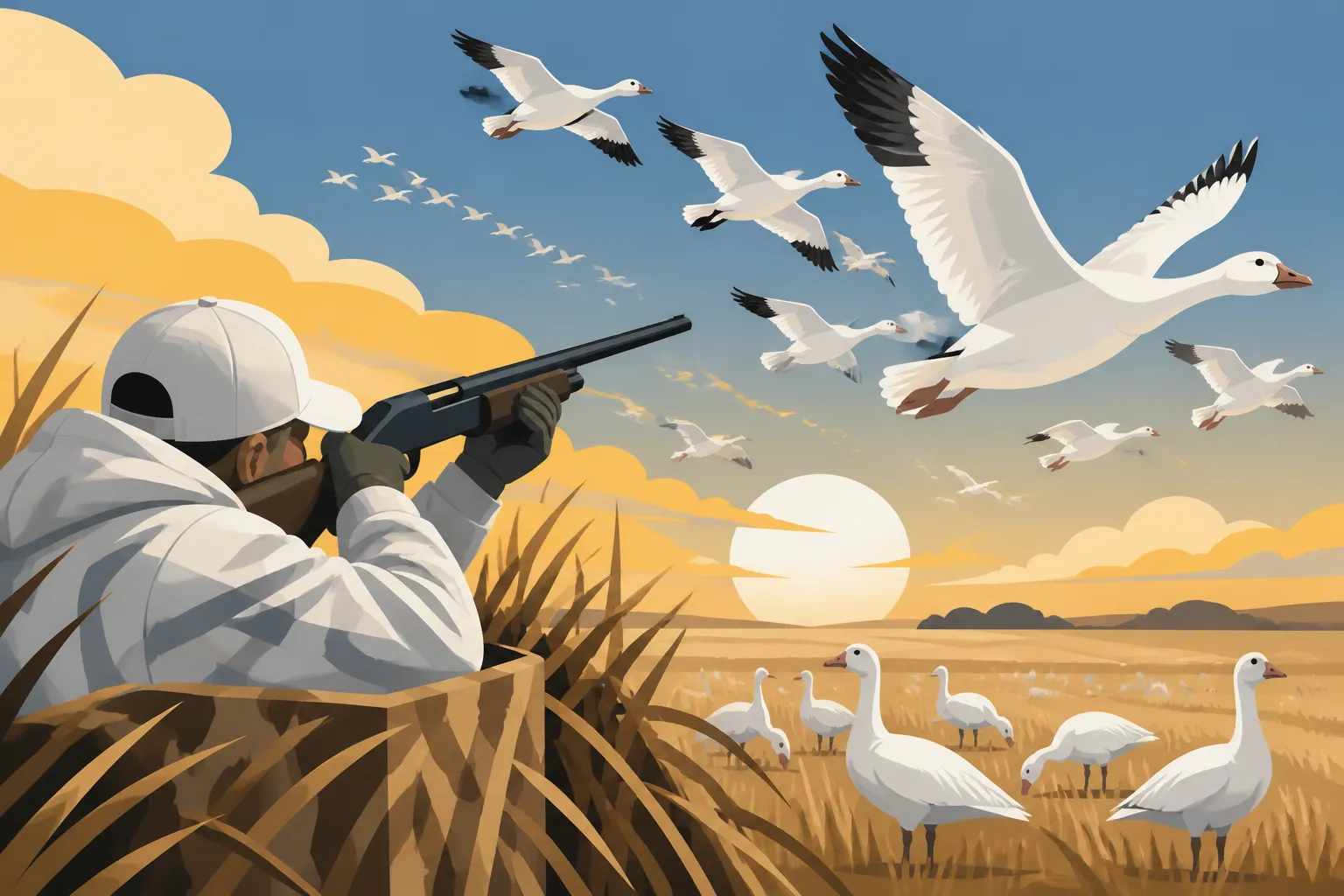
With hundreds of thousands of eyes scanning the horizon, concealment for snow goose hunting is paramount. These birds are notoriously wary, and the slightest glint of sunlight off a face or an unnatural shape in their landing zone will send them flaring. Layout blinds are the standard for field hunting, allowing hunters to lie flat in the field, blending in with the stubble or cover. The key is to make your blind disappear completely.
Beyond the blinds, consider your overall field dressing. Stubble straps and natural vegetation from the field itself should be added to your blinds to break up their outline. Even your face and hands need to be camouflaged; face paint or masks and dark gloves are non-negotiable. Furthermore, parking vehicles well away from the field and approaching your setup in the dark are critical steps. Any foreign object or unusual movement within their sightline can spook an entire flock, ruining a potential setup for hours.
Essential Gear for Saskatchewan Snow Goose Hunts
A successful snow goose hunt in Saskatchewan isn't just about strategy; it's about having the right tools for the job. From vast decoy spreads to specialized firearms, your gear list will be quite extensive.
Decoys: Numbers, Types, and Placement
As touched upon earlier, numbers are king for snow goose decoys. While a small flock might respond to 100-200, to truly intercept the massive migrations, many successful Saskatchewan hunters run anywhere from 500 to 1,500 decoys. The blend of types often includes a realistic "front" of full-body or shell decoys where you expect the birds to land, surrounded by hundreds of more economical wind socks or Sillosocks. These lighter decoys create realistic movement in the slightest breeze, which is a huge attractor.
Placement is critical. Think about creating a "J" or "U" shaped landing zone, with the open end facing into the prevailing wind. Geese prefer to land into the wind, so this configuration encourages them to settle directly in front of your blinds, within shooting range. Strategically placing a few "sentinel" decoys, standing upright on the edge of the spread, can simulate wary birds on watch, adding to the realism. When hunting in cut stubble, ensure your decoys are clearly visible, but not so tightly packed that they look unnatural.
Firearms and Ammunition Considerations
When flocks of snow geese are in range, you’ll be doing a lot of shooting, often at fast-moving targets. A reliable 12-gauge shotgun is the standard, though some hunters prefer a 10-gauge for its heavier payload. Autoloaders are popular due to their faster follow-up shots. Given the volume of shooting, consider a shotgun that can handle sustained use and a bit of abuse from the field environment.
Ammunition-wise, non-toxic shot is a federal requirement for all waterfowl hunting in Canada, including Saskatchewan. Steel shot is the most common and economical choice. For snow geese, shot sizes like BB, BBB, or even T are popular, as these birds are tough and require good penetration to bring down cleanly. Always opt for high-velocity loads for maximum knock-down power at range. It's not uncommon to go through several boxes of shells in a successful day, so be sure to stock up! More information on this can be found in our article on Non-Toxic Shot for Saskatchewan Waterfowl.
Appropriate Clothing for Varied Weather
Saskatchewan weather during the fall migration can be notoriously unpredictable. One day you might be hunting in mild, sunny conditions, and the next could bring driving snow and biting winds. Layering is your best friend. Start with a moisture-wicking base layer, add insulating mid-layers like fleece or down, and top it all off with a waterproof and windproof outer shell in a suitable camouflage pattern (preferably snow goose specific, like white or light tan patterns for snow hunts, or traditional stubble camo for darker fields).
Don't forget the extremities: warm, waterproof gloves (with dexterity for shooting), a warm hat that covers your ears, and insulated, waterproof boots are essential. Many hunters also bring a ground sheet or insulated pad to place under their layout blind for added warmth and comfort during long waits in cold fields. Staying warm and dry directly impacts your focus and endurance, which are critical for an all-day snow goose hunt. GoHunt, with its weather forecasting features, can be an invaluable tool for planning your daily clothing choices.
Scouting and Field Setup for Snow Geese
Finding the birds is often 90% of the battle, and once you’ve located them, setting up your spread effectively is the other 10%. This requires meticulous scouting and a thoughtful approach to your field layout.
Locating Feeding Fields
Snow geese are creatures of habit, typically flying from their roosting lakes to specific feeding fields each morning and evening. Your primary scouting mission is to identify these fields. This usually involves driving grid roads at dawn or dusk, looking for massive white clouds of geese lifting off a roost or descending into a feeding area. Once you spot them, observe which fields they are using. Note the type of crop (peas, wheat, barley, lentils) and the field's characteristics (stubble height, presence of water, proximity to roads).
Permissions are absolutely critical here. Unlike Crown land, most prime grain fields in Saskatchewan are private land. You must obtain permission from the landowner before setting foot on their property, let alone hunting it. Knocking on doors well in advance, showing respect, and offering to help with any crop damage can go a long way. Many hunters find success by identifying a field the birds are currently using, then asking permission from the farmer who owns it. This often means driving around asking multiple landowners, but it's a non-negotiable step for ethical and legal hunting. Our guide on Scouting Fields for Saskatchewan Waterfowl offers more in-depth advice.
Setting Up for Success: Spread Configuration
Once you've secured permission for a hot field, the setup begins. This often means an early start, long before first light. The first step is to identify the "X" – the exact spot where the birds want to be. Look for heavy concentrations of droppings, disturbed stubble, or even feathers. This is where your kill hole and blinds should be. As discussed, a "J" or "U" shape facing the wind is common, with the main body of your spread upwind and the kill hole at the downwind base of the "J."
Place your e-caller speakers strategically within the spread, preferably elevated on poles or in mock "goose bumps" made from leftover stubble, to broadcast sound effectively. Your blinds should be at the base of the kill hole, perfectly concealed and facing out. Consider adding a few flapper decoys or rotary machines (where legal) around the kill hole to add dynamic movement, mimicking landing birds. Ensure shooting lanes are clear, and everyone knows their shooting zones to maintain safety. For more on setting up, check out Setting a Goose Spread in Swathed Barley.
Dealing with Changing Conditions
Saskatchewan’s weather doesn’t just change day-to-day; it can change hour-to-hour. Wind shifts are a common challenge. If the wind direction changes significantly after you've set up, you might need to adjust your blinds or even re-orient part of your spread to maintain that crucial into-the-wind landing approach. Geese will almost always land into the wind, so fighting this instinct is a losing battle.
Rain, snow, and fog also present challenges. Rain can make decoys heavy and diminish the visibility of your spread. Snow can provide excellent camouflage but also make birds harder to spot against a white background. Fog can make hunting impossible due to visibility constraints and is often best to wait out. Being adaptable, having extra clothes, and being prepared to make quick adjustments to your setup are hallmarks of a successful snow goose hunter. Having access to a reliable weather forecast, perhaps through a tool like GoHunt, can help anticipate these changes.
Navigating Regulations and Licensing for Snow Geese
Hunting in Saskatchewan requires adherence to specific federal and provincial regulations. For migratory birds like snow geese, both sets of rules apply, and understanding them is crucial to a legal and ethical hunt.
Federal and Provincial Permit Requirements
To hunt snow geese in Saskatchewan, you'll need a few key documents. Firstly, a federal Migratory Game Bird Hunting Permit (MGBHP) is mandatory across Canada. This permit comes with a Canadian Wildlife Habitat Conservation Stamp affixed, which contributes to vital wetland conservation efforts. You can purchase this online or at most post offices. Secondly, you'll need a provincial Saskatchewan Wildlife Habitat Certificate and a provincial game bird license. These are purchased through your Saskatchewan Hunter and Trapper Licensing (HAL) account. It's always a good idea to create your HAL account well in advance. Our article on The Federal Migratory Game Bird Permit provides more details.
For non-residents, the requirements become a bit more complex. Non-resident alien (from outside Canada) migratory bird hunters must use the services of an outfitter. Non-resident Canadian hunters (from other provinces) can hunt migratory birds without an outfitter but still need all the federal and provincial permits. Always carry all your licenses and permits with you while hunting, and be prepared to present them to a conservation officer if requested.
Bag Limits and Possession Limits
Bag limits for snow geese are typically very generous, especially during the special conservation season, which is specifically designed to help manage burgeoning snow goose populations. Daily bag limits can be as high as 50 birds per day, with possession limits often double that or even unlimited during the spring conservation hunt. These high limits reflect the conservation need to reduce their impact on Arctic breeding grounds.
However, always double-check the current year's Saskatchewan Game Bird Seasons and Limits as published by the Ministry of Environment. These regulations can change annually. It's your responsibility as a hunter to know and abide by these limits. Exceeding bag or possession limits is a serious offense. Remember, conservation season rules can differ from regular fall season rules, especially concerning electronic calls and unplugged shotguns, so pay close attention to the specific dates and conditions.
Non-Resident Specifics
For non-residents, particularly those from the United States, hunting migratory birds in Saskatchewan has specific nuances. As mentioned, non-resident alien hunters must hunt with a licensed outfitter. This requirement ensures that hunters are guided by professionals familiar with local laws and hunting ethics. Additionally, non-resident migratory bird licenses are often valid for specific, shorter terms, such as a "five-day term." This means you need to plan your trip accordingly, ensuring your hunting days fall within your licensed period. Our article on How Many Days a Non-Resident Bird Hunter Gets offers more insight.
Bringing firearms across the border also requires careful planning, including filling out a Non-Resident Firearm Declaration Form (CAFC 909 EF) in advance and paying a fee. It's crucial to declare all firearms at the border and ensure they are stored and transported legally. Researching these details well ahead of your trip will save you a lot of hassle and potential issues at the border.
Post-Hunt Considerations and Game Care
After a successful day of hunting Saskatchewan's snow goose migration, the work isn't over. Proper game care is essential for ethical hunting and for ensuring the meat is fit for the table.
Field Dressing and Transport
Once harvested, snow geese should be field dressed as soon as possible, especially in warmer temperatures. This involves removing the guts to allow the carcass to cool down quickly, preventing bacterial growth and spoilage. Some hunters will also remove the breast meat and legs in the field, making transport easier and reducing overall weight. If you're planning to take birds to a processor, a quick gutting is often sufficient. Always ensure you have a cooler with plenty of ice to chill your birds immediately.
Transporting your game also comes with rules. In Saskatchewan, if you are transporting game, you must be able to prove lawful possession, which means having your valid hunting license and tags (if applicable for other species) readily available. Ensure your birds are in a condition that allows for species and sex identification, if required by regulations. Avoid simply throwing birds in the back of a hot truck; direct sunlight and warm air will degrade the meat quality rapidly.
Processing Your Harvest
Snow goose meat can be delicious when prepared correctly, but many hunters find it has a stronger, "gamey" flavor than other waterfowl. Breasting out the birds is common, providing lean, dark meat perfect for grinding, stewing, or making jerky. The legs can also be utilized, often slow-cooked or confited to break down tough connective tissues. Don't be afraid to experiment with marinades and cooking methods to find what you like best.
If you've had a truly successful hunt, you might find yourself with a significant amount of meat. Consider professional meat processors in larger centers like Saskatoon or Regina, or even smaller rural towns that cater to hunters. They can handle large volumes and often offer various cuts, grinding, and even sausage making. Freezing the meat quickly in vacuum-sealed bags will preserve its quality for many months.
Responsible Disposal and Ethical Practices
Ethical hunting extends beyond the shot. It also includes responsible disposal of game waste and ensuring no meat is wasted. If you're breasting out birds in the field, ensure you're doing so in an appropriate manner, away from roads or areas where the discarded carcasses might attract scavengers to populated areas. Always ensure you're using all edible portions of the bird – wasting game meat is not only unethical but illegal in Saskatchewan.
Beyond the immediate hunt, remember to maintain good landowner relations. Leave the field as you found it, picking up any spent shells, garbage, or even rogue decoy stakes. A clean field and a respectful attitude will greatly increase your chances of being welcomed back for future hunts, which is invaluable in a province like Saskatchewan where private land access is key.
Disclaimer
The information provided in this guide is for general informational purposes only and is not a substitute for official government regulations. Hunting laws and regulations in Saskatchewan, both provincial and federal, can change. It is the hunter's sole responsibility to consult the most current Saskatchewan hunting guide and federal migratory bird regulations before engaging in any hunting activities. Always prioritize safety, ethical practices, and adherence to the law.