Hunting a Burned-Over Boreal Block
Trying to hunt a vast, open landscape that was once dense boreal forest can feel like staring at a blank canvas, especially when that landscape has been recently scorched by fire. The familiar tracks, the thick cover you'd usually rely on, the established game trails – they all seem to have vanished, leaving you wondering where to even begin. This guide aims to demystify hunting in Saskatchewan's burned-over boreal blocks, helping you understand how these areas transform and how to adapt your strategies to find success.
Understanding the Dynamics of a Boreal Burn
When fire sweeps through the northern forests of Saskatchewan, it doesn't just destroy; it reshapes the entire ecosystem, creating a dynamic new environment that, after an initial period, can become incredibly productive for various game species. Understanding these stages of recovery is paramount to hunting them effectively.
The Immediate Aftermath and Short-Term Effects
Imagine the immediate aftermath: the towering spruce and pine reduced to charcoal skeletons, the forest floor a blanket of ash. In the very short term, say the first few months, these areas might seem barren. Most larger game like moose and deer will have fled the immediate danger, seeking refuge in unburned pockets or adjacent intact forest. Smaller animals and ground-nesting birds are often displaced or perish. The landscape is open, raw, and littered with fallen timber that makes travel incredibly challenging.
However, even in this raw state, there are opportunities. Predators like wolves and coyotes might be drawn to the edges of the burn, scavenging on any animals that didn't escape or are now more vulnerable. Water sources, if they remain, become critical congregation points. For hunters, the immediate challenge is immense visibility, but also difficult navigation due to deadfall. Scouting tools, especially those like GoHunt with detailed satellite imagery, become invaluable for understanding the burn's perimeter and identifying potential escape routes or nearby unburned areas that might be holding game.
The Regeneration Cycle: Years 1-5
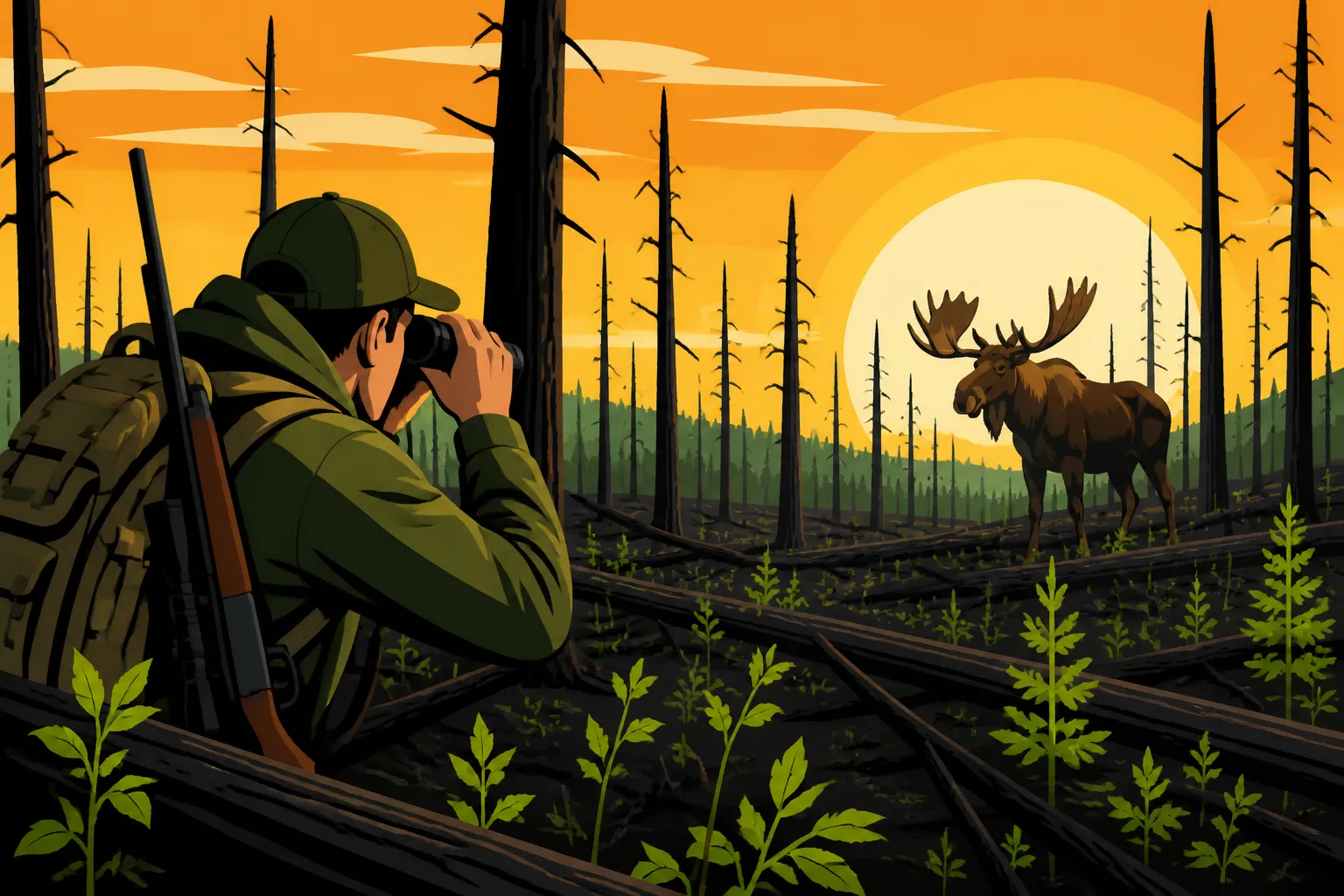
This is where the magic truly begins. After the initial shock, the boreal forest begins its remarkable recovery, and this phase is often a goldmine for hunters. Within the first year, pioneer plants like fireweed, various grasses, and early successional shrubs start to emerge from the ashes, driven by the suddenly nutrient-rich soil and increased sunlight. By years two to five, this growth accelerates dramatically. Aspen, birch, and willow saplings sprout vigorously, creating a dense, delicious buffet of browse.
For species like moose, elk, and white-tailed deer, these young, regenerating burn areas are incredibly attractive. They offer an abundance of high-quality forage that isn't typically found in mature boreal forest. Moose, in particular, will seek out the young willow and aspen. Deer will move in to feed on the tender shoots and forbs. The open nature of the burn in its early stages also makes it easier for these animals to move around and find food, even if thick pockets of new growth start to emerge. This period is when the phrase Why Burned Ground Grows Big Bulls truly rings true, as the enhanced nutrition can lead to impressive antler growth. Hunters often find that game animals, though exposed, quickly adapt to the new cover provided by dense young shrubs and the maze of fallen logs, using them for bedding and escape.
Mature Burn Stages: 5+ Years On
As the years pass, the burned-over block continues its evolution. From year five onwards, the regeneration starts to thicken into a dense, almost impenetrable forest of young trees. The deadfall begins to decompose, but much of it remains, creating a challenging obstacle course. The canopy starts to close, reducing the sunlight that fueled the initial explosion of browse. This changes the dynamics for game.
While still offering excellent habitat, the mature burn often sees a shift in how game utilizes it. The once-abundant browse might become less accessible as trees grow taller. However, the thick new growth now provides incredible security cover. Deer and moose will use these areas for bedding, especially on cold, windy days, feeling secure in the dense tangle. The older, rotting deadfall can create pockets of dry ground, ideal for bedding down. Hunting these areas requires different tactics, often focusing on the edges where the mature burn meets unburnt forest, or along natural corridors that cut through the dense new growth. The sheer density can make it difficult to spot game, but the concentration of animals seeking refuge can be high.
Scouting and Locating Game in Burned Blocks
Successfully hunting a burned-over boreal block hinges heavily on your scouting efforts. The landscape is unique, and traditional scouting methods need to be adapted to this dynamic environment.
Interpreting Satellite Imagery and Topo Maps
Before you even set foot in the burn, your best friends will be high-quality satellite imagery and topographic maps. Tools like GoHunt are indispensable here. They allow you to meticulously study the burn's boundaries, identify unburnt islands, locate natural funnels, and pinpoint water sources. Look for areas where the fire's intensity might have varied, leaving patches of live timber or areas where regrowth might be further along. Pay close attention to the transition zones where the burn meets mature forest, creek beds, or muskeg edges. These interfaces are often prime travel corridors for game moving in and out of the burn.
Topo maps can reveal subtle elevation changes that might dictate where game chooses to bed or travel, especially if parts of the burn are lower-lying and might hold water longer. Identifying ridges or high ground within the burn can reveal potential vantage points for glassing. The key is to visualize the flow of the land and how game animals, responding to the fire, would naturally utilize the remaining or regenerating features. Remember, Scouting With Satellite Imagery in Saskatchewan can save you countless hours of walking through difficult terrain.
On-the-Ground Reconnaissance: What to Look For
Once you've done your digital homework, it's time to hit the ground. Be prepared for a physically demanding experience. Deadfall can be treacherous, and new growth, while providing cover for animals, can be thick for you to navigate. Your primary goal is to find fresh sign. Look for tracks in any remaining soft ground, especially near water sources or along the burn's edges. Identify browse lines on young aspen, willow, or birch saplings – fresh nips indicating deer or moose activity.
Rub lines on saplings or smaller charred trees are critical indicators of buck or bull activity. Pay attention to bedding areas. These might be sheltered pockets within dense regrowth, or on the leeward side of larger fallen logs that offer protection from the wind. In the very early stages of a burn, the sign might be subtle, but as vegetation returns, so will the evidence of game. Remember, Reading Sign After Fresh Saskatchewan Snow (or any fresh sign, snow or not) is an art form, and in a burn, it's even more crucial as the landscape can initially feel devoid of life.
Identifying Unburnt "Islands" and Edges
Within any large burn, there are often pockets that, for various reasons (changes in wind, fuel load, fire breaks), escaped the flames. These "islands" of unburnt timber are absolute magnets for game. They provide immediate cover, shelter, and sometimes even residual food sources, making them natural sanctuaries within the open burn. Game animals will gravitate towards these areas, using them for bedding, resting, and escaping predation.
Similarly, the very edges of the burn, where it transitions into intact forest, are prime hunting locations. These are the highways game use to move in and out of the burn to feed, water, and seek deeper cover. Focus your scouting efforts on these transition zones, looking for trails, fresh tracks, and concentrations of browse. An unburnt finger of timber extending into the burn, or a stand of spruce on a Hunting a Boreal Muskeg Edge that was spared, can provide perfect ambush points or natural funnels for game.
Hunting Strategies for Burned-Over Terrain
Hunting a burned-over block requires patience, adaptability, and a willingness to adjust your usual tactics. The changed environment demands a fresh approach.
Still-Hunting and Stalking Tactics
Still-hunting is often one of the most effective methods in a burned-over area, especially once the new growth has started to provide some cover. The trick is to move incredibly slowly, using the noise of the fallen timber to your advantage. Every crunch and crack of a dead branch underfoot might serve as a natural sound to deer or moose, or it might mask your own movements. Stop frequently, use your binoculars to scan ahead, and listen intently. The openness of the burn, particularly in its earlier stages, means you might spot game at longer distances, but it also means they might spot you.
Stalking, while challenging due to the deadfall, can be extremely effective if you spot an animal at a distance. Plan your route carefully, using any available cover – thickets of new growth, large fallen logs, or the few remaining standing snags – to break up your outline. Always pay attention to the wind, as scent is easily carried across the open landscape. Moving like a predator, using the "deer walk" where you lift your foot and place it down slowly, checking for crunching leaves or twigs, is paramount. Whether you're hunting deer on a Hunting a Poplar Ridge in Parkland or a moose in a regenerating burn, slow movement and keen observation are your best assets.
Stand Hunting and Ambush Points
Even in a burned-over landscape, strategic stand placement can yield significant results. While large, mature trees for treestands might be scarce, you can adapt. Look for the few remaining standing trees on the edges of unburnt pockets, along natural travel corridors, or overlooking concentrations of browse. Ground blinds can be highly effective, especially if you build them into the existing deadfall or dense new growth. These blend seamlessly into the chaotic environment and allow you to sit undetected.
Focus your stand sites on pinch points created by the burn. This could be where the burn forces game to travel through a narrow strip of unburnt timber, across a specific opening, or along the edge of a water feature. Observe where game enters and exits the burn for feeding and bedding. Use mapping tools like GoHunt to mark these potential stand locations and plan your entry and exit routes to minimize disturbance. Remember, game animals in burns are often accustomed to more open surroundings, but they still value security when moving through exposed areas.
Calling and Decoying in Burns
The altered acoustics of a burned-over block can make calling more effective for certain species. With less dense canopy and undergrowth, sounds travel further. For moose, calling during the rut can be incredibly productive, as the deep grunts and cow calls can carry across vast distances. If you're trying Calling a Bull Moose in the Rut, the open nature of the burn might allow you to hear a distant reply more clearly and close the distance.
Similarly, deer calls, rattles, and snort-wheezes can be projected further, potentially drawing in curious bucks. Decoys can also play a vital role, especially in more open areas of the burn. A well-placed moose or deer decoy can draw an animal into shooting range, particularly if they are hesitant to cross a large opening. In areas with limited natural cover, a decoy can be the difference between a distant sighting and a close-range shot. Just be sure your decoy placement provides a clear shot while keeping you concealed.
Navigating the Challenges and Ensuring Safety
Hunting in burned-over boreal blocks presents unique challenges that go beyond just finding game. Safety and preparedness are paramount.
Dealing with Deadfall and Difficult Terrain
Walking through a burned-over forest is an exercise in physical endurance and careful navigation. The ground is often a tangled mess of fallen, charred logs, stumps, and dense, thorny new growth. This terrain is slow going and physically demanding, and the risk of slips, falls, and ankle injuries is significantly higher. Invest in high-quality, ankle-supporting boots with good traction. Carry trekking poles for stability.
Always watch your step, and consider every movement. What might look like a solid log could be completely rotted through and give way. If you manage to harvest an animal, extracting it from this kind of terrain will be exceptionally difficult. Consider how you will quarter and pack out your game, as dragging will be nearly impossible. Knowledge of Getting a Deer Out on a Frozen Trail might be useful, even if the ground isn't frozen, as it speaks to the challenges of moving game through difficult country. Plan for extra time and possibly multiple trips.
Fire Safety and Environmental Awareness
Despite the initial burn, residual embers can sometimes smolder for months, especially in peat-rich soils. Always be vigilant for any signs of smoldering or smoke. If fire bans are in place, respect them without question. Even if no active fire danger exists, practice extreme caution with any open flames or hot vehicle components.
Beyond fire, remember that you are in a recovering ecosystem. Practice strict leave-no-trace principles. Pack out everything you pack in. Be mindful of the fragile new growth and avoid unnecessary damage. This landscape is a testament to nature's resilience, and hunters have a responsibility to respect its healing process.
Remote Access and Emergency Preparedness
Burned-over areas are often in remote parts of Saskatchewan's boreal forest, far from established roads or communities. This means cell service is likely non-existent. Carrying a satellite communication device (like a Garmin inReach or a Zoleo) is not just a recommendation; it's a necessity. These devices allow you to send SOS signals and communicate with loved ones, providing a critical lifeline in an emergency.
Always carry a comprehensive first-aid kit, and know how to use it. Be prepared for unexpected weather changes. Inform someone of your exact hunting area and your expected return time. Carry extra water, food, and emergency shelter. Know how to navigate using a physical map and compass in addition to your digital mapping apps. Even with offline maps on GoHunt, batteries die, and technology can fail. Understanding What to Do If You Get Stuck in the Bush becomes a critical skill when hunting these remote and challenging locations.
| Burn Stage | Characteristics | Game Attractants | Hunting Considerations | Primary Species |
|---|---|---|---|---|
| Immediate (0-1 Year) | Charred, open, extensive deadfall, minimal regrowth | Scavengers, edge feeders, new water sources | Difficult navigation, high visibility (for you & game), focus on unburnt edges | Coyotes, Wolves, displaced Deer/Moose |
| Early Regeneration (1-5 Years) | Abundant pioneer plants, dense young browse (willow, aspen, birch), deadfall present | Excellent forage, some new cover forming | Good visibility (intermittent), challenging navigation, game actively feeding | Moose, White-tailed Deer, Elk, Rabbits |
| Mid-Regeneration (5-15 Years) | Thicker young forest, closing canopy, dense cover, decomposing deadfall | Security cover, bedding areas, some browse becoming less accessible | Very dense cover, reduced visibility, focus on travel corridors and thicker pockets | White-tailed Deer, Moose, Black Bear |
| Mature Burn (>15 Years) | Dense sapling forest, few remaining large trees, significant deadfall decomposition | Deep security cover, historical travel routes re-established | Difficult to penetrate, very low visibility, focus on edges and trails | White-tailed Deer, Black Bear, Moose |
Disclaimer
Hunting is an inherently dangerous activity. This guide provides general information and recommendations. Always prioritize safety, adhere to all local regulations and laws, and obtain the necessary licenses and permits before heading into the field. Conditions can change rapidly, and personal preparedness is your responsibility. The author and publisher are not liable for any injuries or incidents that may occur.