Hunting a Fence Line Between Quarters
You know, it's easy to drive past those unassuming fence lines stretching between agricultural quarters in Saskatchewan and think there's nothing much to them. We often focus on the big bluffs, the thick sloughs, or the wide-open fields. But I'm here to tell you, overlooking these seemingly mundane boundaries is a huge mistake. Many hunters miss out on fantastic opportunities because they don't recognize the incredible potential these linear features hold. This guide will dive deep into why these fence lines are vital wildlife highways and how you can strategically hunt them to your advantage.
Why Fence Lines Are Hidden Gems for Hunters
It might not look like much at first glance, just a few strands of wire or an old wooden fence, maybe a few scraggly bushes growing alongside. But to a whitetail, a mule deer, or even a coyote, these fence lines are absolute lifelines. They're not just property markers; they're travel corridors, security blankets, and often, the key to connecting crucial resources.
The Unseen Travel Corridors
Think about it from an animal's perspective, especially in the vast, open expanses of Saskatchewan's farmland or even in more broken aspen parkland. Standing out in the middle of a quarter section can feel incredibly exposed. A fence line, even a sparse one, provides a subtle but significant line of cover. It's a psychological barrier to some degree, but more importantly, it offers just enough visual obstruction to make deer, moose, and other critters feel more secure as they move from point A to point B.
Animals, particularly deer, are creatures of habit. They prefer to stick to routes that offer the path of least resistance and the most security. A fence line often follows a slight change in topography, maybe a low spot, a slight rise, or where taller grass or brush has been left untamed. These subtle changes become their superhighways. During the day, they might sneak along the fence, staying just inside the cover offered by a field edge, or using the fence itself as a reference point to navigate. At night, with less pressure, they might cross more openly, but those fence lines are still their default paths. When you’re Hunting Whitetails on Saskatchewan Farmland, these often-overlooked corridors become incredibly important.
Food, Water, and Bedding Connections
The true magic of a fence line often lies in what it connects. Imagine a fence separating a harvested stubble field from a standing canola field, or a dense bush quarter from an open pasture. Animals need to move between these different habitat types to fulfill their daily needs: food, water, and bedding. The fence line often serves as the natural bridge.
For instance, a whitetail buck might be bedded in a small bush patch on one quarter, but he needs to move to a pea field on an adjacent quarter to feed in the evening. He's not going to just walk in a straight line across the wide-open expanse if he can help it. Instead, he'll often follow the fence line that borders the bush, providing that thin veil of security, until he can access the food source. Similarly, a fence line might run along a treeline or a small marshy area that holds water, connecting it to prime feeding grounds. These connections are particularly evident in the Forest Fringe, where fence lines often delineate agricultural land from more dense forest cover, creating a distinct edge that animals love to cruise. Understanding these connections is crucial for successful hunting, whether you're targeting a mature buck or just trying to locate a general area where game is moving consistently.
Reading the Signs Along a Saskatchewan Fence Line
Successfully hunting a fence line isn't just about finding one; it's about understanding how animals are using it. This means becoming a master detective, reading the subtle clues left behind by the resident wildlife.
Locating Tracks, Rubs, and Scrapes
The most obvious sign of animal activity along a fence line is, of course, tracks. After a fresh rain or a light snowfall, tracks become incredibly clear. Look for areas where tracks funnel down to a specific crossing point. Are they fresh? Are there multiple sets, indicating regular traffic? Don't just look for deer tracks; moose, elk, and even coyotes will use these same travel lanes. Pay attention to the direction of travel, which can tell you if animals are moving from bedding to feeding, or vice-versa.
Beyond tracks, look closely at the fence posts themselves, or any small trees or bushes growing immediately adjacent to the fence. Bucks, especially during the rut, love to rub their antlers on anything they can get ahold of. Fresh rubs, with bark scraped away and wood exposed, are screaming indicators of a buck in the area. The height of the rub can even give you a rough idea of the size of the deer. Similarly, scrapes—patches of disturbed earth where a buck has pawed away leaves and debris, often urinating over a licking branch above—are another strong sign of a buck marking his territory. You might find these where a fence line crosses a small clearing or where a few trees offer an overhanging branch. This kind of sign reading is vital for Reading Whitetail Sign in Saskatchewan Bluffs and applies equally to fence lines.
Identifying Key Crossing Points and Funnels
Not all fence lines are created equal, and not every foot of a fence line will see the same amount of activity. Animals, like people, prefer the path of least resistance. Look for natural breaks in the fence, or sections where the fence might dip into a shallow swale or coulee. These low spots often act as natural crossing points, especially for larger animals like moose and elk that might find jumping a fence less appealing.
Another common funnel point is where a fence line intersects with a patch of thicker cover, like a bluffy knoll, a small clump of willows, or even where a drainage ditch runs underneath. These intersections create natural constrictions in the landscape, forcing animals to converge at a specific point. If you’re able to scout these areas using tools like GoHunt satellite imagery, you can often identify these choke points before you even set foot on the ground. Zooming in, you might see subtle changes in vegetation density, or faint trails worn into the earth, indicating heavy use. I’ve seen countless times how a slight bend in a fence, or where it comes within 50 yards of a Hunting a Slough Edge for Whitetails, creates a perfect ambush spot.
Strategic Approaches to Hunting Fence Lines
Once you've identified a promising fence line and understood how game is using it, the next step is to devise a hunting strategy. This isn't a one-size-fits-all approach; it needs to be tailored to the species you're pursuing and the specific characteristics of the terrain.
Stand Placement for Whitetails and Mule Deer
When it comes to setting up a stand or blind along a fence line, wind direction is absolutely paramount. Deer have an incredible sense of smell, and if your scent is blowing into their approach path, your hunt is over before it begins. Always approach your stand or blind with the wind in your face, and ensure your scent is blowing away from where you expect animals to come from.
For whitetails, which often prefer thicker cover, look for sections of the fence line that run adjacent to a bush edge, a shelterbelt, or a dense willow run. Hanging a stand on a tree just inside the bush, overlooking the fence line, can be incredibly effective. This allows you to stay hidden while having a clear shot at animals cruising the edge. If there aren't any trees, a well-camouflaged ground blind tucked into a few cattails or against a hay bale can work wonders. Remember to consider the sun's position throughout the day to avoid being silhouetted or having sun glare in your eyes. This kind of thoughtful placement is similar to what you’d consider when Hanging a Stand on a Saskatchewan Bush Edge.
Mule deer, on the other hand, are often found in more open prairie environments, utilizing coulees, draws, and larger expanses of native grass. Here, a fence line might run along the rim of a coulee or across a rolling hillside. For mule deer, spot-and-stalk tactics often work best, but if you're looking for a stationary setup, glassing from a distance and identifying a primary crossing point before the hunt is crucial. Placing a ground blind well in advance, perhaps camouflaged with local vegetation, can allow you to intercept mule deer moving along the fence in their habitual patterns. Always confirm local regulations on permanent stands or blinds on public land.
Still-Hunting and Spot-and-Stalk Tactics
Sometimes, a static stand isn't the best approach, especially if you're exploring a new area or if game activity is unpredictable. This is where still-hunting or spot-and-stalk really shines along a fence line.
Still-hunting involves moving incredibly slowly, taking a few steps, then pausing to observe and listen for several minutes. Think of it as hunting at a snail's pace, blending into your surroundings. As you still-hunt along a fence line, constantly scan ahead and to the sides. Pay close attention to any movement, unusual shapes, or flashes of white (a deer's tail). Use the fence line itself as a guide, staying just inside the edge of cover if available, or using slight rises and dips in the terrain to break up your silhouette. This method is particularly effective in broken cover or where the fence line offers intermittent screening.
For spot-and-stalk, especially prevalent when Glassing a Saskatchewan Coulee for Mule Deer, you’ll want to find a high vantage point overlooking a long stretch of fence line. Use good binoculars or a spotting scope to carefully pick apart the terrain. Once you spot an animal, the challenge is to plan your approach using available cover—hills, brush, or even the fence line itself—to get within shooting range undetected. This can be exhilarating but requires patience, meticulous planning, and a keen understanding of wind direction. A fence line that runs through a series of small depressions or alongside a shelterbelt can provide just enough intermittent cover to execute a successful stalk.
Hunting Fence Line Tactics Overview
| Species | Primary Tactic | Ideal Fence Line Characteristics | Key Considerations |
|---|---|---|---|
| Whitetail Deer | Stand/Blind Hunting | Adjacent to bush, shelterbelts, thick willows | Wind direction, cover for stand, approach path |
| Mule Deer | Spot-and-Stalk/Blind | Coulee rims, rolling hillsides, intermittent brush | Long-range glassing, using terrain for approach |
| Moose/Elk | Still-Hunting/Ambush | Low spots, dense bush intersections, water access | Wind, size of animal, quick shot opportunity |
| Coyotes/Fox | Calling/Still-Hunting | Open stretches, connecting pastures to crop fields | Wind, calling sequence, long-range visibility |
Overcoming Challenges and Maximizing Success
Hunting fence lines, like any hunting method, comes with its own set of challenges. Being prepared for these and understanding the rules of the game will significantly increase your chances of success and ensure a responsible hunting experience.
Respecting Land Boundaries and Permission
This is perhaps the most critical aspect when hunting fence lines between quarters. In Saskatchewan, knowing precisely where property lines lie and securing landowner permission is not just good etiquette—it's the law. Many fence lines serve as property boundaries between different landowners. You might have permission for one quarter, but the adjacent quarter might belong to someone else, or be posted as "No Hunting."
Before you even consider setting up on a fence line, you absolutely must know whose land you are on, and have explicit permission for every parcel you intend to hunt or retrieve game from. Tools like GoHunt or other digital mapping systems can show property boundaries and landowner names, which are invaluable for Scouting With Satellite Imagery in Saskatchewan and then preparing for Knocking on Doors in Saskatchewan Farm Country. Always double-check with the landowner what their specific rules are, especially concerning access to fence lines, retrieving game, or using ATVs. Understanding What Saskatchewan's Posted Signs Must Say is also crucial, as some landowners might allow hunting but restrict vehicle access or certain hunting methods. Respecting these boundaries not only keeps you legal but also builds goodwill with the farming community, which is essential for continued hunting access.
Adapting to Weather and Seasonal Changes
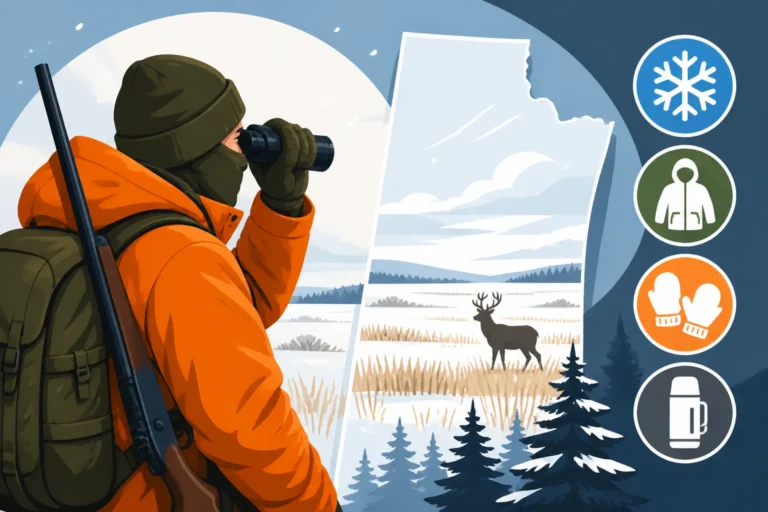
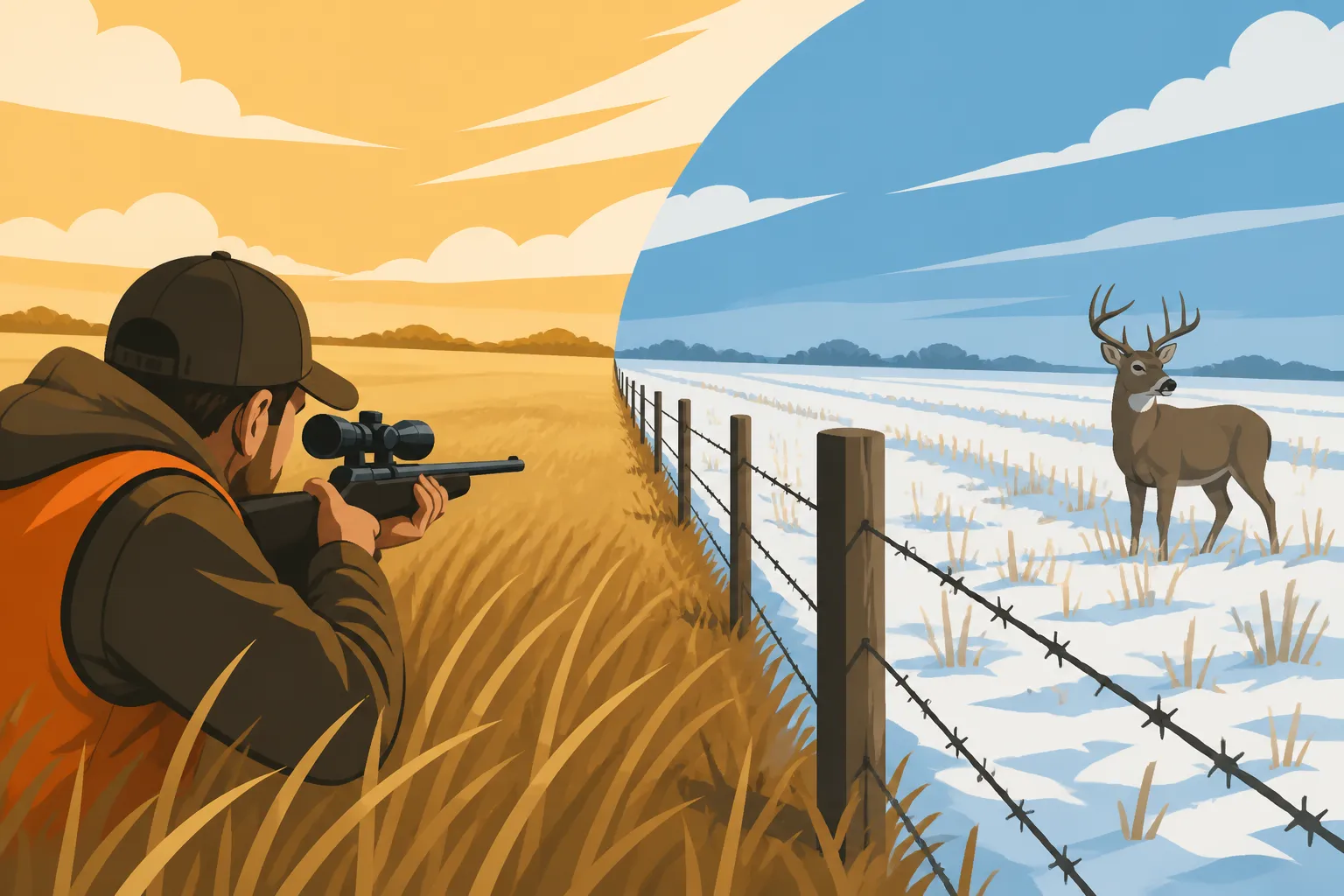
Saskatchewan weather is famously unpredictable, and its influence on animal behavior along fence lines cannot be overstated. A heavy snowfall can completely change how animals move. Deep snow might push deer into denser cover, making them rely more heavily on fence lines that offer some protection from drifts or easier travel paths. Hunting during or just after a fresh snow can be phenomenal for tracking, but also extremely cold, so be sure to dress for Hunting Saskatchewan Winter Weather Safely.
Wind is another major factor. On a calm day, deer might be more relaxed cruising a fence line. On a blustery day, they might hunker down or stick to the lee side of shelterbelts and bluffs. Rain can wash away tracks, but it can also make ground softer for quieter still-hunting. Crop cycles also play a huge role. A fence line bordering a standing cornfield will offer different opportunities than one next to a freshly harvested stubble field. As crops are harvested, bedding and feeding patterns shift, and fence lines become even more important as travel routes in the newly exposed landscape. Always observe the current conditions and adapt your strategy accordingly. The best hunters aren't just good at calling or shooting; they're masters of observation and adaptation.
Disclaimer
Please ensure you are fully aware of and comply with all current Saskatchewan hunting regulations, licensing requirements, and landowner permission laws before heading out on any hunt. Regulations can change, so always consult the latest Saskatchewan hunting guide.