Mule Deer Hunting Saskatchewan’s Prairie
Hunting mule deer on Saskatchewan's vast, open prairie can feel like searching for a needle in a haystack, especially when you're used to the dense cover of the bush. It's a landscape that demands a completely different approach, often leaving hunters frustrated by the sheer scale and the deer's uncanny ability to vanish. This comprehensive guide will walk you through everything you need to know, from understanding these prairie phantoms to mastering the techniques that lead to success in Saskatchewan's unique mule deer country.
Understanding Saskatchewan's Prairie Mule Deer
The prairie environment in Saskatchewan presents a fascinating challenge for mule deer and the hunters who pursue them. Forget your notions of dense forests and thickets; here, survival means adapting to wide-open spaces, significant temperature swings, and limited traditional cover.
The Unique Prairie Environment
Hunting in Saskatchewan's prairie is an experience unlike any other. You're met with endless horizons, rolling grasslands, and skies that stretch forever. This wide-open nature means that both you and the deer are exposed, which can be both a blessing and a curse. On one hand, you can glass for miles, potentially spotting deer from incredible distances. On the other, those same deer can spot you just as easily, and the lack of traditional cover makes it incredibly challenging to close the distance.
The wind is a constant companion on the prairie, often swirling and shifting, making scent control and predicting deer movement a continuous battle. Temperatures can swing wildly from warm, sunny mornings to biting cold afternoons, even in the early fall seasons. Mule deer in this environment thrive by using every subtle undulation, every stand of tall grass, and every sparse bush as a potential hiding spot. They are masters of concealment in plain sight, often melting into the landscape where you'd swear there was no cover at all.
This reliance on subtle terrain means that what appears to be flat, featureless ground from a distance actually holds crucial contours, low spots, and draws that mule deer use for bedding, feeding, and travel. These are the nuances you need to learn to "read" to find success.
Mule Deer Behavior and Habits on the Prairie
Prairie mule deer exhibit distinct behaviors that set them apart from their forest-dwelling cousins. Their survival hinges on their eyesight and hearing, often relying on vast fields of view to detect predators, including hunters. They tend to live in smaller, more dispersed groups outside of the rut, though you might find larger bachelor groups of bucks during early season or does with fawns.
Their daily routines are heavily influenced by the availability of food and water, and crucially, by secure bedding areas. Unlike whitetails, which might seek dense woods, prairie mule deer will often bed down on open hillsides, in the bottom of a coulee, or within tall stands of native grass, always with an escape route in mind. They’ll frequently bed on slopes that allow them to watch their back trail while also catching thermal drafts that carry scent away from them. During the heat of the day, they might move into standing crops like canola or corn, or even tall stubble, finding surprisingly good cover.
Understanding their movement patterns is key. They often travel along natural funnels created by terrain features, fence lines, or shelterbelts, moving from bedding to feeding areas primarily during dawn and dusk. However, during the rut, bucks will cruise almost constantly, checking out does and challenging rivals, sometimes even in the middle of the day. They also tend to be less tolerant of human presence than whitetails in some areas, quickly abandoning a location if they feel pressured.
Key Habitats and Features
While the prairie might seem uniform, it's actually a mosaic of microhabitats that mule deer utilize. The most prominent and critical are the coulees and river breaks. These deep, winding valleys provide invaluable thermal cover, protection from the wind, and a variety of vegetation for forage. Mule deer will often bed on the sunny slopes in colder weather or on the shaded slopes during hotter days, always with an eye on the prevailing wind. You'll find a deep dive into hunting these areas in our guide on Hunting a Prairie Coulee Bottom.
Beyond the major coulees, look for smaller draws, creek bottoms, and even dugouts with surrounding tall grass or willow rings. These seemingly minor features can hold significant numbers of deer, especially if they offer water and some visual obstruction. Regenerative farming practices have also led to more cover in the form of cover crops and perennial grasses, which mule deer readily exploit.
Another critical habitat type are the patches of CRP (Conservation Reserve Program) land or other native grassland initiatives. These areas provide excellent bedding and fawning cover, often going undisturbed for extended periods. Even shelterbelts – the rows of trees planted to protect farmsteads and fields – can act as crucial travel corridors and bedding cover, especially in flat, open areas. Don't overlook the edges of large agricultural fields, particularly those with standing crops like corn or tall stubble after harvest. These can be prime feeding and bedding zones.
Essential Scouting Strategies for Prairie Mule Deer
Effective scouting is the bedrock of a successful prairie mule deer hunt. Given the vastness of the landscape, you can't just stumble upon deer; you need to understand where they live and how they use the terrain before you even step foot in the field.
Pre-Season Digital Scouting
Before you burn a single drop of fuel, your best friend will be digital scouting. Tools like Google Earth or specialized hunting apps are invaluable for breaking down vast landscapes into manageable chunks. You can spend hours poring over satellite imagery from the comfort of your home, identifying potential hotspots before you ever drive a mile.
Start by looking for the obvious: coulees, river breaks, patches of native grassland, and shelterbelts. But then go deeper. Zoom in to identify subtle changes in elevation, pinch points where deer might funnel, potential water sources like dugouts or sloughs, and areas of dense vegetation within larger fields. Look for areas where different habitat types converge, such as a coulee meeting a stubble field, or a block of CRP grass bordering a treeline. Pay attention to fence lines, access roads, and existing trails, as these often dictate how deer move through the landscape.
One brand that's become incredibly useful for this kind of planning is GoHunt. Their mapping platform, often with higher-resolution imagery and specific hunting layers, allows you to mark waypoints, measure distances, and even check land ownership, which is crucial for gaining access. You can identify potential glassing points, plan your approach routes, and even estimate shot distances before you ever leave your couch. This digital groundwork saves countless hours of aimless wandering and helps focus your efforts on the most promising areas.
On-the-Ground Reconnaissance
Once you've narrowed down potential areas digitally, it's time for boots on the ground. This phase is about confirming your digital hunches and finding fresh sign. This needs to be done well before the season, or at least in a way that minimizes disturbance to the deer. Walk slowly, deliberately, and with your eyes peeled.
Look for fresh tracks, especially along creek beds, dusty trails, and around water sources. Pay attention to the size and depth of the tracks – larger, deeper tracks indicate a mature animal. Droppings can tell you about recent activity and diet. While rubs and scrapes aren't as prevalent with mule deer as with whitetails, you might find some on the occasional bush or small tree, especially as the rut approaches. Look for distinct bedding areas – flattened grass in the lee of a hill, within a thicket, or even in the middle of a tall stubble field.
When scouting on foot, also identify good vantage points for glassing during the season. These could be high points along a coulee rim, a slight rise in a field, or even the top of a large hay bale. Consider the wind and sun direction from these points for effective hunting. This ground-level intel is indispensable for understanding the current deer patterns and making real-time adjustments.
Adapting to Changing Conditions
Mule deer, particularly those on the prairie, are highly responsive to environmental changes. What was a prime bedding area in August might be completely empty by October due to harvest or a shift in weather. Being able to adapt to these fluid conditions is paramount.
Drought conditions, for instance, can significantly alter deer movement. Water sources become critical, concentrating deer around the remaining dugouts, creeks, or even leaky taps on farmsteads. A dry fall might also mean less lush forage, pushing deer towards irrigated fields or areas with more resilient vegetation. Conversely, an early snowfall can radically change their patterns, pushing them towards more sheltered areas with food sources that remain accessible. Our article on Hunting Mule Deer After a Snowfall delves into how these beautiful, but challenging, conditions impact hunting strategies.
The progress of the harvest is another huge factor. Standing crops like corn, canola, or peas offer excellent cover and food. As these fields are cut, deer are displaced and forced to find new bedding and feeding areas. This can either concentrate them in remaining standing crops or push them into coulees, shelterbelts, or native grass patches. Keeping an eye on local harvest reports or driving around to see which fields are being cut can give you a significant advantage. Crop rotation also plays a role; a field that was peas last year might be wheat this year, offering different types of cover and forage. Staying current with these changes will keep you on the deer's trail.
The Art of Glassing and Spot-and-Stalk Hunting
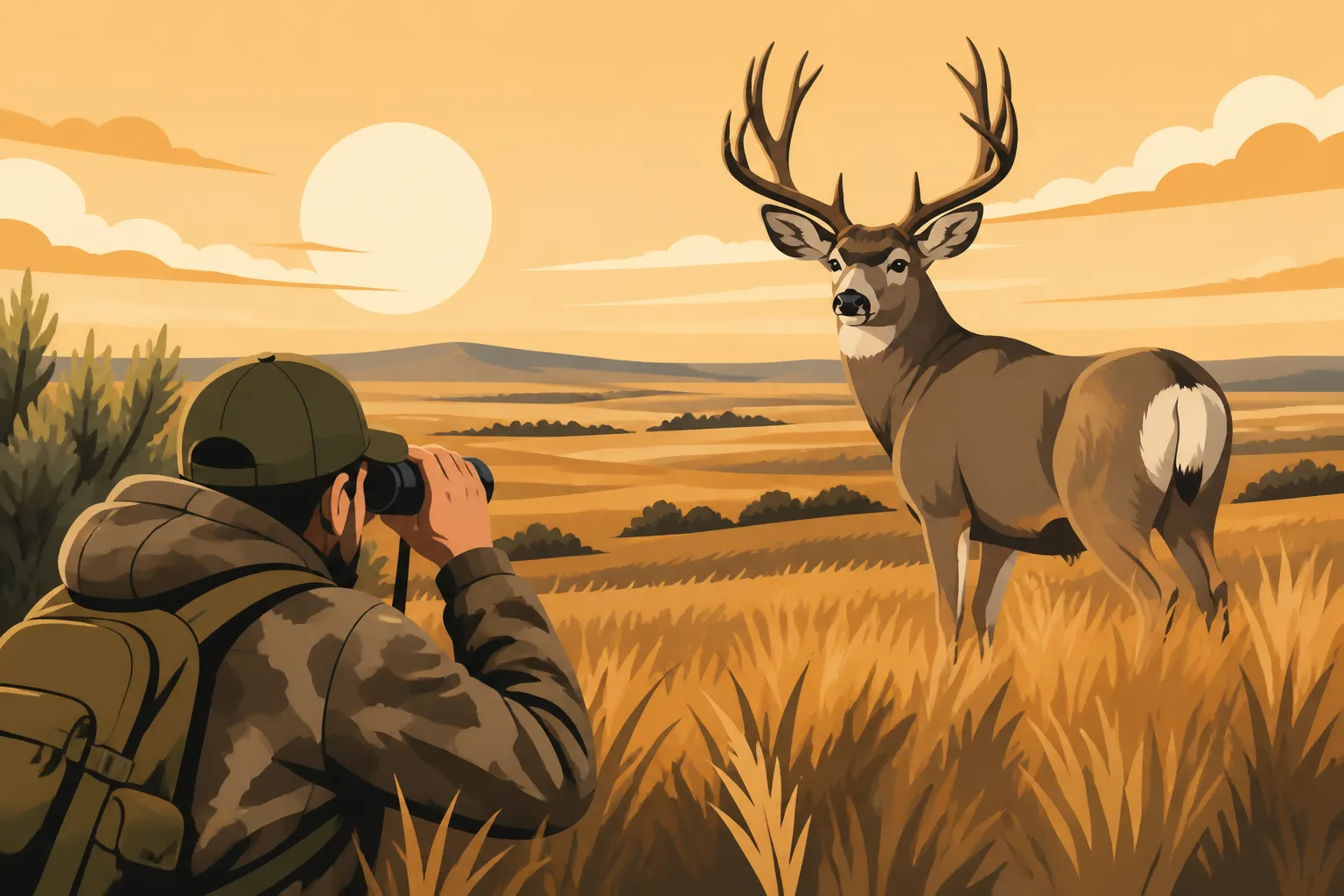
On the vast Saskatchewan prairie, your eyes and your ability to use optics are your most powerful hunting tools. Spot-and-stalk is often the most effective method, demanding patience, precision, and a deep understanding of the terrain.
Choosing the Right Optics
Effective glassing starts with quality optics. You'll need a good pair of binoculars, ideally 10×42 or 12×50, for covering large areas with minimal arm fatigue. Don't skimp here; clear, bright glass makes all the difference when you're straining to pick out a deer's ear at a mile. Image-stabilized binoculars are a luxury but can be a game-changer for prolonged scanning.
Equally important, especially for longer distances, is a high-quality spotting scope, typically 20-60x magnification with an 80mm objective lens. This allows you to scrutinize distant animals, judge their size, and determine if they're worth a stalk, all without disturbing them. A sturdy tripod is absolutely non-negotiable for both your binoculars (with an adapter) and your spotting scope. Trying to handhold a scope at 60x is futile; you'll see nothing but shake.
Finally, a reliable rangefinder is essential. Knowing the exact distance to your target is critical for making accurate shots on the prairie, where distances can be deceiving. Get one with angle compensation if you plan to shoot across coulees or up and down hillsides. Practice with all your optics before the season, getting comfortable with adjustments and field of view.
Strategic Glassing Techniques
Glassing isn't just randomly looking through your binoculars; it's a systematic process. Find a high vantage point that offers a panoramic view of the area you want to hunt. Set up your spotting scope and binoculars on your tripod. Start by slowly scanning the nearest areas, then move outward in a grid pattern. Divide the landscape into smaller sections and thoroughly examine each one.
Pay particular attention to areas of varying texture or color: the edges of fields, the tops and bottoms of coulees, any patches of brush, and shadowed areas. Deer often appear as a slight color anomaly or a horizontal line in an otherwise vertical landscape. Look for parts of a deer – an ear, an antler tip, a patch of hide – rather than expecting to see a whole animal standing out. Use the thermals to your advantage; as the sun warms the air, mirage can make distant objects shimmer, but early mornings and late evenings often provide clearer viewing. For more detailed advice, check out our piece on Glassing a Saskatchewan Coulee for Mule Deer.
Patience is key. You might spend hours glassing an area that appears empty, only for a deer to materialize out of nowhere. Many hunters make the mistake of scanning too quickly. Slow down, be methodical, and let your eyes adjust. Often, if you think you see something, keep your optics on that spot for several minutes. What you initially thought was a rock might just twitch an ear.
Mastering the Spot-and-Stalk
Once you've spotted a buck worth pursuing, the real challenge begins: the spot-and-stalk. This is where the prairie truly tests your hunting skills. Your primary adversaries are the open terrain, the ever-present wind, and the mule deer's incredible eyesight and hearing.
The first step is to analyze your approach. Use mapping tools like GoHunt to identify terrain features that can provide cover: folds in the land, drainage ditches, tall grass, or even the backside of a small rise. Plan a route that keeps you out of sight and, crucially, keeps the wind in your favor. Mule deer have an excellent sense of smell, and a shifting wind can instantly bust your stalk.
Move slowly and deliberately. Every step should be calculated. Avoid skylining yourself on ridges. If you need to cross an open area, crawl or belly-crawl, using the lowest available cover. When you reach a point where you can no longer advance unseen, use your rangefinder to determine the distance to the deer and prepare for your shot. Remember, on the prairie, shots can be long, so practice shooting from various field positions at extended ranges. Our article on Stalking Mule Deer Across Open Ground provides even more specialized advice for these tricky situations. The ability to move quietly and blend into your surroundings is paramount. A successful stalk feels like a slow, deliberate chess match against a highly perceptive opponent.
Decoy and Calling Tactics for Prairie Mule Deer
While spot-and-stalk is dominant, don't underestimate the power of decoys and calls for prairie mule deer, especially during the rut. These tactics can turn a difficult situation into a close-range opportunity.
When and How to Use Decoys
Decoys can be incredibly effective for enticing wary prairie bucks into range, particularly when they're preoccupied with finding does during the pre-rut and rut phases. The key is knowing when and how to deploy them. A life-sized mule deer decoy can be bulky, but the payoff can be huge.
Typically, you'll want to use a buck decoy to challenge a dominant buck or a doe decoy to lure in a rut-crazed male. Always set up your decoy to appear as natural as possible, facing it either slightly quartering away from your position (to present a broadside shot to the approaching buck) or facing the approaching buck (to simulate a challenge). Positioning is critical. You want the decoy to be the focal point, drawing the buck's attention away from your hiding spot.
Scent control is paramount when using decoys. Ensure your decoy is scent-free, and consider adding some doe or buck estrus scent to enhance realism, though be careful not to overdo it. Always consider the wind direction when placing your decoy and choosing your stand location. You want the approaching buck to come in downwind of the decoy, but crosswind to your position, allowing you to get a shot before it winds you. Decoys work best in open terrain where they can be seen from a distance, but not so open that a buck can circle too widely to get downwind of you.
Effective Calling Techniques
Mule deer calling differs somewhat from whitetail calling, but it can be highly effective. Grunt tubes and rattling antlers are your primary tools. During the pre-rut, soft buck grunts can pique a buck's curiosity, making him think another buck is tending a hot doe. As the rut intensifies, more aggressive grunts and snorts can challenge a buck, drawing him in for a closer look.
Rattling is another potent tactic. While it's often associated with whitetails, mule deer bucks will certainly respond to the sound of two bucks fighting, especially during the peak rut. Mimic a realistic fight sequence: light sparring, building to intense clashing, then a period of silence, followed by more light sparring. Again, always be mindful of the wind and set yourself up for a shot before the buck arrives.
Doe bleats, especially estrus bleats, can also be used to attract bucks looking for a receptive female. These are generally softer and used more subtly. The most crucial aspect of calling mule deer is listening and observing their response. If a buck starts coming, don't overcall. If he hangs up, try a softer, more inquisitive call. Unlike whitetails, which might come charging in, mule deer often approach cautiously, using their superior eyesight to scan the area before committing.
Combining Decoys and Calls
The real magic often happens when you combine decoys with calling. This synergy creates a more convincing scenario for an approaching buck. Imagine: a buck sees a rival buck (your decoy) in his territory, and then hears the sounds of grunting and sparring. This visual and auditory stimulus can be incredibly powerful.
When combining these tactics, position your decoy first. Then, set up your blind or hide a short distance away, downwind or crosswind, from where you expect the buck to approach. Begin your calling sequence, using grunts or rattling to draw attention to the decoy. As the buck approaches, be ready. He'll likely focus on the decoy, giving you precious moments to raise your weapon and take a shot.
This strategy often requires a hunting partner. One hunter can be the caller, positioned slightly away from the decoy and the shooter, directing the buck's attention. The shooter remains silent and focused on the shot opportunity. Practice your communication beforehand so you can work seamlessly as a team. This combination setup works especially well in areas with limited natural cover, as the decoy can create the illusion of a more secure situation, drawing the buck into an ambush zone.
Gear and Equipment Considerations
Hunting prairie mule deer demands specific gear tailored to the open environment, potentially long shots, and unpredictable weather. Being properly equipped can make the difference between a successful hunt and a frustrating experience.
Rifles and Ammunition for Long Shots
Given the expansive nature of the prairie, shots at mule deer can often be at extended ranges. Therefore, a flat-shooting, accurate rifle is paramount. Popular calibers like .270 Win, .30-06, .300 Win Mag, 7mm Rem Mag, 6.5 Creedmoor, or .28 Nosler are all excellent choices, known for their ballistic performance over distance.
Beyond the caliber, bullet construction is critical. Choose high-quality, boat-tail, heavy-for-caliber bullets designed for controlled expansion and energy retention at long ranges. Practice extensively at various distances, not just 100 yards. Set up targets at 200, 300, 400 yards, and even further if you anticipate such shots. Know your rifle's external ballistics, including bullet drop and wind drift, intimately. A quality scope with good light-gathering capabilities and a reliable turrets or a bullet drop compensator (BDC) reticle is also a must. Remember, ethical hunting means knowing your effective range and sticking to it, no matter the opportunity.
Clothing and Footwear for Prairie Conditions
Saskatchewan weather on the prairie can be extremely fickle. One day you might be enjoying mild, sunny conditions, and the next, a fierce cold front could roll in. Layering is your best friend. Start with a moisture-wicking base layer, add insulating mid-layers (fleece or synthetic down), and top it with a windproof and waterproof outer shell. Look for quiet fabrics that won't rustle when you move.
Good quality, comfortable footwear is also non-negotiable. You'll be doing a lot of walking, often over uneven terrain, through stubble fields, and possibly up and down coulee slopes. Choose boots that are durable, waterproof, offer good ankle support, and are broken in. Consider insulated boots for later season hunts when temperatures can plummet. Remember, cold, wet feet can quickly end a hunt. For additional tips on staying comfortable and safe in challenging conditions, our guide on Hunting Saskatchewan Winter Weather Safely provides valuable insights.
Camouflage patterns that blend into open country are generally effective. Think prairie grasses, faded stubble, or even dusty earth tones rather than deep forest patterns. The key is to break up your outline and blend into the specific environment you're hunting.
Navigation and Safety Essentials
The vastness of the prairie can be disorienting, and cell service is often unreliable or nonexistent. A reliable GPS device or a smartphone with offline mapping capabilities (like the GoHunt app) is essential for navigation. Always carry a traditional compass and a physical map as a backup. Mark your vehicle's location, important land features, and planned routes.
Beyond navigation, a basic emergency kit should always be with you. This includes a first-aid kit, fire-starting materials, a multi-tool, extra food and water, and a headlamp. A satellite communication device (like a Garmin inReach or Zoleo) is a wise investment, allowing you to send messages or SOS signals even without cell service.
Always tell someone where you're going and when you expect to return. Be aware of local wildlife, including coyotes, and potential hazards like old fences or hidden sloughs. Know your own physical limits and don't push yourself too hard, especially when hunting alone. Planning for safety means anticipating problems before they happen and being prepared to deal with them effectively.
Accessing and Respecting Private Land
The majority of prime mule deer habitat on the Saskatchewan prairie is privately owned. Gaining permission is not just a courtesy; it's a legal requirement and often the gateway to a successful hunt.
The Importance of Landowner Relations
Building positive relationships with landowners is arguably the most critical aspect of hunting private land in Saskatchewan. Never assume access. Always seek explicit permission before entering any private property. The best approach is to knock on doors well in advance of the season, ideally in person. Dress neatly, be polite, introduce yourself, and clearly state your intentions. Offer to share some of your harvest or even help with small chores around the farm. Our guide, Knocking on Doors in Saskatchewan Farm Country, offers practical advice on making these crucial first impressions.
Respect their land as if it were your own. Drive only on designated trails or field approaches, close gates, avoid driving on wet fields, and pick up any litter. Be mindful of livestock, ensuring gates are properly latched and you don't disturb cattle. Leave no trace of your presence other than tracks in the snow or dirt. A good landowner relationship isn't a one-time transaction; it's an ongoing commitment to mutual respect and understanding. Many of the best hunting spots are shared by word-of-mouth, and being a responsible hunter can open up incredible opportunities for years to come.
Understanding Posted Land and Regulations
Saskatchewan has clear laws regarding land access. Posted land, indicated by signs, means entry is prohibited unless you have explicit permission. These signs must be clearly visible and meet specific size and content requirements. However, even if land isn't posted, it is still considered private, and you are legally required to obtain permission from the landowner or occupier before hunting.
Always carry written permission if possible, or at least have a clear record of verbal permission, including the date and the landowner's name. Familiarize yourself with the boundaries of the property you have permission for. This often means cross-referencing legal land descriptions with your mapping app. It's easy to accidentally trespass, especially in featureless prairie, so take the time to know exactly where you are. Our comprehensive article on Saskatchewan Landowner Permission Law provides a detailed breakdown of your rights and responsibilities as a hunter on private land. Ignorance of the law is never an excuse, and trespassing can lead to significant fines and the loss of hunting privileges.
Hunting Crown Land Opportunities
While much of the prime prairie mule deer country is private, Saskatchewan does offer some Crown (public) land opportunities, especially in areas with more significant topographical features or within designated Wildlife Management Zones (WMZs) that have Crown land blocks. Accessing these areas often requires more research and effort but can yield great results, especially if you're looking to avoid the complexities of private land permission.
Utilize online resources provided by the Saskatchewan Ministry of Environment to locate Crown land parcels. Digital mapping tools with specific Crown land layers are incredibly helpful for identifying these blocks. Once you've found a suitable area, scout it thoroughly, as these lands can receive more hunting pressure than private land. Always be aware of any specific regulations that apply to Crown land, such as restrictions on vehicle use. Our guide to Hunting Whitetails on Saskatchewan Crown Land (and the principles apply equally to mule deer) offers a starting point for understanding how to identify and hunt these public spaces responsibly. Remember, public land means shared land, so respect other users and practice ethical hunting behaviors.
Field Care and Game Management
Successfully harvesting a mule deer on the prairie is only part of the journey. Proper field care is critical to ensuring the meat is high quality, and responsible game management practices are essential for sustaining healthy herds.
Efficient Field Dressing and Cooling
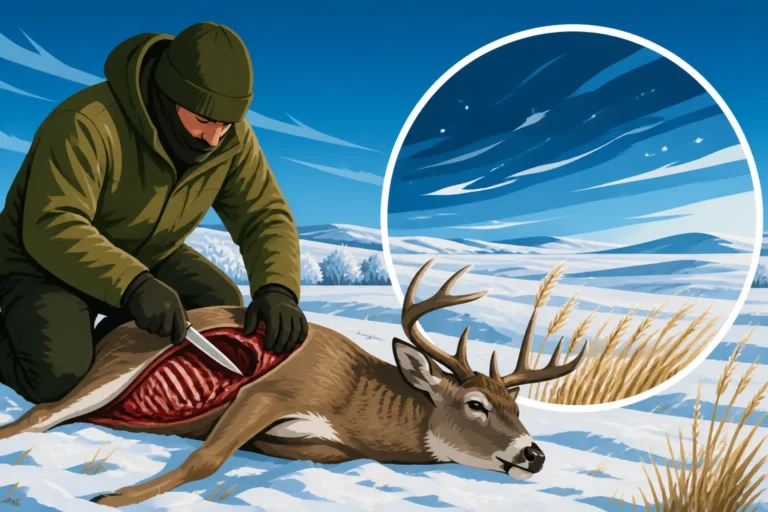
Once your mule deer is down, prompt and efficient field dressing is paramount. The prairie environment, particularly during early season hunts, can be surprisingly warm, accelerating spoilage. Get the guts out as quickly as possible to allow the carcass to begin cooling. This means removing the digestive tract, lungs, and heart to eliminate a significant source of heat and bacteria.
After dressing, if temperatures are mild, consider skinning the deer immediately to aid cooling. If you can't skin it right away, prop the cavity open with sticks to allow air circulation. In warmer conditions, you might even need to quarter the deer and get it into coolers with ice as soon as possible. Elevating the carcass off the ground helps airflow and keeps it clean. Our detailed guide on Meat Care in Saskatchewan's Cold Snaps provides excellent advice, even if you're not in the "cold snap" part of the season, the principles of cooling apply. The goal is to get the core temperature of the meat down as rapidly as possible to prevent bacterial growth.
Transporting Your Harvest
Getting a prairie mule deer out of a deep coulee or across miles of open stubble can be a strenuous task, especially if you're hunting alone. Game carts are invaluable tools for transporting a whole or half carcass across relatively flat or gently rolling terrain. Look for models with large, pneumatic tires that can handle rough ground.
For more challenging terrain, or if you're a significant distance from your vehicle, boning out the deer in the field might be the most practical option. This involves separating the meat from the bone, making it much lighter and easier to pack out in game bags. Always carry sharp knives, a bone saw, and plenty of clean game bags. If permitted, ATVs or side-by-sides can be a lifesaver for retrieving game, but always confirm the rules for their use on the land you're hunting. Our article on Getting a Deer Out on a Frozen Trail shares tips that are useful for any difficult extraction, regardless of the temperature. Protect your meat during transport from dirt, flies, and excessive heat, especially if driving long distances.
CWD Testing Requirements
Saskatchewan takes Chronic Wasting Disease (CWD) very seriously, and certain Wildlife Management Zones (WMZs) have mandatory CWD testing requirements for harvested deer, including mule deer. It's your responsibility as a hunter to know if the zone you hunted in requires testing and to comply with the regulations.
The process typically involves submitting the deer's head (with about 4 inches of neck attached) to a designated CWD drop-off location within a specified timeframe. These locations often include provincial park offices, Ministry of Environment field offices, or specific co-op stores. You'll need to fill out a submission form with your hunting license details and the location of the harvest. The Ministry of Environment will then test the sample and notify you of the results. Participating in CWD testing is crucial for monitoring the disease's spread and for the overall health of Saskatchewan's deer populations. Our comprehensive resource on Saskatchewan's CWD Testing Rules provides all the necessary details and locations for submission. Understanding and adhering to these rules helps ensure a sustainable future for hunting in the province.
| Aspect | Spot-and-Stalk Hunting | Ambush Hunting (e.g., Decoys, Calls) |
|---|---|---|
| Primary Advantage | Highly active, covers vast ground, thrilling | Can bring deer into close range, less physical exertion |
| Key Challenge | Remaining undetected, wind changes, physical demands | Requires perfect setup, patience, deer can hang up or circle downwind |
| Terrain Suitability | Rolling hills, coulees, varied cover | More open areas where decoys can be seen, or pinch points for calls |
| Required Skills | Glassing, navigation, stealth, judging distance | Scouting for approach routes, decoy placement, calling realism, patience |
| Best Conditions | Overcast, moderate wind, good visibility | Pre-rut to peak rut, good visibility for decoy, stable wind for setup |
| Essential Gear | High-quality optics, rangefinder, comfortable boots | Decoys, calls, scent control, comfortable blind/seat |
| Mental Mindset | Persistent, adaptable, problem-solver | Patient, strategic, observant of deer reactions |
Disclaimer
Please note that hunting regulations, season dates, and access rules in Saskatchewan are subject to change. It is the responsibility of every hunter to consult the most current Saskatchewan Hunters' and Trappers' Guide and provincial regulations before engaging in any hunting activities. Always prioritize safety, ethical hunting practices, and respect for wildlife and landowners.